
C4 January 2010 Q2
2.
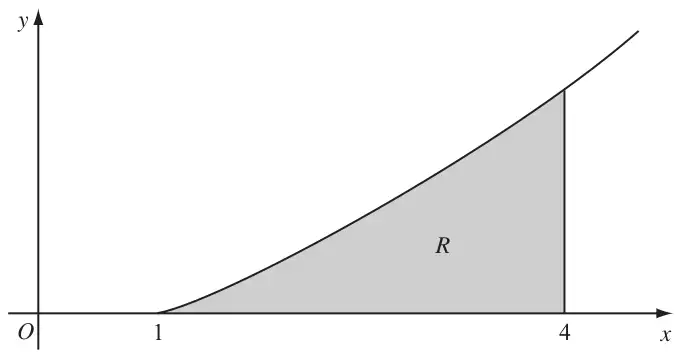
Figure 1 shows a sketch of the curve with equation \(y = x\ln x,\ x \geqslant 1\). The finite region \(R\), shown shaded in Figure 1, is bounded by the curve, the \(x\)-axis and the line \(x = 4\).
The table shows corresponding values of \(x\) and \(y\) for \(y = x\ln x\).
| \(x\) | 1 | 1.5 | 2 | 2.5 | 3 | 3.5 | 4 |
|---|---|---|---|---|---|---|---|
| \(y\) | 0 | 0.608 | 3.296 | 4.385 | 5.545 |
(a) Complete the table with the values of \(y\) corresponding to \(x = 2\) and \(x = 2.5\), giving your answers to 3 decimal places. (2)
(b) Use the trapezium rule, with all the values of \(y\) in the completed table, to obtain an estimate for the area of \(R\), giving your answer to 2 decimal places. (4)
(c)
(i) Use integration by parts to find \(\displaystyle\int x\ln x\,\mathrm{d}x\).
(ii) Hence find the exact area of \(R\), giving your answer in the form \(\dfrac{1}{4}(a\ln 2 + b)\), where \(a\) and \(b\) are integers. (7)
| Scheme | Marks |
|---|---|
| 1.386, 2.291 awrt 1.386, 2.291 | B1 B1 |
| (2) |
| Scheme | Marks |
|---|---|
| \(A \approx \dfrac{1}{2} \times 0.5(\ \ldots\ )\) | B1 |
| \(= \ldots\ \big(0 + 2(0.608 + 1.386 + 2.291 + 3.296 + 4.385) + 5.545\big)\) | M1 |
| \(= 0.25\big(0 + 2(0.608 + 1.386 + 2.291 + 3.296 + 4.385) + 5.545\big)\) ft their (a) | A1ft |
| \(= 0.25 \times 29.477\ldots \approx 7.37\) cao | A1 |
| (4) |
| Scheme | Marks |
|---|---|
| (i) \(\displaystyle\int x\ln x\,\mathrm{d}x = \frac{x^2}{2}\ln x - \int \frac{x^2}{2} \times \frac{1}{x}\,\mathrm{d}x\) | M1 A1 |
| \(\displaystyle = \frac{x^2}{2}\ln x - \int \frac{x}{2}\,\mathrm{d}x\) | |
| \(= \dfrac{x^2}{2}\ln x - \dfrac{x^2}{4}\quad (+C)\) | M1 A1 |
| (ii) \(\left[\dfrac{x^2}{2}\ln x - \dfrac{x^2}{4}\right]_1^4 = (8\ln 4 - 4) - \left(-\dfrac{1}{4}\right)\) | M1 |
| \(= 8\ln 4 - \dfrac{15}{4}\) | |
| \(= 8(2\ln 2) - \dfrac{15}{4}\) \(\ln 4 = 2\ln 2\) seen or implied | M1 |
| \(= \dfrac{1}{4}(64\ln 2 - 15)\) \(a = 64,\ b = -15\) | A1 |
| (7) | |
| (13 marks) |