
C4 January 2008 Q3
3.
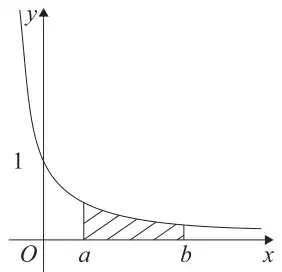
The curve shown in Figure 2 has equation \(y = \dfrac{1}{(2x+1)}\). The finite region bounded by the curve, the \(x\)-axis and the lines \(x = a\) and \(x = b\) is shown shaded in Figure 2. This region is rotated through \(360^\circ\) about the \(x\)-axis to generate a solid of revolution.
Find the volume of the solid generated. Express your answer as a single simplified fraction, in terms of \(a\) and \(b\). (5)
| Scheme | Marks |
|---|---|
| Volume \(= \underline{\pi\displaystyle\int_a^b\left(\frac{1}{2x+1}\right)^2\mathrm{d}x} = \pi\int_a^b\frac{1}{(2x+1)^2}\,\mathrm{d}x\) | B1 |
| \(= \pi\displaystyle\int_a^b(2x+1)^{-2}\,\mathrm{d}x\) | |
| \(= (\pi)\left[\dfrac{(2x+1)^{-1}}{(-1)(2)}\right]_a^b\) | |
| \(= (\pi)\Big[\underline{-\tfrac{1}{2}(2x+1)^{-1}}\Big]_a^b\) | M1 A1 |
| \(= (\pi)\left[\left(\dfrac{-1}{2(2b+1)}\right) - \left(\dfrac{-1}{2(2a+1)}\right)\right]\) | dM1 |
| \(= \dfrac{\pi}{2}\left[\dfrac{-2a - 1 + 2b + 1}{(2a+1)(2b+1)}\right]\) | |
| \(= \dfrac{\pi}{2}\left[\dfrac{2(b-a)}{(2a+1)(2b+1)}\right]\) | |
| \(= \dfrac{\pi(b-a)}{(2a+1)(2b+1)}\) | A1 aef |
| (5) | |
| (5 marks) |
Notes
B1: Use of \(V = \pi\displaystyle\int\underline{y^2}\,\mathrm{d}x\). Can be implied. Ignore limits.
M1: Integrating to give \(\underline{\pm p(2x+1)^{-1}}\) A1: \(\underline{-\tfrac{1}{2}(2x+1)^{-1}}\)
dM1: Substitutes limits of \(b\) and \(a\) and subtracts the correct way round.
A1 aef: \(\underline{\dfrac{\pi(b-a)}{(2a+1)(2b+1)}}\)
Allow other equivalent forms such as \[\frac{\pi b - \pi a}{(2a+1)(2b+1)} \text{ or } \frac{-\pi(a-b)}{(2a+1)(2b+1)} \text{ or } \frac{\pi(b-a)}{4ab+2a+2b+1} \text{ or } \frac{\pi b - \pi a}{4ab+2a+2b+1}.\]
Note that \(\pi\) is not required for the middle three marks of this question.
Aliter 3. Way 2
| Scheme | Marks |
|---|---|
| Volume \(= \underline{\pi\displaystyle\int_a^b\left(\frac{1}{2x+1}\right)^2\mathrm{d}x} = \pi\int_a^b\frac{1}{(2x+1)^2}\,\mathrm{d}x\) | B1 |
| \(= \pi\displaystyle\int_a^b(2x+1)^{-2}\,\mathrm{d}x\) | |
| Applying substitution \(u = 2x + 1 \Rightarrow \tfrac{\mathrm{d}u}{\mathrm{d}x} = 2\) and changing limits \(x \to u\) so that \(a \to 2a+1\) and \(b \to 2b+1\), gives | |
| \(= (\pi)\displaystyle\int_{2a+1}^{2b+1}\frac{u^{-2}}{2}\,\mathrm{d}u\) | |
| \(= (\pi)\left[\dfrac{u^{-1}}{(-1)(2)}\right]_{2a+1}^{2b+1}\) | |
| \(= (\pi)\Big[\underline{-\tfrac{1}{2}u^{-1}}\Big]_{2a+1}^{2b+1}\) | M1 A1 |
| \(= (\pi)\left[\left(\dfrac{-1}{2(2b+1)}\right) - \left(\dfrac{-1}{2(2a+1)}\right)\right]\) | dM1 |
| \(= \dfrac{\pi}{2}\left[\dfrac{-2a - 1 + 2b + 1}{(2a+1)(2b+1)}\right]\) | |
| \(= \dfrac{\pi}{2}\left[\dfrac{2(b-a)}{(2a+1)(2b+1)}\right]\) | |
| \(= \dfrac{\pi(b-a)}{(2a+1)(2b+1)}\) | A1 aef |
| (5) |
B1: Use of \(V = \pi\displaystyle\int\underline{y^2}\,\mathrm{d}x\). Can be implied. Ignore limits. M1: Integrating to give \(\underline{\pm pu^{-1}}\). A1: \(\underline{-\tfrac{1}{2}u^{-1}}\). dM1: Substitutes limits of \(2b+1\) and \(2a+1\) and subtracts the correct way round. A1 aef: \(\underline{\dfrac{\pi(b-a)}{(2a+1)(2b+1)}}\)
Note that \(\pi\) is not required for the middle three marks of this question.
Allow other equivalent forms such as \[\frac{\pi b - \pi a}{(2a+1)(2b+1)} \text{ or } \frac{-\pi(a-b)}{(2a+1)(2b+1)} \text{ or } \frac{\pi(b-a)}{4ab+2a+2b+1} \text{ or } \frac{\pi b - \pi a}{4ab+2a+2b+1}.\]