
C4 January 2007 Q2
2.
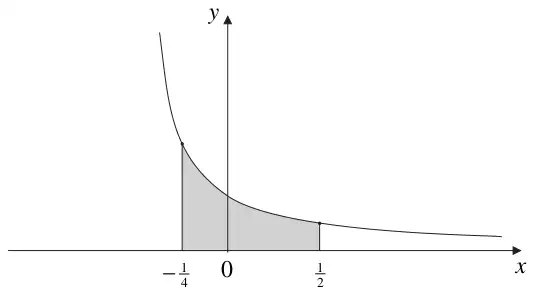
The curve with equation \(y = \dfrac{1}{3(1 + 2x)}\), \(x \gt -\frac{1}{2}\), is shown in Figure 1.
The region bounded by the lines \(x = -\frac{1}{4}\), \(x = \frac{1}{2}\), the \(x\)-axis and the curve is shown shaded in Figure 1.
This region is rotated through 360 degrees about the \(x\)-axis.
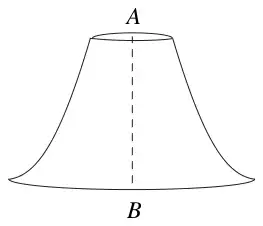
Figure 2 shows a paperweight with axis of symmetry \(AB\) where \(AB = 3\) cm. \(A\) is a point on the top surface of the paperweight, and \(B\) is a point on the base of the paperweight. The paperweight is geometrically similar to the solid in part (a).
| Scheme | Marks |
|---|---|
| Volume \(= \underline{\pi\displaystyle\int_{-\frac{1}{4}}^{\frac{1}{2}} \left(\frac{1}{3(1 + 2x)}\right)^2\mathrm{d}x} = \frac{\pi}{9}\int_{-\frac{1}{4}}^{\frac{1}{2}} \frac{1}{(1 + 2x)^2}\,\mathrm{d}x\) | B1 |
| \(= \left(\dfrac{\pi}{9}\right)\displaystyle\int_{-\frac{1}{4}}^{\frac{1}{2}} (1 + 2x)^{-2}\,\mathrm{d}x\) | M1 |
| \(= \left(\dfrac{\pi}{9}\right)\left[\dfrac{(1 + 2x)^{-1}}{(-1)(2)}\right]_{-\frac{1}{4}}^{\frac{1}{2}}\) | M1 A1 |
| \(= \left(\dfrac{\pi}{9}\right)\left[-\tfrac{1}{2}(1 + 2x)^{-1}\right]_{-\frac{1}{4}}^{\frac{1}{2}}\) | |
| \(= \left(\dfrac{\pi}{9}\right)\left[\left(\dfrac{-1}{2(2)}\right) - \left(\dfrac{-1}{2\left(\frac{1}{2}\right)}\right)\right]\) | |
| \(= \left(\dfrac{\pi}{9}\right)\left[-\tfrac{1}{4} - (-1)\right]\) | |
| \(= \dfrac{\pi}{12}\) | A1 aef |
| (5) |
Notes
B1 Use of \(\underline{V = \pi\int y^2\,\mathrm{d}x}\). Can be implied. Ignore limits.
M1 Moving their power to the top. (Do not allow power of -1.) Can be implied. Ignore limits and \(\frac{\pi}{9}\)
M1 Integrating to give \(\underline{\pm p(1 + 2x)^{-1}}\)
A1 \(\underline{-\frac{1}{2}(1 + 2x)^{-1}}\)
A1 aef Use of limits to give exact values of \(\frac{\pi}{12}\) or \(\frac{3\pi}{36}\) or \(\frac{2\pi}{24}\) or aef
Note: \(\frac{\pi}{9}\) (or implied) is not needed for the middle three marks of question 2(a).
Aliter (a) Way 2
| Volume \(= \underline{\pi\displaystyle\int_{-\frac{1}{4}}^{\frac{1}{2}} \left(\frac{1}{3(1 + 2x)}\right)^2\mathrm{d}x} = \pi\int_{-\frac{1}{4}}^{\frac{1}{2}} \frac{1}{(3 + 6x)^2}\,\mathrm{d}x\) | B1 |
| \(= (\pi)\displaystyle\int_{-\frac{1}{4}}^{\frac{1}{2}} (3 + 6x)^{-2}\,\mathrm{d}x\) | M1 |
| \(= (\pi)\left[\dfrac{(3 + 6x)^{-1}}{(-1)(6)}\right]_{-\frac{1}{4}}^{\frac{1}{2}}\) | M1 A1 |
| \(= (\pi)\left[-\tfrac{1}{6}(3 + 6x)^{-1}\right]_{-\frac{1}{4}}^{\frac{1}{2}}\) | |
| \(= (\pi)\left[\left(\dfrac{-1}{6(6)}\right) - \left(\dfrac{-1}{6\left(\frac{3}{2}\right)}\right)\right]\) | |
| \(= (\pi)\left[-\tfrac{1}{36} - \left(-\tfrac{1}{9}\right)\right]\) | |
| \(= \dfrac{\pi}{12}\) | A1 aef |
| [5] |
B1 Use of \(\underline{V = \pi\int y^2\,\mathrm{d}x}\). Can be implied. Ignore limits.
M1 Moving their power to the top. (Do not allow power of -1.) Can be implied. Ignore limits and \(\pi\)
M1 Integrating to give \(\underline{\pm p(3 + 6x)^{-1}}\)
A1 \(\underline{-\frac{1}{6}(3 + 6x)^{-1}}\)
A1 aef Use of limits to give exact values of \(\frac{\pi}{12}\) or \(\frac{3\pi}{36}\) or \(\frac{2\pi}{24}\) or aef
Note: \(\pi\) is not needed for the middle three marks of question 2(a).
| Scheme | Marks |
|---|---|
| From Fig.1, \(AB = \frac{1}{2} - \left(-\frac{1}{4}\right) = \frac{3}{4}\) units As \(\frac{3}{4}\) units \(\equiv\) 3cm then scale factor \(k = \dfrac{3}{\left(\frac{3}{4}\right)} = 4\). | |
| Hence Volume of paperweight \(= (4)^3\left(\dfrac{\pi}{12}\right)\) | M1 |
| \(V = \underline{\dfrac{16\pi}{3}}\ \text{cm}^3 = 16.75516\ldots\ \text{cm}^3\) | A1 |
| (2) | |
| (7 marks) |
Notes
M1 \((4)^3 \times\) (their answer to part (a))
A1 \(\frac{16\pi}{3}\) or awrt 16.8 or \(\frac{64\pi}{12}\) or aef