C3 June 2013 Q2
2. Given that\[\mathrm{f}(x)=\ln x,\qquad x>0\]sketch on separate axes the graphs of
Show, on each diagram, the point where the graph meets or crosses the \(x\)-axis.
In each case, state the equation of the asymptote. (7)
| Scheme | Marks |
|---|---|
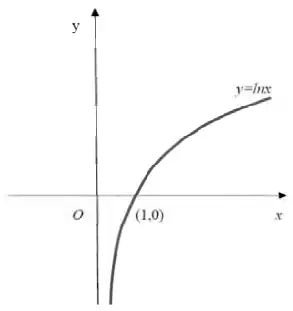
| \(\ln\) graph crossing \(x\) axis at \((1,0)\) and asymptote at \(x=0\) | B1 |
Notes
(i) B1 Correct shape, correct position and passing through \((1,0)\).
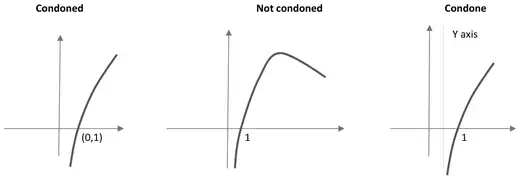
Graph must ‘start’ to the rhs of the \(y\)-axis in quadrant 4 with a gradient that is large. The gradient then decreases as it moves through \((1,0)\) into quadrant 1. There must not be an obvious maximum point but condone ‘slips’. Condone the point marked \((0,1)\) on the correct axis. See practice and qualification for clarification. Do not with hold this mark if (\(x=0\)) the asymptote is incorrect or not given.
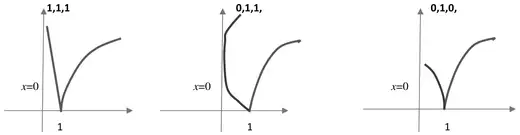
Examples of graphs in number 2: Part (i)
| Scheme | Marks |
|---|---|
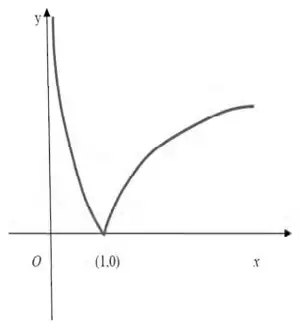
| Shape including cusp | B1ft |
| Touches or crosses the \(x\) axis at \((1,0)\) | B1ft |
| Asymptote given as \(x=0\) | B1 |
Notes
(ii) B1ft Correct shape including the cusp wholly contained in quadrant 1.
The shape to the rhs of the cusp should have a decreasing gradient and must not have an obvious maximum.. The shape to the lhs of the cusp should not bend backwards past \((1,0)\)
Tolerate a ‘linear’ looking section here but not one with incorrect curvature (See examples sheet (ii) number 3. For further clarification see practice and qualification items.
Follow through on an incorrect sketch in part (i) as long as it was above and below the \(x\) axis.
B1ft The curve touches or crosses the \(x\) axis at \((1,0)\). Allow for the curve passing through a point marked ‘1’ on the \(x\) axis. Condone the point marked on the correct axis as \((0,1)\)
Follow through on an incorrect intersection in part (i).
B1 Award for the asymptote to the curve given/ marked as \(x=0\). Do not allow for it given/ marked as ‘the \(y\) axis’. There must be a graph for this mark to be awarded, and there must be an asymptote on the graph at \(x=0\). Accept if \(x=0\) is drawn separately to the y axis.
Examples of graphs in number 2: Part (ii)
| Scheme | Marks |
|---|---|
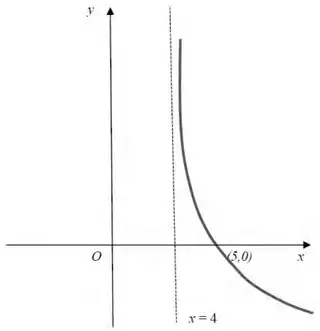
| Shape | B1 |
| Crosses at \((5,0)\) | B1ft |
| Asymptote given as \(x=4\) | B1 |
| (7 marks) |
Notes
B1 Correct shape.
The gradient should always be negative and becoming less steep. It must be approximately infinite at the lh end and not have an obvious minimum. The lh end must not bend ‘forwards’ to make a C shape. The position is not important for this mark. See practice and qualification for clarification.
B1ft The graph crosses (or touches) the \(x\) axis at \((5,0)\). Allow for the curve passing through a point marked ‘5’ on the \(x\) axis. Condone the point marked on the correct axis as \((0,5)\)
Follow through on an incorrect intersection in part (i). Allow for \(\left((i)+4,0\right)\)
B1 The asymptote is given/ marked as \(x=4\). There must be a graph for this to be awarded and there must be an asymptote on the graph (in the correct place to the rhs of the \(y\) axis).
If the graphs are not labelled as (i), (ii) and (iii) mark them in the order that they are given.
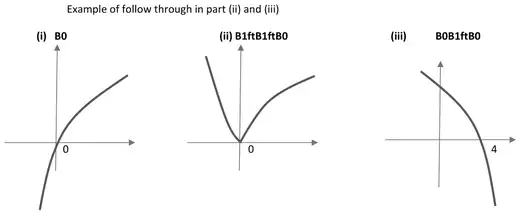
Example of follow through in part (ii) and (iii)