C3 January 2013 Q5
5.
Given that \(x = \cot y\),
| Scheme | Marks |
|---|---|
| (a) \(\dfrac{\mathrm{d}y}{\mathrm{d}x} = 3x^2 \times \ln 2x + x^3 \times \dfrac{1}{2x} \times 2\) \(= 3x^2\ln 2x + x^2\) | M1A1A1 |
| (3) | |
| (b) \(\dfrac{\mathrm{d}y}{\mathrm{d}x} = 3(\boldsymbol{x + \sin 2x})^2 \times (1 + 2\cos 2x)\) | B1M1A1 |
| (3) |
Notes
(i)(a) M1 Applies the product rule vu’+uv’ to \(x^3\ln 2x\).
If the rule is quoted it must be correct. There must have been some attempt to differentiate both terms. If the rule is not quoted (nor implied by their working, with terms written out u=…,u’=….,v=….,v’=….followed by their vu’+uv’) then only accept answers of the form
\(Ax^2 \times \ln 2x + x^3 \times \dfrac{B}{x}\) where A, B are constants\(\neq\)0
A1 One term correct, either \(3x^2 \times \ln 2x\) or \(x^3 \times \dfrac{1}{2x} \times 2\)
A1 Cao. \(\dfrac{\mathrm{d}y}{\mathrm{d}x} = 3x^2 \times \ln 2x + x^3 \times \dfrac{1}{2x} \times 2\). The answer does not need to be simplified.
For reference the simplified answer is \(\dfrac{\mathrm{d}y}{\mathrm{d}x} = 3x^2\ln 2x + x^2 = x^2(3\ln 2x + 1)\)
(i)(b) B1 Sight of \((x + \sin 2x)^2\)
M1 For applying the chain rule to \((x + \sin 2x)^3\). If the rule is quoted it must be correct. If it is not quoted possible forms of evidence could be sight of \(C(x + \sin 2x)^2 \times (1 \pm D\cos 2x)\) where \(C\) and \(D\) are non- zero constants.
Alternatively accept \(u = x + \sin 2x\), u’= followed by \(Cu^2 \times \text{their } u'\)
Do not accept \(C(x + \sin 2x)^2 \times 2\cos 2x\) unless you have evidence that this is their u’
Allow ‘invisible’ brackets for this mark, ie. \(C(x + \sin 2x)^2 \times 1 \pm D\cos 2x\)
A1 Cao \(\dfrac{dy}{dx} = 3(x + \sin 2x)^2 \times (1 + 2\cos 2x)\). There is no requirement to simplify this.
You may ignore subsequent working (isw) after a correct answer in part (i)(a) and (b)
Alternative to (a)(i) when ln(2x) is written lnx+ln2
M1 Writes \(x^3\ln 2x\) as \(x^3\ln 2 + x^3\ln x\).
Achieves \(Ax^2\) for differential of \(x^3\ln 2\) and applies the product rule vu’+uv’ to \(x^3\ln x\).
A1 Either \(3x^2 \times \ln 2 + 3x^2\ln x\) or \(x^3 \times \dfrac{1}{x}\)
A1 A correct (un simplified) answer. Eg \(3x^2 \times \ln 2 + 3x^2\ln x + x^3 \times \dfrac{1}{x}\)
| Scheme | Marks |
|---|---|
| \(\dfrac{\mathrm{d}x}{\mathrm{d}y} = -\operatorname{cosec}^2 y\) | M1A1 |
| \(\dfrac{\mathrm{d}y}{\mathrm{d}x} = -\dfrac{1}{\operatorname{cosec}^2 y}\) | M1 |
| Uses \(\operatorname{cosec}^2 y = 1 + \cot^2 y\) and \(x = \cot y\) in \(\dfrac{\mathrm{d}y}{\mathrm{d}x}\) or \(\dfrac{\mathrm{d}x}{\mathrm{d}y}\) to get an expression in \(x\) | |
| \(\dfrac{\mathrm{d}y}{\mathrm{d}x} = -\dfrac{1}{\operatorname{cosec}^2 y} = -\dfrac{1}{1 + \cot^2 y} = -\dfrac{1}{1 + x^2}\) cso | M1, A1* |
| (5) | |
| (11 marks) |
Notes
M1 Writing the derivative of coty as -cosec2y. It must be in terms of y
A1 \(\dfrac{\mathrm{d}x}{\mathrm{d}y} = -\operatorname{cosec}^2 y\) or \(1 = -\operatorname{cosec}^2 y\dfrac{\mathrm{d}y}{\mathrm{d}x}\). Both lhs and rhs must be correct.
M1 Using \(\dfrac{\mathrm{d}y}{\mathrm{d}x} = \dfrac{1}{\mathrm{d}x/\mathrm{d}y}\)
M1 Using \(\operatorname{cosec}^2 y = 1 + \cot^2 y\) and \(x = \cot y\) to get \(\dfrac{\mathrm{d}y}{\mathrm{d}x}\) or \(\dfrac{\mathrm{d}x}{\mathrm{d}y}\) just in terms of x.
A1 cso \(\dfrac{\mathrm{d}y}{\mathrm{d}x} = -\dfrac{1}{1 + x^2}\)
Alternative to 5(ii) using quotient rule
M1 Writes \(\cot y\) as \(\dfrac{\cos y}{\sin y}\) and applies the quotient rule, a form of which appears in the formula book. If the rule is quoted it must be correct. There must have been some attempt to differentiate both terms. If the rule is not quoted (nor implied by their working, meaning terms are written out u=…,u’=….,v=….,v’=….followed by their \(\dfrac{vu' - uv'}{v^2}\))
only accept answers of the form \(\dfrac{\sin y \times \pm\sin y - \cos y \times \pm\cos y}{(\sin y)^2}\)
A1 Correct un simplified answer with both lhs and rhs correct.
\(\dfrac{\mathrm{d}x}{\mathrm{d}y} = \dfrac{\sin y \times -\sin y - \cos y \times \cos y}{(\sin y)^2} = \left\{-1 - \cot^2 y\right\}\)
M1 Using \(\dfrac{\mathrm{d}y}{\mathrm{d}x} = \dfrac{1}{\mathrm{d}x/\mathrm{d}y}\)
M1 Using \(\sin^2 y + \cos^2 y = 1\), \(\dfrac{1}{\sin^2 y} = \operatorname{cosec}^2 y\) and \(\operatorname{cosec}^2 y = 1 + \cot^2 y\) to get \(\dfrac{\mathrm{d}y}{\mathrm{d}x}\) or \(\dfrac{\mathrm{d}x}{\mathrm{d}y}\) in \(x\)
A1 cso \(\dfrac{\mathrm{d}y}{\mathrm{d}x} = -\dfrac{1}{1 + x^2}\)
Alternative to 5(ii) using the chain rule, first two marks
M1 Writes \(\cot y\) as \((\tan y)^{-1}\) and applies the chain rule (or quotient rule).
Accept answers of the form \(-(\tan y)^{-2} \times \sec^2 y\)
A1 Correct un simplified answer with both lhs and rhs correct.
\(\dfrac{\mathrm{d}x}{\mathrm{d}y} = -(\tan y)^{-2} \times \sec^2 y\)
Alternative to 5(ii) using a triangle – last M1
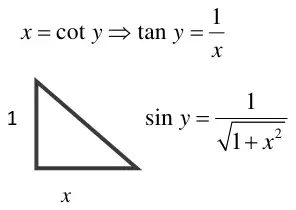
M1 Uses triangle with \(\tan y = \dfrac{1}{x}\) to find siny and get \(\dfrac{\mathrm{d}y}{\mathrm{d}x}\) or \(\dfrac{\mathrm{d}x}{\mathrm{d}y}\) just in terms of x