
C3 January 2013 Q7
7. \[\mathrm{h}(x) = \frac{2}{x + 2} + \frac{4}{x^2 + 5} - \frac{18}{(x^2 + 5)(x + 2)}, \qquad x \geqslant 0\]
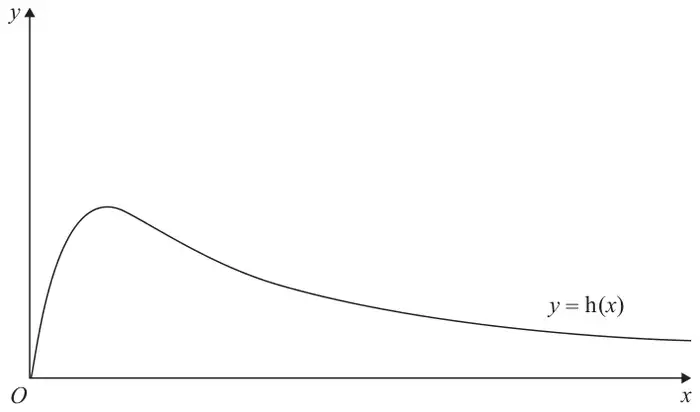
Figure 2 shows a graph of the curve with equation \(y = \mathrm{h}(x)\).
| Scheme | Marks |
|---|---|
| \(\dfrac{2}{x + 2} + \dfrac{4}{x^2 + 5} - \dfrac{18}{(x + 2)(x^2 + 5)} = \dfrac{2(x^2 + 5) + 4(x + 2) - 18}{(x + 2)(x^2 + 5)}\) | M1A1 |
| \(= \dfrac{2x(x + 2)}{(x + 2)(x^2 + 5)}\) | M1 |
| \(= \dfrac{2x}{(x^2 + 5)}\) | A1* |
| (4) |
Notes
M1 Combines the three fractions to form a single fraction with a common denominator.
Allow errors on the numerator but at least one must have been adapted.
Condone ‘invisible’ brackets for this mark.
Accept three separate fractions with the same denominator.
Amongst possible options allowed for this method are
\(\dfrac{2x^2 + 5 + 4x + 2 - 18}{(x + 2)(x^2 + 5)}\) Eg 1 An example of ‘invisible’ brackets
\(\dfrac{2(x^2 + 5)}{(x + 2)(x^2 + 5)} + \dfrac{4}{(x + 2)(x^2 + 5)} - \dfrac{18}{(x + 2)(x^2 + 5)}\) Eg 2An example of an error (on middle term), 1st term has been adapted
\(\dfrac{2(x^2 + 5)^2(x + 2) + 4(x + 2)^2(x^2 + 5) - 18(x^2 + 5)(x + 2)}{(x + 2)^2(x^2 + 5)^2}\) Eg 3 An example of a correct fraction with a different denominator
A1 Award for a correct un simplified fraction with the correct (lowest) common denominator.
\(\dfrac{2(x^2 + 5) + 4(x + 2) - 18}{(x + 2)(x^2 + 5)}\)
Accept if there are three separate fractions with the correct (lowest) common denominator.
Eg \(\dfrac{2(x^2 + 5)}{(x + 2)(x^2 + 5)} + \dfrac{4(x + 2)}{(x + 2)(x^2 + 5)} - \dfrac{18}{(x + 2)(x^2 + 5)}\)
Note, Example 3 would score M1A0 as it does not have the correct lowest common denominator
M1 There must be a single denominator. Terms must be collected on the numerator.
A factor of (x+2) must be taken out of the numerator and then cancelled with one in the denominator. The cancelling may be assumed if the term ‘disappears’
A1* Cso \(\dfrac{2x}{(x^2 + 5)}\) This is a given solution and this mark should be withheld if there are any errors
| Scheme | Marks |
|---|---|
| \(\mathrm{h}'(x) = \dfrac{(x^2 + 5) \times 2 - 2x \times 2x}{(x^2 + 5)^2}\) | M1A1 |
| \(\mathrm{h}'(x) = \dfrac{10 - 2x^2}{(x^2 + 5)^2}\) cso | A1 |
| (3) |
Notes
M1 Applies the quotient rule to \(\dfrac{2x}{(x^2 + 5)}\), a form of which appears in the formula book.
If the rule is quoted it must be correct. There must have been some attempt to differentiate both terms. If the rule is not quoted (nor implied by their working, meaning terms are written out u=…,u’=….,v=….,v’=….followed by their \(\dfrac{vu' - uv'}{v^2}\)) then only accept answers of the form
\(\dfrac{(x^2 + 5) \times A - 2x \times Bx}{(x^2 + 5)^2}\) where A, B > 0
A1 Correct unsimplified answer \(\mathrm{h}'(x) = \dfrac{(x^2 + 5) \times 2 - 2x \times 2x}{(x^2 + 5)^2}\)
A1 \(\mathrm{h}'(x) = \dfrac{10 - 2x^2}{(x^2 + 5)^2}\) The correct simplified answer. Accept \(\dfrac{2(5 - x^2)}{(x^2 + 5)^2}\), \(\dfrac{-2(x^2 - 5)}{(x^2 + 5)^2}\), \(\dfrac{10 - 2x^2}{(x^4 + 10x^2 + 25)}\)
DO NOT ISW FOR PART (b). INCORRECT SIMPLIFICATION IS A0
Alternative to (b) using the product rule
M1 Sets \(\mathrm{h}(x) = 2x(x^2 + 5)^{-1}\) and applies the product rule vu’+uv’ with terms being 2x and (x2+5)-1
If the rule is quoted it must be correct. There must have been some attempt to differentiate both terms. If the rule is not quoted (nor implied by their working, meaning terms are written out u=…,u’=….,v=….,v’=….followed by their vu’+uv’) then only accept answers of the form
\((x^2 + 5)^{-1} \times A + 2x \times \pm Bx(x^2 + 5)^{-2}\)
A1 Correct un simplified answer \((x^2 + 5)^{-1} \times 2 + 2x \times -2x(x^2 + 5)^{-2}\)
A1 The question asks for h’(x) to be put in its simplest form. Hence in this method the terms need to be combined to form a single correct expression.
For a correct simplified answer accept
\(\mathrm{h}'(x) = \dfrac{10 - 2x^2}{(x^2 + 5)^2} = \dfrac{2(5 - x^2)}{(x^2 + 5)^2} = \dfrac{-2(x^2 - 5)}{(x^2 + 5)^2} = (10 - 2x^2)(x^2 + 5)^{-2}\)
| Scheme | Marks |
|---|---|
| Maximum occurs when \(\mathrm{h}'(x) = 0 \Rightarrow 10 - 2x^2 = 0 \Rightarrow x = ..\) | M1 |
| \(\Rightarrow x = \sqrt{5}\) | A1 |
| When \(x = \sqrt{5} \Rightarrow \mathrm{h}(x) = \dfrac{\sqrt{5}}{5}\) | M1,A1 |
| Range of h(x) is \(0 \leqslant h(x) \leqslant \dfrac{\sqrt{5}}{5}\) | A1ft |
| (5) | |
| (12 marks) |
Notes
M1 Sets their h’(x)=0 and proceeds with a correct method to find x. There must have been an attempt to differentiate. Allow numerical errors but do not allow solutions from ‘unsolvable’ equations.
A1 Finds the correct x value of the maximum point \(x = \sqrt{5}\).
Ignore the solution \(x = -\sqrt{5}\) but withhold this mark if other positive values found.
M1 Substitutes their answer into their h’(x)=0 in h(x) to determine the maximum value
A1 Cso-the maximum value of h(x) = \(\dfrac{\sqrt{5}}{5}\). Accept equivalents such as \(\dfrac{2\sqrt{5}}{10}\) but not 0.447
A1ft Range of h(x) is \(0 \leqslant \mathrm{h}(x) \leqslant \dfrac{\sqrt{5}}{5}\). Follow through on their maximum value if the M’s have been scored. Allow \(0 \leqslant y \leqslant \dfrac{\sqrt{5}}{5}\), \(0 \leqslant \text{Range} \leqslant \dfrac{\sqrt{5}}{5}\), \(\left[0, \dfrac{\sqrt{5}}{5}\right]\) but not \(0 \leqslant x \leqslant \dfrac{\sqrt{5}}{5}\), \(\left(0, \dfrac{\sqrt{5}}{5}\right)\)
If a candidate attempts to work out \(h^{-1}(x)\) in (b) and does all that is required for (b) in (c), then allow.
Do not allow \(h^{-1}(x)\) to be used for h’(x) in part (c). For this question (b) and (c) can be scored together.