
C2 June 2009 Q9
9.
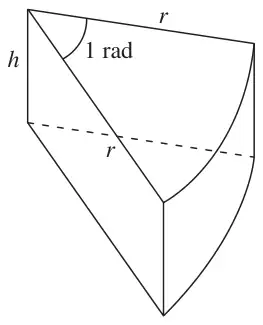
Figure 2 shows a closed box used by a shop for packing pieces of cake. The box is a right prism of height \(h\) cm. The cross section is a sector of a circle. The sector has radius \(r\) cm and angle 1 radian.
The volume of the box is 300 cm3.
| Scheme | Marks |
|---|---|
| (Arc length =) \(r\theta = r \times 1 = r\) . Can be awarded by implication from later work, e.g. \(3rh\) or \((2rh + rh)\) in the \(S\) formula. (Requires use of \(\theta = 1\)). | B1 |
| (Sector area =) \(\dfrac{1}{2}r^2\theta = \dfrac{1}{2}r^2 \times 1 = \dfrac{r^2}{2}\) . Can be awarded by implication from later work, e.g. the correct volume formula. (Requires use of \(\theta = 1\)). | B1 |
| Surface area = 2 sectors + 2 rectangles + curved face \((= r^2 + 3rh)\) (See notes below for what is allowed here) | M1 |
| Volume \(= 300 = \tfrac{1}{2}r^2h\) | B1 |
| Sub for \(h\): \(\ S = r^2 + 3 \times \dfrac{600}{r}\quad = r^2 + \dfrac{1800}{r}\) (*) | A1cso |
| (5) |
Notes
M1 for attempting a formula (with terms added) for surface area. May be incomplete or wrong and may have extra term(s), but must have an \(r^2\) (or \(r^2\theta\) ) term and an \(rh\) (or \(rh\theta\) ) term.
| Scheme | Marks |
|---|---|
| \(\dfrac{\mathrm{d}S}{\mathrm{d}r} = 2r - \dfrac{1800}{r^2}\) or \(2r - 1800r^{-2}\) or \(2r + -1800r^{-2}\) | M1A1 |
| \(\dfrac{\mathrm{d}S}{\mathrm{d}r} = 0 \Rightarrow r^3 = \ldots,\quad r = \sqrt[3]{900}\), or AWRT 9.7 (NOT \(-9.7\) or \(\pm 9.7\) ) | M1, A1 |
| (4) |
Notes
In parts (b), (c) and (d), ignore labelling of parts
1st M1 for attempt at differentiation (one term is sufficient) \(r^n \to kr^{n-1}\)
2nd M1 for setting their derivative (a 'changed function') = 0 and solving as far as \(r^3 = \ldots\) (depending upon their 'changed function', this could be \(r = \ldots\) or \(r^2 = \ldots\), etc., but the algebra must deal with a negative power of \(r\) and should be sound apart from possible sign errors, so that \(r^n = \ldots\) is consistent with their derivative).
| Scheme | Marks |
|---|---|
| \(\dfrac{\mathrm{d}^2S}{\mathrm{d}r^2} = \ldots.\) and consider sign, \(\dfrac{\mathrm{d}^2S}{\mathrm{d}r^2} = 2 + \dfrac{3600}{r^3}\ > 0\) so point is a minimum | M1, A1ft |
| (2) |
Notes
M1 for attempting second derivative (one term is sufficient) \(r^n \to kr^{n-1}\), and considering its sign. Substitution of a value of \(r\) is not required. (Equating it to zero is M0).
A1ft for a correct second derivative (or correct ft from their first derivative) and a valid reason (e.g. > 0), and conclusion. The actual value of the second derivative, if found, can be ignored. To score this mark as ft, their second derivative must indicate a minimum.
Alternative:
M1: Find value of \(\dfrac{\mathrm{d}S}{\mathrm{d}r}\) on each side of their value of \(r\) and consider sign.
A1ft: Indicate sign change of negative to positive for \(\dfrac{\mathrm{d}S}{\mathrm{d}r}\), and conclude minimum.
Alternative:
M1: Find value of \(S\) on each side of their value of \(r\) and compare with their 279.65.
A1ft: Indicate that both values are more than 279.65, and conclude minimum.
| Scheme | Marks |
|---|---|
| \(S_{\min} = (9.65\ldots)^2 + \dfrac{1800}{9.65\ldots}\) (Using their value of \(r\), however found, in the given \(S\) formula) | M1 |
| \(= 279.65\ldots\) (AWRT: 280) (Dependent on full marks in part (b)) | A1 |
| (2) | |
| [13] |