
C2 January 2012 Q9
9.
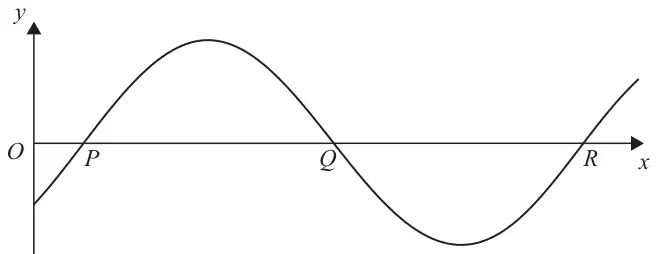
Figure 4 shows part of the curve with equation\[y = \sin(ax - b), \quad \text{where } a \gt 0,\ 0 \lt b \lt \pi\]The curve cuts the \(x\)-axis at the points \(P\), \(Q\) and \(R\) as shown.
Given that the coordinates of \(P\), \(Q\) and \(R\) are \(\left(\dfrac{\pi}{10}, 0\right)\), \(\left(\dfrac{3\pi}{5}, 0\right)\) and \(\left(\dfrac{11\pi}{10}, 0\right)\) respectively, find the values of \(a\) and \(b\).
(4)| Scheme | Marks |
|---|---|
| \(\sin(3x - 15) = \tfrac{1}{2}\) so \(3x - 15 = 30\ (\alpha)\) and \(x = 15\) | M1 A1 |
| Need \(3x - 15 = 180 - \alpha\) or \(3x - 15 = 540 - \alpha\) | M1 |
| Need \(3x - 15 = 180 - \alpha\) and \(3x - 15 = 360 + \alpha\) and \(3x - 15 = 540 - \alpha\) | M1 |
| \(x = 55\) or 175 | A1 |
| \(x = 55, 135, 175\) | A1 |
| (6) |
Notes
M1 Correct order of operation: inverse sine then linear algebra - not just \(3x - 15 = 30\) (slips in linear algebra lose Accuracy mark)
A1 Obtains first solution 15
M1 Uses either \(180 - \alpha\) or \(540 - \alpha\),
M1 uses all three \(180 - \alpha\) and \(360 + \alpha\) and \(540 - \alpha\)
A1, for one further correct solution 55 or 175, (depends only on second M1)
A1 – all 3 further correct solutions
If more than 4 solutions in range, lose last A1
Common slips: Just obtains 15 and 55, or 15 and 175 – usually M1A1M1M0A1A0
Just obtains 15 and 135 is usually M1A1M0M0A0A0 (It is easy to get this erroneously)
Obtains 5, 45, 125 and 165 – usually M1A0M1M1A0A0
Obtains 25, 65, 145, (185) usually M1A0M1M1A0A0
Working in radians – lose last A1 earned for \(\tfrac{\pi}{12}, \tfrac{11\pi}{36}, \tfrac{3\pi}{4}\) and \(\tfrac{35\pi}{36}\) or numerical equivalents
Mixed radians and degrees is usually Method marks only
Methods involving no working should be sent to Review
| Scheme | Marks |
|---|---|
| At least one of \(\left(\tfrac{a\pi}{10} - b\right) = 0\) (or \(n\pi\)) \(\left(\tfrac{a3\pi}{5} - b\right) = \pi\) {or \((n + 1)\pi\)} or in degrees or \(\left(\tfrac{a11\pi}{10} - b\right) = 2\pi\) {or \((n + 2)\pi\)} | M1 |
| If two of above equations used eliminates \(a\) or \(b\) to find one or both of these or uses period property of curve to find \(a\) or uses other valid method to find either \(a\) or \(b\) (May see \(\dfrac{5\pi}{10}a = \pi\) so \(a =\) ) | M1 |
| Obtains \(a = 2\) | A1 |
| Obtains \(b = \tfrac{\pi}{5}\) (must be in radians) | A1 |
| (4) |
Notes
M1: Award for \(\left(\tfrac{a\pi}{10} - b\right) = 0\) or \(\tfrac{a\pi}{10} = b\) BUT \(\sin\left(\tfrac{a\pi}{10} - b\right) = 0\) is M0
M1: As described above but solving \(\left(\tfrac{a\pi}{10} - b\right) = 0\) with \(\left(\tfrac{a3\pi}{5} - b\right) = 0\) is M0 (It gives \(a = b = 0\))
Special cases:
Can obtain full marks here for both correct answers with no working M1M1A1A1
For \(a = 2\) only, with no working, award M0M1A1A0 For \(b = \tfrac{\pi}{5}\) only with no working M1M0A0A1
Alternative
Some use translations and stretches to give answers.
If they achieve \(a = 2\) they earn second method and first accuracy. If they achieve correct value for \(b\) they earn first method and second accuracy.
Common error is \(a = 2\) and \(b = \tfrac{\pi}{10}\). This is usually M0M1A1A0 unless they have stated \(\left(\tfrac{a\pi}{10} - b\right) = 0\) earlier in which case they earn first M1.