
C2 January 2010 Q4
4.
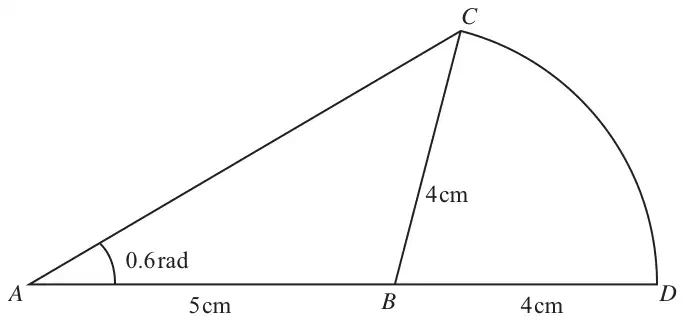
An emblem, as shown in Figure 1, consists of a triangle \(ABC\) joined to a sector \(CBD\) of a circle with radius 4 cm and centre \(B\). The points \(A\), \(B\) and \(D\) lie on a straight line with \(AB = 5\) cm and \(BD = 4\) cm. Angle \(BAC = 0.6\) radians and \(AC\) is the longest side of the triangle \(ABC\).
| Scheme | Marks | |
|---|---|---|
| Method (i) | Method (ii) | |
| Either \(\dfrac{\sin(A\hat{C}B)}{5} = \dfrac{\sin 0.6}{4}\) | or \(4^2 = b^2 + 5^2 - 2 \times b \times 5\cos 0.6\) | M1 |
| \(\therefore\ A\hat{C}B = \arcsin(0.7058\ldots)\) \(= [0.7835..\ \text{ or }\ 2.358]\) | \(\therefore\ b = \dfrac{10\cos 0.6 \pm \sqrt{(100\cos^2 0.6 - 36)}}{2}\) \(= [6.96\ \text{ or }\ 1.29]\) | M1 |
| Use angles of triangle \(A\hat{B}C = \pi - 0.6 - A\hat{C}B\) | Use sine / cosine rule with value for \(b\) \(\sin B = \dfrac{\sin 0.6}{4} \times b\) or \(\cos B = \dfrac{25 + 16 - b^2}{40}\) | M1, |
| (But as \(AC\) is the longest side so) \(A\hat{B}C = 1.76\) (*)(3sf) [Allow \(100.7^\circ \to 1.76\)] In degrees \(0.6 = 34.377^\circ\), \(A\hat{C}B = 44.9^\circ\) | (But as \(AC\) is the longest side so) \(A\hat{B}C = 1.76\) (*)(3sf) | A1 |
| (4) | ||
Notes
1st M1 for correct use of sine rule to find \(ACB\) or cosine rule to find \(b\) (M0 for \(ABC\) here or for use of sin \(x\) where \(x\) could be \(ABC\))
2nd M1 for a correct expression for angle \(ACB\) (This mark may be implied by .7835 or by arcsin (.7058)) and needs accuracy. In second method this M1 is for correct expression for \(b\) – may be implied by 6.96. [Note \(10\cos 0.6 \approx 8.3\) ] (do not need two answers)
3rd M1 for a correct method to get angle \(ABC\) in method (i) or sin\(ABC\) or cos\(ABC\) , in method (ii) (If sin \(B\) >1, can have M1A0)
A1cso for correct work leading to 1.76 3sf . Do not need to see angle 0.1835 considered and rejected.
Special case
If answer 1.76 is assumed then usual mark is M0 M0 M0 A0. A Fully checked method may be worth M1 M1 M0 A0. A maximum of 2 marks. The mark is either 2 or 0.
Either M1 for \(A\hat{C}B\) is found to be 0,7816 (angles of triangle) then
M1 for checking \(\dfrac{\sin(A\hat{C}B)}{5} = \dfrac{\sin 0.6}{4}\) with conclusion giving numerical answers
This gives a maximum mark of 2/4
OR M1 for \(b\) is found to be 6.97 (cosine rule)
M1 for checking \(\dfrac{\sin(ABC)}{b} = \dfrac{\sin 0.6}{4}\) with conclusion giving numerical answers
This gives a maximum mark of 2/4
Candidates making this assumption need a complete method. They cannot earn M1M0. So the score will be 0 or 2 for part (a). Circular arguments earn 0/4.
| Scheme | Marks |
|---|---|
| \(\left[C\hat{B}D = \pi - 1.76 = 1.38\right]\) Sector area \(= \tfrac{1}{2} \times 4^2 \times (\pi - 1.76) = [11.0 \sim 11.1]\) \(\dfrac{1}{2} \times 4^2 \times 79.3\) is M0 | M1 |
| Area of \(\Delta ABC = \tfrac{1}{2} \times 5 \times 4 \times \sin(1.76) = [9.8]\) or \(\dfrac{1}{2} \times 5 \times 4 \times \sin 101\) | M1 |
| Required area = awrt 20.8 or 20.9 or 21.0 or gives 21 (2sf) after correct work. | A1 |
| (3) | |
| [7] |
Notes
1st M1 for a correct expression for sector area or a value in the range 11.0 – 11.1
2nd M1 for a correct expression for the area of the triangle or a value of 9.8
Ignore 0.31 (working in degrees) as subsequent work.
A1 for answers which round to 20.8 or 20.9 or 21.0. No need to see units.