
C1 June 2018 Q5
5.
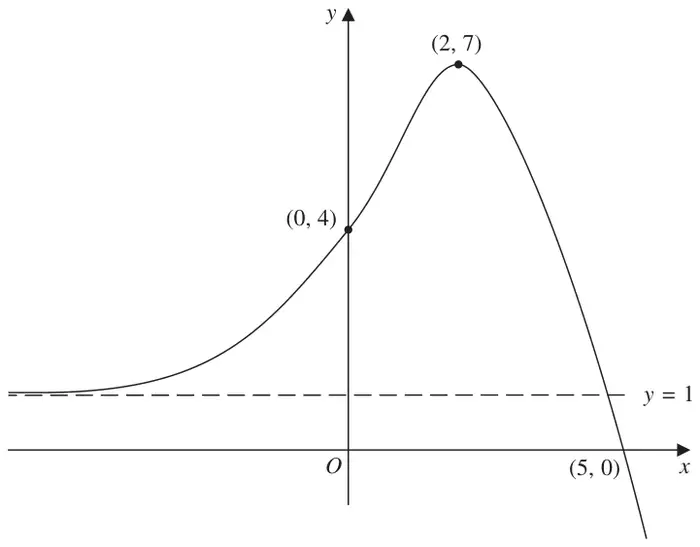
Figure 1 shows the sketch of a curve with equation \(y = \mathrm{f}(x)\), \(x \in \mathbb{R}\).
The curve crosses the \(y\)-axis at \((0, 4)\) and crosses the \(x\)-axis at \((5, 0)\).
The curve has a single turning point, a maximum, at \((2, 7)\).
The line with equation \(y = 1\) is the only asymptote to the curve.
Given that the line with equation \(y = k\), where \(k\) is a constant, meets the curve \(y = \mathrm{f}(x)\) at only one point,
| Scheme | Marks |
|---|---|
| \((4, 7)\) | B1 |
| (1) |
Notes
Accept \((4, 7)\) or \(x = 4\), \(y = 7\) or a sketch of \(y = \mathrm{f}\left(x - 2\right)\) with a maximum point marked at \((4, 7)\). (Condone missing brackets) There should be no other coordinates.
| Scheme | Marks |
|---|---|
| \((x =)\ 2.5\) | B1 |
| (1) |
Notes
Allow \((2.5, 0)\) (condone missing brackets) but no other values or points. Allow a sketch of \(\mathrm{f}(2x)\) with the only \(x\)-intercept marked at \(x = 2.5\) (Allow \((0, 2.5)\) marked in the correct place.
| Scheme | Marks |
|---|---|
| \(y = 1\) (oe e.g. \(y - 1 = 0\)) | B1 |
| (1) |
Notes
Must be an equation and not just ‘1’ and no other asymptotes stated.
| Scheme | Marks |
|---|---|
| \(k \leqslant 1\) or \(k = 7\) | B1 |
| \(k \leqslant 1 \quad k = 7\) | B1 |
| (2) | |
| (5 marks) |
Notes
B1: Either of \(k \leqslant 1\) or \(k = 7\)
Accept either of \(y \leqslant 1\) or \(y = 7\)
Note that \(k = 7\) may sometimes be seen embedded in e.g. \(k = 0, 1, 7\) and can score B1 here.
B1: Both correct and in terms of \(k\) with no other solutions.