
C1 June 2016 Q4
4.
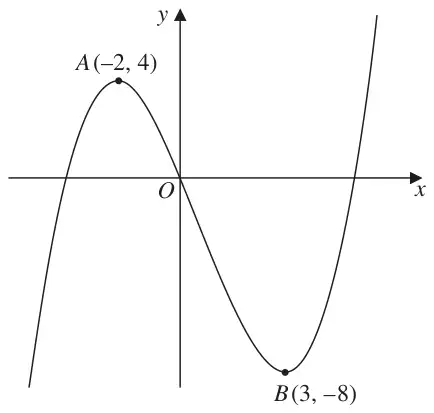
Figure 1 shows a sketch of part of the curve with equation \(y = \mathrm{f}(x)\). The curve has a maximum point \(A\) at \((-2, 4)\) and a minimum point \(B\) at \((3, -8)\) and passes through the origin \(O\).
On separate diagrams, sketch the curve with equation
On each diagram, show clearly the coordinates of the maximum and the minimum points and the coordinates of the point where the curve crosses the \(y\)-axis.
Note original points are \(A(-2, 4)\) and \(B(3, -8)\)
| Scheme | Marks |
|---|---|
| Shape | B1 |
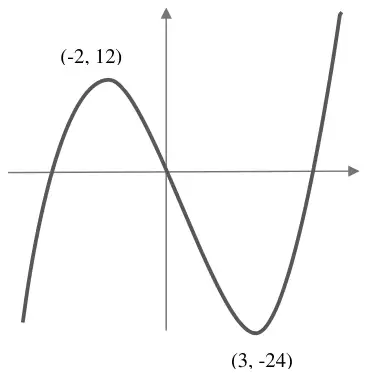
| Maximum at \((-2, 12)\) and minimum at \((3, -24)\) | B1 |
| (2) |
Notes
B1: Similar shape to given figure passing through the origin. A cubic shape with a maximum in the second quadrant and a minimum in the 4th quadrant.
There must be evidence of a change in at least one of the \(y\)-coordinates (inconsistent changes in the y-coordinates are acceptable) but not the \(x\)-coordinates.
B1: Maximum at \((-2, 12)\) and minimum at \((3, -24)\) with coordinates written the right way round. Condone missing brackets. The coordinates may appear on the sketch, or separately in the text (not necessarily referenced as \(A\) and \(B\)). If they are on the sketch, the \(x\) and \(y\) coordinates can be positioned correctly on the axes rather than given as coordinate pairs.
In cases of ambiguity, the sketch has precedence. The origin does not need to be labelled. Nor do the \(x\) and \(y\) axes.
| Scheme | Marks |
|---|---|
| Shape | M1 |
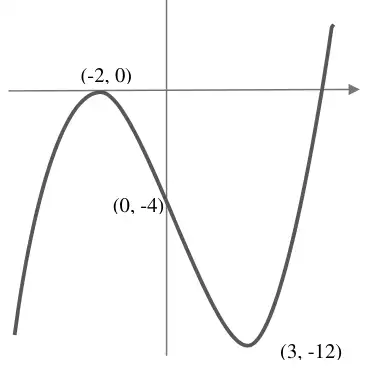
| Maximum at \((-2, 0)\) and minimum at \((3, -12)\) | A1 |
| Crosses \(y\)-axis at \((0, -4)\) | A1 |
| (3) | |
| (5 marks) |
Notes
M1: A positive cubic which does not pass through the origin with a maximum to the left of the \(y\)-axis and a minimum to the right of the \(y\)-axis.
A1: Maximum at \((-2, 0)\) and minimum at \((3, -12)\). Condone missing brackets. For the max allow just \(-2\) or \((0, -2)\) if marked in the correct place. If the coordinates are in the text, they must appear as \((-2, 0)\) and must not contradict the sketch. The curve must touch the \(x\)-axis at \((-2, 0)\). For the min allow coordinates as shown or 3 and \(-12\) to be marked in the correct places on the axes. In cases of ambiguity, the sketch has precedence.
A1: Crosses \(y\)-axis at \((0, -4)\). Allow just \(-4\) (not +4) and allow \((-4, 0)\) if marked in the correct place. If the coordinates are in the text, they must appear as \((0, -4)\) and must not contradict the sketch.
In cases of ambiguity, the sketch has precedence.