
Higher January 2020 Paper 1 Q20
20 The curve C has equation \(\;y = 4(x - 1)^2 - a\;\) where \(\;a \gt 4\)
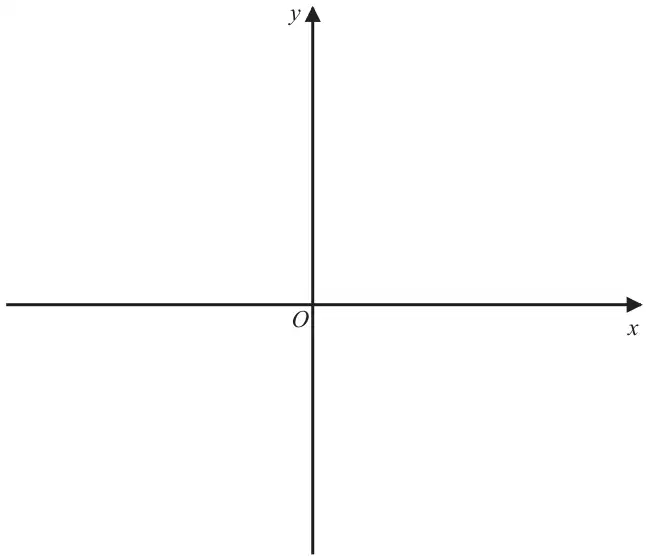
Using the axes below, sketch the curve C.
On your sketch show clearly, in terms of \(a\),
(i) the coordinates of any points of intersection of C with the coordinate axes,
(ii) the coordinates of the turning point.
(4)
| Scheme | Marks |
|---|---|
| graph drawn in shape of a quadratic with a minimum in any quadrant | M1 |
| \(x = 1\), \(y = 4(1 - 1)^2 - a\) | M1 |
| \(x = 1 \pm \sqrt{\dfrac{a}{4}}\) oe or \(y = 4 - a\) | M1 |
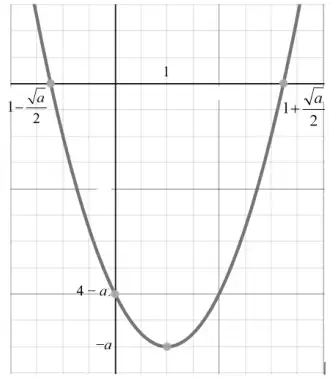 Answer: Correct graph | A1 |
| (4) | |
| (4 marks) |
Notes
M1: for a quadratic with a minimum
M1: for finding the turning point (may be seen marked on the graph as \((1, -a)\))
M1: for finding one of the intercepts (or award for any one correct coordinate shown on graph)
\((0, 4 - a)\) or \(\left(1 + \dfrac{\sqrt{a}}{2}, 0\right)\) or \(\left(1 - \dfrac{\sqrt{a}}{2}, 0\right)\)
Note: The 0’s can be ignored (as shown in the diagram)
A1: for a fully correct graph
• quadratic shape with minimum in the fourth quadrant and marked as \((1, -a)\) oe
• \(x\)-axis intercepts marked as \(\left(1 + \dfrac{\sqrt{a}}{2}, 0\right)\) oe on the positive \(x\)-axis and \(\left(1 - \dfrac{\sqrt{a}}{2}, 0\right)\) oe on the negative \(x\)-axis
• \(y\)-axis intercept marked as \((0, 4 - a)\) oe
Note: The 0’s can be ignored (as shown in the diagram)