
A2 June 2024 Q6
6.
In this question you must show all stages of your working.
Solutions relying entirely on calculator technology are not acceptable.
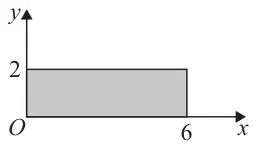
The shaded region, shown in Figure 4, is bounded by the \(x\)-axis, the line with equation \(x = 6\), the line with equation \(y = 2\) and the \(y\)-axis.
This region is rotated through \(360^\circ\) about the \(x\)-axis to form a solid of revolution.
This solid is used to model a non-uniform cylinder of height 6 cm and radius 2 cm.
The mass per unit volume of the cylinder at the point \((x, y, z)\) is \(\lambda(x + 2)\ \text{kg cm}^{-3}\), where \(0 \leqslant x \leqslant 6\) and \(\lambda\) is a constant.
The point \(O\) is the centre of one end of the cylinder. The point \(A\) is the centre of the other end of the cylinder.
A uniform solid hemisphere of radius 3 cm has density \(\lambda\ \text{kg cm}^{-3}\). The hemisphere is attached to the cylinder with the centre of its circular face in contact with the point \(A\) on the cylinder to form the model shown in Figure 5.
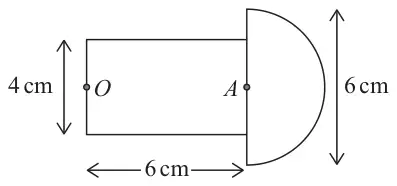
The model is placed with the end containing \(O\) on a rough inclined plane which is inclined at angle \(\alpha^\circ\) to the horizontal. The plane is sufficiently rough to prevent the model from sliding. The model is on the point of toppling.
| Scheme | Marks | AO |
|---|---|---|
| Mass \(= \displaystyle\int_0^6 \pi 2^2\lambda(x + 2)\,\mathrm{d}x\) | M1 | 3.4 |
| \(= 4\pi\lambda\left[\dfrac{x^2}{2} + 2x\right]_0^6\) | A1 | 1.1b |
| \(= 4\pi\lambda\left(\dfrac{36}{2} + 12\right) = 120\lambda\pi\ \text{(kg)}\) * | A1* | 2.2a |
| (3) |
Notes
M1: Correct method for total mass
A1: Correct integration with limits seen or implied
A1*: Obtain given answer from correct working
| Scheme | Marks | AO |
|---|---|---|
| Moment about \(y\)-axis \(= \displaystyle\int_0^6 4\pi x\lambda(x + 2)\,\mathrm{d}x\) | M1 | 2.1 |
| \(= 4\pi\lambda\left[\dfrac{x^3}{3} + x^2\right]_0^6 \quad \big(= 4\lambda\pi(72 + 36) = 432\lambda\pi\big)\) | A1 | 1.1b |
| Distance from \(O = \dfrac{\text{their } 432\lambda\pi}{120\lambda\pi}\) | DM1 | 3.1b |
| \(= \dfrac{432}{120} = 3.6\ \text{(cm)}\) * | A1* | 2.2a |
| (4) |
Notes
M1: Correct method for moments about \(y\)-axis (condone missing \(\pi\) and \(\lambda\))
A1: Correct unsimplified integral
DM1: Correct method to obtain distance from \(O\); dependent on first M.
A1*: Obtain given answer from correct working
| Scheme | Marks | AO |
|---|---|---|
| Use of \(\dfrac{3}{8} \times 3\) | B1 | 1.2 |
| Moments about a diameter of the base | M1 | 3.1b |
| \(120\lambda\pi \times 3.6 + \left(6 + \dfrac{3}{8} \times 3\right) \times \dfrac{2}{3}\pi(3)^3\lambda = (120 + 18)\pi\lambda d\) | A1 A1 | 1.1b 1.1b |
| \(\left(d = \dfrac{747}{184} = 4.0597...\right)\) | ||
| \(\tan\alpha^\circ = \dfrac{2}{\text{their } d}\) | M1 | 2.1 |
| \(\alpha = 26.2\) | A1 | 1.1b |
| (6) | ||
| (13 marks) |
Notes
B1: Use of correct formula for c of m of a hemisphere, seen or implied
M1: Condone use of a parallel axis. Require relevant terms and dimensionally correct.
Condone common factors cancelled throughout
A1: Unsimplified equation with at most one error. Incorrect volume of hemisphere is only one error
A1: Correct unsimplified equation
M1: Correct use of trigonometry to obtain \(\alpha\)
A1: \(26\ (26.2265...)\) or better