
A2 June 2024 Q4
4.
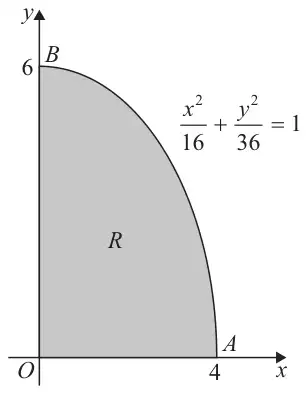
A uniform lamina \(OAB\) is in the shape of the region \(R\).
Region \(R\) lies in the first quadrant and is bounded by the curve with equation \(\dfrac{x^2}{16} + \dfrac{y^2}{36} = 1\), the \(x\)-axis, and the \(y\)-axis, as shown shaded in Figure 3.
The point \(A\) is the point of intersection of the curve and the \(x\)-axis.
The point \(B\) is the point of intersection of the curve and the \(y\)-axis.
One unit on each axis represents 1 m.
The area of \(R\) is \(6\pi\)
The centre of mass of \(R\) lies at the point with coordinates \((\bar{x}, \bar{y})\)
The lamina is freely suspended from \(A\) and hangs in equilibrium with \(OA\) at angle \(\theta^\circ\) to the downward vertical.
| Scheme | Marks | AO |
|---|---|---|
| Moments about the \(y\)-axis: \(\displaystyle\int (\rho)\,xy\,\mathrm{d}x\) | M1 | 3.1a |
| \(= (\rho)\displaystyle\int x\sqrt{36 - \dfrac{9x^2}{4}}\,\mathrm{d}x = k\left(36 - \dfrac{9x^2}{4}\right)^{\frac{3}{2}}\) | M1 | 2.1 |
| \(= \left[-\dfrac{4}{27}\left(36 - \dfrac{9x^2}{4}\right)^{\frac{3}{2}}(\rho)\right]_0^4 \quad \big(= 32(\rho)\big)\) | A1 | 1.1b |
| \(\bar{x} = \dfrac{\int xy\,\mathrm{d}x}{6\pi}\) | DM1 | 3.1a |
| \(\bar{x} = \dfrac{32}{6\pi} = \dfrac{16}{3\pi}\) * | A1* | 2.2a |
| (5) |
Notes
M1: Correct method for moments about the \(y\)-axis: \(\displaystyle\int (\rho)\,xy\,\mathrm{d}x\) or \(\displaystyle\int (\rho)\dfrac{1}{2}x^2\,\mathrm{d}y\)
Integrand should be in one variable only.
(corrected from the printed mark scheme, which says “moments about the \(x\)-axis” here)
M1: Integrate to obtain \(k\left(A - Bx^2\right)^{\frac{3}{2}}\) Ignore limits and / or constant of integration
A1: Correct integration with correct limits seen or implied.
DM1: Complete method to obtain \(\bar{x}\). Dependent on first M1.
A1*: Obtain given answer from correct working
| Scheme | Marks | AO |
|---|---|---|
| Moments about the \(x\)-axis: \(\displaystyle\int \dfrac{1}{2}y^2(\rho)\,\mathrm{d}x\ \left(= \dfrac{1}{2}(\rho)\int 36 - \dfrac{9x^2}{4}\,\mathrm{d}x\right)\) | M1 | 3.1a |
| \(= \dfrac{1}{2}(\rho)\left[36x - \dfrac{3}{4}x^3\right]_0^4 \quad \left(= \dfrac{1}{2}(\rho)(144 - 48) = 48(\rho)\right)\) | A1 | 1.1b |
| \(\bar{y} = \dfrac{\int \frac{1}{2}y^2\,\mathrm{d}x}{6\pi}\) | DM1 | 2.1 |
| \(= \dfrac{48}{6\pi} \quad \left(= \dfrac{8}{\pi}\right)\) | A1 | 2.2a |
| (4) |
Notes
M1: Correct method for moments about the \(x\)-axis: \(\displaystyle\int (\rho)\,xy\,\mathrm{d}y\) or \(\displaystyle\int (\rho)\dfrac{1}{2}y^2\,\mathrm{d}x\)
(corrected from the printed mark scheme, which says “moments about the \(y\)-axis” here)
A1: Correct integration with correct limits seen or implied.
DM1: Complete method to obtain \(\bar{y}\). Dependent on previous M1.
A1: Correct exact equivalent
| Scheme | Marks | AO |
|---|---|---|
| Correct use of trigonometry | M1 | 3.1a |
| \(\tan\theta^\circ = \dfrac{\textit{their } \bar{y}}{4 - \dfrac{16}{3\pi}} \quad \left(= \dfrac{6}{3\pi - 4}\right)\) | A1ft | 1.1b |
| \(\theta = 47.9 \quad (48 \text{ or better})\) | A1 | 1.1b |
| (3) | ||
| (12 marks) |
Notes
M1: Correct use of trigonometry to find a relevant angle
A1ft: Correct unsimplified expression for \(\tan\theta\) or its reciprocal. Follow their \(\bar{y}\)
A1: 48 or better (47.8823...) 0.836 radians is A0