
AS October 2020 Q1
1.
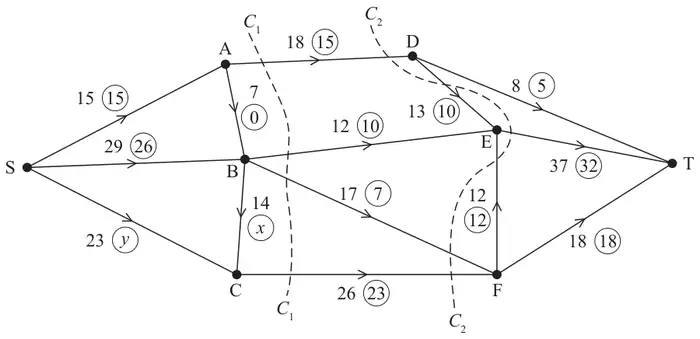
Figure 1 shows a capacitated, directed network of pipes. The number on each arc represents the capacity of the corresponding pipe. The numbers in circles represent a feasible flow from S to T.
Two cuts, \(C_1\) and \(C_2\), are shown in Figure 1.
Given that the flow through the network is increased by two units using the route found in (d),
| Scheme | Marks | AO |
|---|---|---|
| (i) \((x =)\ 9\) | B1 | 1.1b |
| (ii) \((y =)\ 14\) | B1 | 1.1b |
| (2) |
Notes
(i) B1: Cao
(ii) B1: Cao
| Scheme | Marks | AO |
|---|---|---|
| SA, FE, FT | B1 | 1.1b |
| (1) |
Notes
B1: Cao
| Scheme | Marks | AO |
|---|---|---|
| (i) Value of cut \(C_1 = 18 + 12 + 17 + 26 = 73\) | B1 | 1.1b |
| (ii) Value of cut \(C_2 = 18 + 37 + 17 + 26 = 98\) | B1 | 1.1b |
| (2) |
Notes
(i) B1: Cao
(ii) B1: Cao
| Scheme | Marks | AO |
|---|---|---|
| e.g. SCFBET, SBCFBET | B1 | 1.1b |
| (1) |
Notes
B1: A correct flow-augmenting route
| Scheme | Marks | AO |
|---|---|---|
| Use of max-flow min-cut theorem Identification of cut through SA, AB, BE, FE and FT Value of flow = 57 Therefore it follows that flow is maximal | M1 A1 A1 | 2.1 3.1a 2.2a |
| (3) | ||
| (9 marks) |
Notes
M1: Construct argument based on max-flow min-cut theorem (e.g. attempt to find a cut through saturated arcs) – if the cut is only given in terms of the capacity of the arcs (rather than in terms of the nodes at each end) then M1 only in this part
A1: Use appropriate process of finding a minimum cut – cut and value correct
A1: Correct deduction that the flow is maximal