
October 2021 Paper 2 Q7
7.
In this question you should show all stages of your working.
Solutions relying entirely on calculator technology are not acceptable.
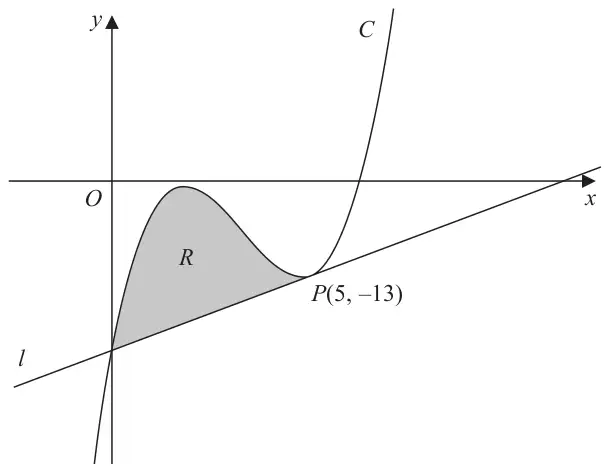
Figure 2 shows a sketch of part of the curve \(C\) with equation
\[y = x^3 - 10x^2 + 27x - 23\]The point \(P(5,\ -13)\) lies on \(C\)
The line \(l\) is the tangent to \(C\) at \(P\)
The finite region \(R\), shown shaded in Figure 2, is bounded by the curve \(C\) and the line \(l\).
| Scheme | Marks | AO |
|---|---|---|
| \(y = x^3 - 10x^2 + 27x - 23 \Rightarrow \dfrac{\mathrm{d}y}{\mathrm{d}x} = 3x^2 - 20x + 27\) | B1 | 1.1b |
| \(\left(\dfrac{\mathrm{d}y}{\mathrm{d}x}\right)_{x=5} = 3 \times 5^2 - 20 \times 5 + 27\ (= 2)\) | M1 | 1.1b |
| \(y + 13 = 2(x - 5)\) | M1 | 2.1 |
| \(y = 2x - 23\) | A1 | 1.1b |
| (4) |
Notes
B1: Correct derivative
M1: Substitutes \(x = 5\) into their derivative. This may be implied by their value for \(\dfrac{\mathrm{d}y}{\mathrm{d}x}\)
M1: Fully correct straight line method using \((5,\ -13)\) and their \(\dfrac{\mathrm{d}y}{\mathrm{d}x}\) at \(x = 5\)
A1: cao. Must see the full equation in the required form.
| Scheme | Marks | AO |
|---|---|---|
| Both \(C\) and \(l\) pass through \((0,\ -23)\) and so \(C\) meets \(l\) again on the \(y\)-axis | B1 | 2.2a |
| (1) |
Notes
B1: Makes a suitable deduction.
Alternative via equating \(l\) and \(C\) and factorising e.g.
\(x^3 - 10x^2 + 27x - 23 = 2x - 23\)
\(x^3 - 10x^2 + 25x = 0\)
\(x\left(x^2 - 10x + 25\right) = 0 \Rightarrow x = 0\)
So they meet on the \(y\)-axis
| Scheme | Marks | AO |
|---|---|---|
| \(\displaystyle\pm\int \left(x^3 - 10x^2 + 27x - 23 - (2x - 23)\right)\mathrm{d}x\) \(= \pm\left(\dfrac{x^4}{4} - \dfrac{10}{3}x^3 + \dfrac{25}{2}x^2\right)\) | M1 A1ft | 1.1b 1.1b |
| \(\left[\dfrac{x^4}{4} - \dfrac{10}{3}x^3 + \dfrac{25}{2}x^2\right]_0^5\) \(= \left(\dfrac{625}{4} - \dfrac{1250}{3} + \dfrac{625}{2}\right)(-0)\) | dM1 | 2.1 |
| \(= \dfrac{625}{12}\) | A1 | 1.1b |
| (4) | ||
| (9 marks) |
Notes
M1: For an attempt to integrate \(x^n \rightarrow x^{n+1}\) for \(\pm\)“\(C - l\)”
A1ft: Correct integration in any form which may be simplified or unsimplified. (follow through their equation from (a))
If they attempt as 2 separate integrals e.g. \(\displaystyle\int \left(x^3 - 10x^2 + 27x - 23\right)\mathrm{d}x - \int (2x - 23)\,\mathrm{d}x\) then award this mark for the correct integration of the curve as in the alternative.
If they combine the curve with the line first then the subsequent integration must be correct or a correct ft for their line and allow for \(\pm\)“\(C - l\)”
dM1: Fully correct strategy for the area. Award for use of 5 as the limit and condone the omission of the “\(-\ 0\)”. Depends on the first method mark.
A1: Correct exact value
(c) Alternative
| Scheme | Marks | AO |
|---|---|---|
| \(\displaystyle\pm\int \left(x^3 - 10x^2 + 27x - 23\right)\mathrm{d}x\) \(= \pm\left(\dfrac{x^4}{4} - \dfrac{10}{3}x^3 + \dfrac{27}{2}x^2 - 23x\right)\) | M1 A1 | 1.1b 1.1b |
| \(\left[\dfrac{x^4}{4} - \dfrac{10}{3}x^3 + \dfrac{27}{2}x^2 - 23x\right]_0^5 + \dfrac{1}{2} \times 5(23 + 13)\) \(= -\dfrac{455}{12} + 90\) | dM1 | 2.1 |
| \(= \dfrac{625}{12}\) | A1 | 1.1b |
M1: For an attempt to integrate \(x^n \rightarrow x^{n+1}\) for \(\pm C\)
A1: Correct integration for \(\pm C\)
dM1: Fully correct strategy for the area e.g. correctly attempts the area of the trapezium and subtracts the area enclosed between the curve and the \(x\)-axis. Need to see the use of 5 as the limit condoning the omission of the “\(-\ 0\)” and a correct attempt at the trapezium and the subtraction.
May see the trapezium area attempted as \(\displaystyle\int (2x - 23)\,\mathrm{d}x\) in which case the integration and use of the limits needs to be correct or correct follow through for their straight line equation.
Depends on the first method mark.
A1: Correct exact value
Note if they do \(l - C\) rather than \(C - l\) and the working is otherwise correct allow full marks if their final answer is given as a positive value. E.g. correct work with \(l - C\) leading to \(-\dfrac{625}{12}\) and then e.g. hence area is \(\dfrac{625}{12}\) is acceptable for full marks.
If the answer is left as \(-\dfrac{625}{12}\) then score A0