
October 2021 Paper 2 Q6
6.
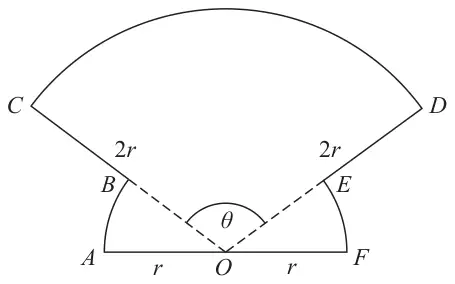
The shape \(OABCDEFO\) shown in Figure 1 is a design for a logo.
In the design
- \(OAB\) is a sector of a circle centre \(O\) and radius \(r\)
- sector \(OFE\) is congruent to sector \(OAB\)
- \(ODC\) is a sector of a circle centre \(O\) and radius \(2r\)
- \(AOF\) is a straight line
Given that the size of angle \(COD\) is \(\theta\) radians,
| Scheme | Marks | AO |
|---|---|---|
| Angle \(AOB = \dfrac{\pi - \theta}{2}\) | B1 | 2.2a |
| (1) |
Notes
B1: Deduces the correct expression for angle \(AOB\)
Note that \(\dfrac{180 - \theta}{2}\) scores B0
Note that some candidates may change the angle to degrees at the start and all marks are available e.g.
(a) \(\dfrac{180 - \dfrac{180\theta}{\pi}}{2}\)
(b) \(2\left(\dfrac{180 - \dfrac{180\theta}{\pi}}{2}\right) \times \dfrac{1}{360} \times \pi r^2 + \dfrac{\theta}{360} \times \dfrac{180}{\pi} \times \pi(2r)^2 = \dfrac{1}{2}\pi r^2 - \dfrac{1}{2}r^2\theta + 2r^2\theta = \dfrac{1}{2}r^2(3\theta + \pi)\)
(c) \(4r + 2\left(\dfrac{180 - \dfrac{180\theta}{\pi}}{2}\right) \times \dfrac{1}{360} \times 2\pi r + \dfrac{180\theta}{\pi} \times \dfrac{1}{360} \times 2\pi(2r) = 4r + \pi r + r\theta\)
| Scheme | Marks | AO |
|---|---|---|
| Area \(= 2 \times \dfrac{1}{2}r^2\left(\dfrac{\pi - \theta}{2}\right) + \dfrac{1}{2}(2r)^2\theta\) | M1 | 2.1 |
| \(= \dfrac{1}{2}r^2\pi - \dfrac{1}{2}r^2\theta + 2r^2\theta = \dfrac{3}{2}r^2\theta + \dfrac{1}{2}r^2\pi = \dfrac{1}{2}r^2(3\theta + \pi)\,*\) | A1* | 1.1b |
| (2) |
Notes
M1: Fully correct strategy for the area using their angle from (a) appropriately.
Need to see \(2 \times \dfrac{1}{2}r^2\alpha\) or just \(r^2\alpha\) where \(\alpha\) is their angle in terms of \(\theta\) from part (a) + \(\dfrac{1}{2}(2r)^2\theta\) with or without the brackets.
A1*: Correct proof. For this mark you can condone the omission of the brackets in \(\dfrac{1}{2}(2r)^2\theta\) as long as they are recovered in subsequent work e.g. when this term becomes \(2r^2\theta\)
The first term must be seen expanded as e.g. \(\dfrac{1}{2}r^2\pi - \dfrac{1}{2}r^2\theta\) or equivalent
Note that some candidates may change the angle to degrees at the start and all marks are available e.g.
(a) \(\dfrac{180 - \dfrac{180\theta}{\pi}}{2}\)
(b) \(2\left(\dfrac{180 - \dfrac{180\theta}{\pi}}{2}\right) \times \dfrac{1}{360} \times \pi r^2 + \dfrac{\theta}{360} \times \dfrac{180}{\pi} \times \pi(2r)^2 = \dfrac{1}{2}\pi r^2 - \dfrac{1}{2}r^2\theta + 2r^2\theta = \dfrac{1}{2}r^2(3\theta + \pi)\)
(c) \(4r + 2\left(\dfrac{180 - \dfrac{180\theta}{\pi}}{2}\right) \times \dfrac{1}{360} \times 2\pi r + \dfrac{180\theta}{\pi} \times \dfrac{1}{360} \times 2\pi(2r) = 4r + \pi r + r\theta\)
| Scheme | Marks | AO |
|---|---|---|
| Perimeter \(= 4r + 2r\left(\dfrac{\pi - \theta}{2}\right) + 2r\theta\) | M1 | 3.1a |
| \(= 4r + r\pi + r\theta\) or e.g. \(r(4 + \pi + \theta)\) | A1 | 1.1b |
| (2) | ||
| (5 marks) |
Notes
M1: Fully correct strategy for the perimeter using their angle from (a) appropriately
Need to see \(4r + 2r\alpha + 2r\theta\) where \(\alpha\) is their angle from part (a) in terms of \(\theta\)
A1: Correct simplified expression
Note that some candidates may change the angle to degrees at the start and all marks are available e.g.
(a) \(\dfrac{180 - \dfrac{180\theta}{\pi}}{2}\)
(b) \(2\left(\dfrac{180 - \dfrac{180\theta}{\pi}}{2}\right) \times \dfrac{1}{360} \times \pi r^2 + \dfrac{\theta}{360} \times \dfrac{180}{\pi} \times \pi(2r)^2 = \dfrac{1}{2}\pi r^2 - \dfrac{1}{2}r^2\theta + 2r^2\theta = \dfrac{1}{2}r^2(3\theta + \pi)\)
(c) \(4r + 2\left(\dfrac{180 - \dfrac{180\theta}{\pi}}{2}\right) \times \dfrac{1}{360} \times 2\pi r + \dfrac{180\theta}{\pi} \times \dfrac{1}{360} \times 2\pi(2r) = 4r + \pi r + r\theta\)