
October 2021 Paper 2 Q15
15.
Give the exact value of \(R\) and the value of \(\alpha\) in radians to 3 decimal places. (3)
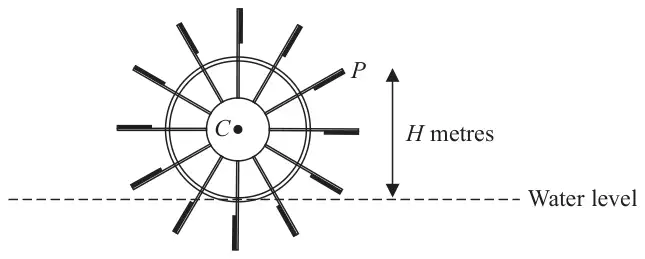
Figure 6 shows the cross-section of a water wheel.
The wheel is free to rotate about a fixed axis through the point \(C\).
The point \(P\) is at the end of one of the paddles of the wheel, as shown in Figure 6.
The water level is assumed to be horizontal and of constant height.
The vertical height, \(H\) metres, of \(P\) above the water level is modelled by the equation\[H = 3 + 4\cos(0.5t) - 2\sin(0.5t)\]where \(t\) is the time in seconds after the wheel starts rotating.
Using the model, find
In a single revolution of the wheel, \(P\) is below the water level for a total of \(T\) seconds.
According to the model,
(Solutions based entirely on calculator technology are not acceptable.)
(4)In reality, the water level may not be of constant height.
| Scheme | Marks | AO |
|---|---|---|
| \(R = \sqrt{5}\) | B1 | 1.1b |
| \(\tan\alpha = \dfrac{1}{2}\) or \(\sin\alpha = \dfrac{1}{\sqrt{5}}\) or \(\cos\alpha = \dfrac{2}{\sqrt{5}} \Rightarrow \alpha = \ldots\) | M1 | 1.1b |
| \(\alpha = 0.464\) | A1 | 1.1b |
| (3) |
Notes
B1: \(R = \sqrt{5}\) only.
M1: Proceeds to a value for \(\alpha\) from \(\tan\alpha = \pm\dfrac{1}{2}\) or \(\sin\alpha = \pm\dfrac{1}{\text{``}R\text{''}}\) or \(\cos\alpha = \pm\dfrac{2}{\text{``}R\text{''}}\)
It is implied by either awrt 0.464 (radians) or awrt 26.6 (degrees)
A1: \(\alpha =\) awrt 0.464
| Scheme | Marks | AO |
|---|---|---|
| (i) \(3 + 2\sqrt{5}\) | B1ft | 3.4 |
| (ii) \(\cos(0.5t + 0.464) = 1 \Rightarrow 0.5t + 0.464 = 2\pi\) \(\Rightarrow t = \ldots\) | M1 | 3.4 |
| \(t = 11.6\) | A1 | 1.1b |
| (3) |
Notes
(b)(i)
B1ft: For \(\left(3 + 2\sqrt{5}\right)\) m or awrt 7.47 m and remember to isw. Condone lack of units.
Follow through on their \(R\) value so allow \(3 + 2 \times\) Their \(R\). (Allow in decimals with at least 3sf accuracy)
(b)(ii)
M1: Uses \(0.5t \pm \text{``}0.464\text{''} = 2\pi\) to obtain a value for \(t\)
Follow through on their 0.464 but this angle must be in radians.
It is possible in degrees but only using \(0.5t \pm \text{``}26.6\text{''} = 360\)
A1: Awrt 11.6
Alternative for (b):
| Scheme | Marks |
|---|---|
| \(H = 3 + 4\cos(0.5t) - 2\sin(0.5t) \Rightarrow \dfrac{\mathrm{d}H}{\mathrm{d}t} = -2\sin(0.5t) - \cos(0.5t) = 0\) \(\Rightarrow \tan(0.5t) = -\dfrac{1}{2} \Rightarrow 0.5t = 2.677\ldots, 5.819\ldots \Rightarrow t = 5.36,\ 11.6\) | M1 A1 |
| \(t = 11.6 \Rightarrow H = 7.47\) | B1ft |
Score as follows:
M1: For a complete method: Attempts \(\dfrac{\mathrm{d}H}{\mathrm{d}t}\) and attempts to solve \(\dfrac{\mathrm{d}H}{\mathrm{d}t} = 0\) for \(t\)
A1: For \(t =\) awrt 11.6
B1ft: For awrt 7.47 or \(3 + 2 \times\) Their \(R\)
| Scheme | Marks | AO |
|---|---|---|
| \(3 + 2\sqrt{5}\cos(0.5t + 0.464) = 0\) \(\cos(0.5t + 0.464) = -\dfrac{3}{2\sqrt{5}}\) | M1 | 3.4 |
| \(\cos(0.5t + 0.464) = -\dfrac{3}{2\sqrt{5}} \Rightarrow 0.5t + 0.464 = \cos^{-1}\left(-\dfrac{3}{2\sqrt{5}}\right)\) \(\Rightarrow t = 2\left(\cos^{-1}\left(-\dfrac{3}{2\sqrt{5}}\right) - 0.464\right)\) | dM1 | 1.1b |
| So the time required is e.g.: \(2(3.977\ldots - 0.464) - 2(2.306\ldots - 0.464)\) | dM1 | 3.1b |
| \(= 3.34\) | A1 | 1.1b |
| (4) |
Notes
M1: Uses the model and sets \(3 + 2\text{``}\sqrt{5}\text{''}\cos(\ldots) = 0\) and proceeds to \(\cos(\ldots) = k\) where \(|k| \lt 1\).
Allow e.g. \(3 + 2\text{``}\sqrt{5}\text{''}\cos(\ldots) \lt 0\)
dM1: Solves \(\cos(0.5t \pm \text{``}0.464\text{''}) = k\) where \(|k| \lt 1\) to obtain at least one value for \(t\)
This requires e.g. \(2\left(\pi + \cos^{-1}(k) \pm \tan^{-1}\left(\dfrac{1}{2}\right)\right)\) or e.g. \(2\left(\pi - \cos^{-1}(k) \pm \tan^{-1}\left(\dfrac{1}{2}\right)\right)\)
Depends on the previous method mark.
dM1: A fully correct strategy to find the required duration. E.g. finds 2 consecutive values of \(t\) when \(H = 0\) and subtracts. Alternatively finds \(t\) when \(H\) is minimum and uses the times found correctly to find the required duration.
Depends on the previous method mark.
Examples:
Second time at water level – first time at water level:\[2\left(\pi + \cos^{-1}\left(\dfrac{3}{2\sqrt{5}}\right) - \tan^{-1}\left(\frac{1}{2}\right)\right) - 2\left(\pi - \cos^{-1}\left(\dfrac{3}{2\sqrt{5}}\right) - \tan^{-1}\left(\frac{1}{2}\right)\right) = 7.02685\ldots - 3.68492\ldots\]
\(2 \times\) (first time at minimum point – first time at water level):\[2\left(2\left(\pi - \tan^{-1}\left(\frac{1}{2}\right)\right) - 2\left(\pi - \cos^{-1}\left(\dfrac{3}{2\sqrt{5}}\right) - \tan^{-1}\left(\frac{1}{2}\right)\right)\right) = 2(5.35589\ldots - 3.68492\ldots)\]
Note that both of these examples equate to \(4\cos^{-1}\left(\dfrac{3}{2\sqrt{5}}\right)\) which is not immediately obvious but may be seen as an overall method.
There may be other methods – if you are not sure if they deserve credit send to review.
A1: Correct value. Must be 3.34 (not awrt).
Special Cases in (c):
Note that if candidates have an incorrect \(\alpha\) and have e.g. \(3 + 2\sqrt{5}\cos(0.5t - 0.464)\), this has no impact on the final answer. So for candidates using \(3 + 2\sqrt{5}\cos(0.5t \pm \alpha)\) in (c) allow all the marks including the A mark as a correct method should always lead to 3.34
Some values to look for:
\(0.5t \pm \text{``}0.464\text{''} = \pm 2.306,\ \pm 3.977,\ \pm 8.598,\ \pm 10.26\)
| Scheme | Marks | AO |
|---|---|---|
| e.g. the “3” would need to vary | B1 | 3.5c |
| (1) | ||
| (11 marks) |
Notes
B1: Correct refinement e.g. As in scheme. If they suggest a specific function to replace the “3” then it must be sensible e.g. a trigonometric function rather than e.g. a quadratic/linear one.