
October 2020 Paper 2 Q15
15.
In this question you must show all stages of your working.
Solutions relying entirely on calculator technology are not acceptable.
A geometric series has common ratio \(r\) and first term \(a\).
Given \(r \ne 1\) and \(a \ne 0\)
Given also that \(S_{10}\) is four times \(S_5\)
| Scheme | Marks | AO |
|---|---|---|
| \(S_n = a + ar + ar^2 + \ldots\ldots + ar^{n-1}\) | B1 | 1.2 |
| \(rS_n = ar + ar^2 + ar^3 + \ldots\ldots + ar^n \Rightarrow S_n - rS_n = \ldots\) | M1 | 2.1 |
| \(S_n - rS_n = a - ar^n\) | A1 | 1.1b |
| \(S_n(1 - r) = a(1 - r^n) \Rightarrow S_n = \dfrac{a(1 - r^n)}{(1 - r)}\) * | A1* | 2.1 |
| (4) |
Notes
B1: Writes out the sum or lists terms. Condone the omission of \(S\).
The sum must include the first and last terms and (at least) two other correct terms and no incorrect terms e.g. \(ar^n\)
Note that the sum may be seen embedded within their working.
M1: For the key step in attempting to multiply the first series by \(r\) and subtracting.
A1: \(S_n - rS_n = a - ar^n\) either way around but condone one side being prematurely factorised (but not both) following correct work but this could follow B0 if insufficient terms were shown.
A1*: Depends on all previous marks. Proceeds to given result showing all steps including seeing both sides unfactorised at some point in their working.
Note: If terms are listed rather than added then allow the first 3 marks if otherwise correct but withhold the final mark.
Example for (a):
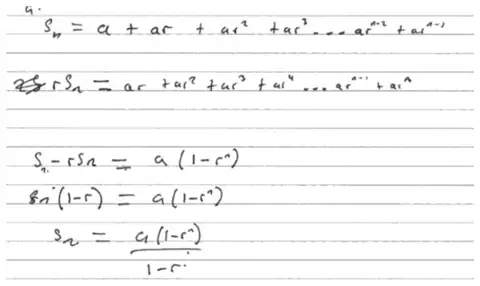
This scores B1M1A1A0:
B1: Writes down the sum including first and last terms and at least 2 other correct terms and no incorrect terms
M1: Multiplies by \(r\) and subtracts
A1: Correct equation (we allow one side to be prematurely factorised)
A0: One side was prematurely factorised
| Scheme | Marks | AO |
|---|---|---|
| \(\dfrac{a(1 - r^{10})}{1 - r} = 4 \times \dfrac{a(1 - r^5)}{1 - r}\) or \(4 \times \dfrac{a(1 - r^{10})}{1 - r} = \dfrac{a(1 - r^5)}{1 - r}\) Equation in \(r^{10}\) and \(r^5\) (and possibly \(1 - r\)) | M1 | 3.1a |
| \(1 - r^{10} = 4(1 - r^5)\) | A1 | 1.1b |
| \(r^{10} - 4r^5 + 3 = 0 \Rightarrow (r^5 - 1)(r^5 - 3) = 0 \Rightarrow r^5 = \ldots\) or e.g. \(1 - r^{10} = 4(1 - r^5) \Rightarrow (1 - r^5)(1 + r^5) = 4(1 - r^5) \Rightarrow r^5 = \ldots\) | dM1 | 2.1 |
| \(r = \sqrt[5]{3}\) oe only | A1 | 1.1b |
| (4) | ||
| (8 marks) |
Notes
M1: For the correct strategy of producing an equation in just \(r^{10}\) and \(r^5\) (and possibly \((1 - r)\)) with the “4” on either side using the result from part (a) and makes progress to at least cancel through by \(a\)
Some candidates retain the “\(1 - r\)” and start multiplying out e.g. \((1 - r)(1 - r^{10})\) and this mark is still available as long as there is progress in cancelling the “\(a\)”.
A1: Correct equation with the \(a\) and the \(1 - r\) cancelled. Allow any correct equation in just \(r^5\) and \(r^{10}\)
dM1: Depends on the first M. Solves as far as \(r^5 = \ldots\) by solving a 3 term quadratic in \(r^5\) by a valid method – see general guidance or by difference of 2 squares – see above
A1: \(r = \sqrt[5]{3}\) oe only. The solution \(r = 1\) if found must be rejected here.
(b) Note: For candidates who use \(S_5 = 4S_{10}\) expect to see:
\(4 \times \dfrac{a(1 - r^{10})}{1 - r} = \dfrac{a(1 - r^5)}{1 - r} \Rightarrow 4(1 - r^{10}) = (1 - r^5)\) M1A0
\(4r^{10} - r^5 - 3 = 0 \Rightarrow (4r^5 + 3)(r^5 - 1) = 0 \Rightarrow r^5 = \ldots\) or \(4(1 - r^5)(1 + r^5) = (1 - r^5) \Rightarrow r^5 = \ldots\) dM1A0