
October 2020 Paper 1 Q11
11.
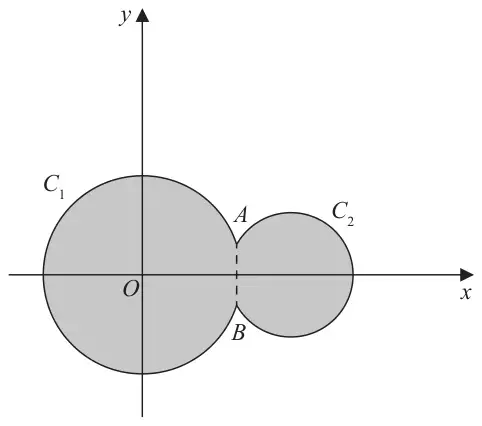
Circle \(C_1\) has equation \(x^2 + y^2 = 100\)
Circle \(C_2\) has equation \((x - 15)^2 + y^2 = 40\)
The circles meet at points \(A\) and \(B\) as shown in Figure 3.
The region shown shaded in Figure 3 is bounded by \(C_1\) and \(C_2\)
| Scheme | Marks | AO |
|---|---|---|
| Solves \(x^2 + y^2 = 100\) and \((x - 15)^2 + y^2 = 40\) simultaneously to find \(x\) or \(y\) E.g. \((x - 15)^2 + 100 - x^2 = 40 \Rightarrow x = \ldots\) | M1 | 3.1a |
| Either \(\Rightarrow -30x + 325 = 40 \Rightarrow x = 9.5\) Or \(y = \dfrac{\sqrt{39}}{2} = \text{awrt } \pm 3.12\) | A1 | 1.1b |
| Attempts to find the angle \(AOB\) in circle \(C_1\) Eg Attempts \(\cos\alpha = \dfrac{\text{``}9.5\text{''}}{10}\) to find \(\alpha\) then \(\times 2\) | M1 | 3.1a |
| Angle \(AOB = 2 \times \arccos\left(\dfrac{9.5}{10}\right) = 0.635\) rads (3sf) * | A1* | 2.1 |
| (4) |
Notes
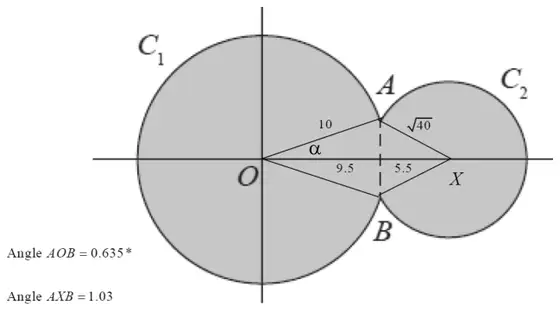
M1: For the key step in an attempt to find either coordinate for where the two circles meet.
Look for an attempt to set up an equation in a single variable leading to a value for \(x\) or \(y\).
A1: \(x = 9.5\) (or \(y = \dfrac{\sqrt{39}}{2} = \text{awrt } \pm 3.12\))
M1: Uses the radius of the circle and correct trigonometry in an attempt to find angle \(AOB\) in circle \(C_1\)
E.g. Attempts \(\cos\alpha = \dfrac{\text{``}9.5\text{''}}{10}\) to find \(\alpha\) then \(\times 2\)
Alternatives include \(\tan\alpha = \dfrac{\sqrt{100 - \left(\text{``}9.5\text{''}\right)^2}}{\text{``}9.5\text{''}} = (0.3286\ldots)\) to find \(\alpha\) then \(\times 2\)
And \(\cos AOB = \dfrac{10^2 + 10^2 - \left(\sqrt{39}\right)^2}{2 \times 10 \times 10} = \dfrac{161}{200}\)
A1*: Correct and careful work in proceeding to the given answer. Condone an answer with greater accuracy.
Condone a solution where the intermediate value has been truncated, provided the trig equation is correct.
E.g. \(\sin\alpha = \dfrac{\sqrt{39}}{20} \Rightarrow \alpha = 0.317 \Rightarrow AOB = 2\alpha = 0.635\)
Condone a solution written down from awrt \(36.4^\circ\) (without the need to shown any calculation.)
Alternative (a)
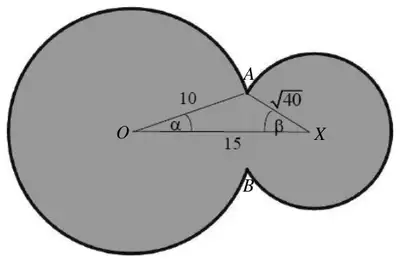
M1: For the key step in attempting to find all lengths in triangle \(OAX\), condoning slips
A1: All three lengths correct
M1: Attempts cosine rule to find \(\alpha\) then \(\times 2\)
A1*: Correct and careful work in proceeding to the given answer
| Scheme | Marks | AO |
|---|---|---|
| Attempts \(10 \times (2\pi - 0.635) = 56.48\) | M1 | 1.1b |
| Attempts to find angle \(AXB\) or \(AXO\) in circle \(C_2\) (see diagram) E.g. \(\cos\beta = \dfrac{15 - \text{``}9.5\text{''}}{\sqrt{40}} \Rightarrow \beta = \ldots\) (Note \(AXB = 1.03\) rads) | M1 | 3.1a |
| Attempts \(10 \times (2\pi - 0.635) + \sqrt{40} \times (2\pi - 2\beta)\) | dM1 | 2.1 |
| \(= 89.7\) | A1 | 1.1b |
| (4) | ||
| (8 marks) |
Notes
M1: Attempts to use the formula \(s = r\theta\) with \(r = 10\) and \(\theta = 2\pi - 0.635\)
The formula may be embedded. You may see \(\underline{2\pi 10} + 2\pi\sqrt{40} \underline{- 10 \times 0.635}\ldots\) which is fine for this M1
M1: Attempts to use a correct method in order to find angle \(AXB\) or \(AXO\) in circle \(C_2\)
Amongst many other methods are \(\tan\beta = \dfrac{\text{``}3.12\text{''}}{15 - 9.5}\) and \(\cos AXB = \dfrac{40 + 40 - \left(\sqrt{39}\right)^2}{2 \times \sqrt{40} \times \sqrt{40}} = \dfrac{41}{80}\)
Note that many candidates believe this to be 0.635. This scores M0 dM0 A0
dM1: A full and complete attempt to find the perimeter of the region.
It is dependent upon having scored both M’s.
A1: awrt 89.7