
June 2022 Paper 1 Q16
16.
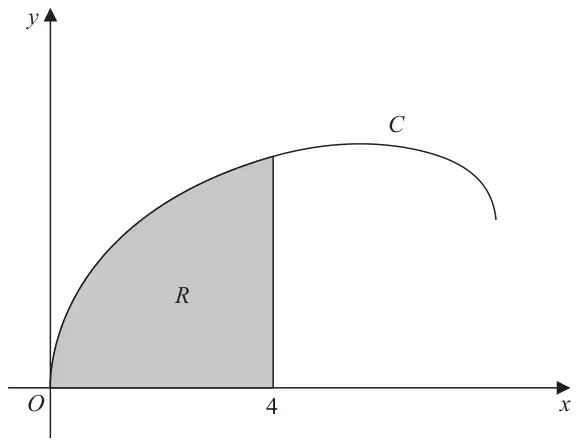
Figure 6 shows a sketch of the curve \(C\) with parametric equations
\[x = 8\sin^2 t \qquad y = 2\sin 2t + 3\sin t \qquad 0 \leqslant t \leqslant \dfrac{\pi}{2}\]The region \(R\), shown shaded in Figure 6, is bounded by \(C\), the \(x\)-axis and the line with equation \(x = 4\)
| Scheme | Marks | AO |
|---|---|---|
| Attempts \(y.\dfrac{\mathrm{d}x}{\mathrm{d}t} = (2\sin 2t + 3\sin t) \times 16\sin t\cos t\) and uses \(\sin 2t = 2\sin t\cos t\) | M1 | 2.1 |
Correct expanded integrand. Usually for one of \((R) = \displaystyle\int 48\sin^2 t\cos t + 16\sin^2 2t\,\mathrm{d}t\) \((R) = \displaystyle\int 48\sin^2 t\cos t + 64\sin^2 t\cos^2 t\,\mathrm{d}t\) \((R) = \displaystyle\int 24\sin 2t\sin t + 16\sin^2 2t\,\mathrm{d}t\) | A1 | 1.1b |
| Attempts to use \(\cos 4t = 1 - 2\sin^2 2t = (1 - 8\sin^2 t\cos^2 t)\) | M1 | 1.1b |
| \(R = \displaystyle\int_0^a 8 - 8\cos 4t + 48\sin^2 t\cos t\,\mathrm{d}t\) * | A1* | 2.1 |
| Deduces \(a = \dfrac{\pi}{4}\) | B1 | 2.2a |
| (5) |
Notes
(a) Condone work in another variable, say \(\theta \leftrightarrow t\) if used consistently for the first 3 marks
M1: For the key step in attempting \(y.\dfrac{\mathrm{d}x}{\mathrm{d}t} = (2\sin 2t + 3\sin t) \times 16\sin t\cos t\) with an attempt to use \(\sin 2t = 2\sin t\cos t\) Condone slips in finding \(\dfrac{\mathrm{d}x}{\mathrm{d}t}\) but it must be of the form \(k\sin t\cos t\)
E.g. I \(y.\dfrac{\mathrm{d}x}{\mathrm{d}t} = (2\sin 2t + 3\sin t) \times k\sin t\cos t = (4\sin t\cos t + 3\sin t) \times k\sin t\cos t\)
E.g. II \(y.\dfrac{\mathrm{d}x}{\mathrm{d}t} = (2\sin 2t + 3\sin t) \times k\sin t\cos t = (2\sin 2t + 3\sin t) \times \dfrac{k}{2}\sin 2t\)
A1: A correct (expanded) integrand in \(t\). Don’t be concerned by the absence of \(\int\) or \(\mathrm{d}t\) or limits
\((R) = \displaystyle\int 48\sin^2 t\cos t + 16\sin^2 2t\,\mathrm{d}t\) or \((R) = \displaystyle\int 48\sin^2 t\cos t + 64\sin^2 t\cos^2 t\,\mathrm{d}t\)
but watch for other correct versions such as \((R) = \displaystyle\int 24\sin 2t\sin t + 16\sin^2 2t\,\mathrm{d}t\)
M1: Attempts to use \(\cos 4t = \pm 1 \pm 2\sin^2 2t\) to get the integrand in the correct form.
If they have the form \(P\sin^2 2t\) it is acceptable to write \(P\sin^2 2t = \dfrac{P}{2}(\pm 1 \pm \cos 4t)\)
If they have the form \(Q\sin^2 t\cos^2 t\) sight and use of \(\sin 2t\) and/or \(\cos 2t\) will usually be seen first.
There are many ways to do this, below is such an example
Allow candidates to start with the given answer and work backwards using the same rules. So expect to see \(\cos 4t = \pm 1 \pm 2 \times \sin^2 2t\) or \(\cos 4t = \pm 2 \times \cos^2 2t \pm 1\) before double angle identities for \(\sin 2t\) or \(\cos 2t\) are used.
A1*: Proceeds to the given answer with correct working. The order of the terms is not important.
Ignore limits for this mark. The integration sign and the \(\mathrm{d}t\) must be seen on their final answer.
If they have worked backwards there must be a concluding statement to the effect that they know that they have shown it. The integration sign and the \(dt\) must also be seen
E.g. Reaches \(\displaystyle\int 48\sin^2 t\cos t + 64\sin^2 t\cos^2 t\,\mathrm{d}t\)
Answer is
\[\begin{aligned} &\int 8 - 8\cos 4t + 48\sin^2 t\cos t\,\mathrm{d}t \\ = &\int 8 - 8(1 - 2\sin^2 2t) + 48\sin^2 t\cos t\,\mathrm{d}t \\ = &\int 16\sin^2 2t + 48\sin^2 t\cos t\,\mathrm{d}t \\ = &\int 64\sin^2 t\cos^2 t + 48\sin^2 t\cos t\,\mathrm{d}t \qquad \text{which is the same, } \checkmark \end{aligned}\]B1: Deduces \(a = \dfrac{\pi}{4}\). It may be awarded from the upper limit and can be awarded from (b)
| Scheme | Marks | AO |
|---|---|---|
| \(\displaystyle\int 8 - 8\cos 4t + 48\sin^2 t\cos t\,\mathrm{d}t = 8t - 2\sin 4t + 16\sin^3 t\) | M1 A1 | 2.1 1.1b |
| \(\left[8t - 2\sin 4t + 16\sin^3 t\right]_0^{\frac{\pi}{4}} = 2\pi + 4\sqrt{2}\) | M1 A1 | 2.1 1.1b |
| (4) | ||
| (9 marks) |
Notes
M1: For the key process in using a correct approach to integrating the trigonometric terms.
May be done separately.
There may be lots of intermediate steps (e.g. let \(u = \sin t\)).
There are other more complicated methods so look carefully at what they are doing.
A1: \(\displaystyle\int 8 - 8\cos 4t + 48\sin^2 t\cos t\,\mathrm{d}t = 8t - 2\sin 4t + 16\sin^3 t\ (+c)\)
If they have written \(16\sin^3 t\) as \(16\sin t^3\) only award if further work implies a correct answer.
Similarly, \(8t\) may be written as \(8x\). Award if further work implies \(8t\), e.g. substituting in their limits.
Do not penalise this sort of slip at all, these are intermediate answers.
M1: Uses the limits their \(a\) and 0 where \(a = \dfrac{\pi}{6},\ \dfrac{\pi}{4}\) or \(\dfrac{\pi}{3}\) in an expression of the form \(kt \pm P\sin 4t \pm Q\sin^3 t\) leading to an exact answer. Ignore evidence at lower limit as terms are 0
A1: CSO \(2\pi + 4\sqrt{2}\) or exact simplified equivalent such as \(2\pi + \dfrac{8}{\sqrt{2}}\) or \(2\pi + \sqrt{32}\).
Be aware that \(\displaystyle\int_0^{\frac{\pi}{4}} 8 - 8\cos 4t + 48\sin^2 t\cos t\,\mathrm{d}t = 8t \underline{+} \lambda\sin 4t + 16\sin^3 t\ (+c)\) would lead to the correct answer but would only score M1 A0 M1 A0