
June 2019 Paper 2 Q2
2. The speed of a small jet aircraft was measured every 5 seconds, starting from the time it turned onto a runway, until the time when it left the ground.
The results are given in the table below with the time in seconds and the speed in \(\mathrm{m\,s^{-1}}\).
| Time (s) | 0 | 5 | 10 | 15 | 20 | 25 |
|---|---|---|---|---|---|---|
| Speed (\(\mathrm{m\,s^{-1}}\)) | 2 | 5 | 10 | 18 | 28 | 42 |
Using all of this information,
Given that the jet accelerated smoothly in these 25 seconds,
| Scheme | Marks | AO | ||||||||||||||
|---|---|---|---|---|---|---|---|---|---|---|---|---|---|---|---|---|
| ||||||||||||||||
| Uses an allowable method to estimate the area under the curve. E.g. Way 1: an attempt at the trapezium rule (see below) Way 2: \(\{s =\}\left(\dfrac{2 + 42}{2}\right)(25)\ \{= 550\}\) Way 3: \(42 = 2 + 25(a) \Rightarrow a = 1.6 \Rightarrow s = 2(25) + (0.5)(1.6)(25)^2\ \{= 550\}\) Way 4: \(\{d =\}(2)(5) + 5(5) + 10(5) + 18(5) + 28(5)\ \{= 63(5) = 315\}\) Way 5: \(\{d =\}\ 5(5) + 10(5) + 18(5) + 28(5) + 42(5)\ \{= 103(5) = 515\}\) Way 6: \(\{d =\}\ \dfrac{315 + 515}{2}\ \{= 415\}\) Way 7: \(\{d =\}\left(\dfrac{2 + 5 + 10 + 18 + 28 + 42}{6}\right)(25)\ \{= 437.5\}\) | M1 | 3.1a | ||||||||||||||
| \(\dfrac{1}{2} \times (5) \times [2 + 2(5 + 10 + 18 + 28) + 42]\) or \(\dfrac{1}{2} \times [\text{``}315\text{''} + \text{``}515\text{''}]\) | M1 | 1.1b | ||||||||||||||
| \(= 415\ \{\text{m}\}\) | A1 | 1.1b | ||||||||||||||
| (3) |
Notes
M1: A low-level problem-solving mark for using an allowable method to estimate the area under the curve. E.g.
- Way 1: See scheme. Allow \(\lambda(2 + 2(5 + 10 + 18 + 28) + 42);\ \lambda \gt 0\) for 1st M1
- Way 2: Uses \(s = \left(\dfrac{u + v}{2}\right)t\) which is equivalent to finding the area of a large trapezium
- Way 3: Complete method using a uniform acceleration equation.
- Way 4: Sums rectangles lying below the curve. Condone a slip on one of the speeds.
- Way 5: Sums rectangles lying above the curve. Condone a slip on one of the speeds.
- Way 6: Average the result of Way 4 and Way 5. Equivalent to Way 1. (corrected from the printed mark scheme: “Way 3 and Way 4”)
- Way 7: Applies (average speed) \(\times\) (time)
M1: Correct trapezium rule method with \(h = 5\). Condone a slip on one of the speeds.
The ‘2’ and ‘42’ should be in the correct place in the [......].
A1: 415
Note: Units do not have to be stated
Note: Give final A0 for giving a final answer with incorrect units.
e.g. give final A0 for 415 km or \(415\ \mathrm{m\,s^{-1}}\)
Note: Only the 1st M1 can only be scored for Way 2, Way 3, Way 4, Way 5 and Way 7 methods
Note: Full marks in part (a) can only be scored by using a Way 1 or a Way 6 method.
Note: Give M0 M0 A0 for \(\{d =\}\ 2(5) + 5(5) + 10(5) + 18(5) + 28(5) + 42(5)\ \{= 105(5) = 525\}\)
(i.e. using too many rectangles)
Note Condone M1 M0 A0 for \(\left[\dfrac{(2+10)}{2}(10) + \dfrac{(10+18)}{2}(5) + \dfrac{(18+28)}{2}(5) + \dfrac{(28+42)}{2}(5)\right] = 395\) m
Note: Give M1 M1 A1 for \(5\left[\dfrac{(2+5)}{2} + \dfrac{(5+10)}{2} + \dfrac{(10+18)}{2} + \dfrac{(18+28)}{2} + \dfrac{(28+42)}{2}\right] = 415\) m
Note: Give M1 M1 A1 for \(\dfrac{5}{2}(2 + 42) + 5(5 + 10 + 18 + 28) = 415\) m
Note: Bracketing mistake:
Unless the final calculated answer implies that the method has been applied correctly
give M1 M0 A0 for \(\dfrac{5}{2}(2) + 2(5 + 10 + 18 + 28) + 42\ \{= 169\}\)
give M1 M0 A0 for \(\dfrac{5}{2}(2 + 42) + 2(5 + 10 + 18 + 28)\ \{= 232\}\)
Note: Give M0 M0 A0 for a Simpson’s Rule Method
| Scheme | Marks | AO |
|---|---|---|
| Alt 1 Uses a Way 1, Way 2, Way 3, Way 5, Way 6 or Way 7 method in (a) Overestimate and a relevant explanation e.g.
| B1ft | 2.4 |
| (1) | ||
| (4 marks) |
Notes
(b) Alt 2
| Scheme | Marks | AO |
|---|---|---|
| Uses a Way 4 method in (a) Underestimate and a relevant explanation e.g.
| B1ft | 2.4 |
| (1) |
Alt 1
B1ft: This mark depends on both an answer to part (a) being obtained and the first M in part (a)
See scheme
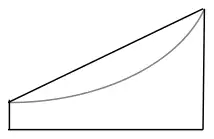
Note: Allow the explanation “curve concaves upwards”
Note: Do not allow explanations such as “curve is concave” or “curve concaves downwards”
Note: Do not allow explanation “gradient of the curve is positive”
Note: Do not allow explanations which refer to “friction” or “air resistance”
Note: The diagram below is sufficient as an explanation. It must show the top of a trapezium lying above the curve.
Alt 2
B1ft: This mark depends on both an answer to part (a) being obtained and the first M in part (a)
See scheme
Note: Do not allow explanations which refer to “friction” or “air-resistance”