
June 2019 Paper 1 Q5
5.
\[\mathrm{f}(x) = 2x^2 + 4x + 9 \qquad x \in \mathbb{R}\]| Scheme | Marks | AO |
|---|---|---|
| \(2x^2 + 4x + 9 = 2(x \pm k)^2 \pm \ldots\) \(a = 2\) | B1 | 1.1b |
| Full method \(2x^2 + 4x + 9 = 2(x+1)^2 \pm \ldots\) \(a = 2\ \&\ b = 1\) | M1 | 1.1b |
| \(2x^2 + 4x + 9 = 2(x+1)^2 + 7\) | A1 | 1.1b |
| (3) |
Notes
B1: Achieves \(2x^2 + 4x + 9 = 2(x \pm k)^2 \pm \ldots\) or states that \(a = 2\)
M1: Deals correctly with first two terms of \(2x^2 + 4x + 9\).
Scored for \(2x^2 + 4x + 9 = 2(x+1)^2 \pm \ldots\) or stating that \(a = 2\) and \(b = 1\)
A1: \(2x^2 + 4x + 9 = 2(x+1)^2 + 7\)
Note that this may be done in a variety of ways including equating \(2x^2 + 4x + 9\) with the expanded form of \(a(x+b)^2 + c \equiv ax^2 + 2abx + ab^2 + c\)
| Scheme | Marks | AO |
|---|---|---|
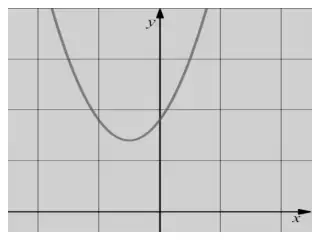 | ||
| U shaped curve any position but not through \((0,0)\) | B1 | 1.2 |
| \(y\)-intercept at \((0,\ 9)\) | B1 | 1.1b |
| Minimum at \((-1,\ 7)\) | B1ft | 2.2a |
| (3) |
Notes
B1: For a U-shaped curve in any position not passing through \((0,0)\). Be tolerant of slips of the pen but do not allow if the curve bends back on itself
B1: A curve with a \(y\)-intercept on the +ve \(y\) axis of 9. The curve cannot just stop at \((0,\ 9)\)
Allow the intercept to be marked 9, \((0,\ 9)\) but not \((9,\ 0)\)
B1ft: For a minimum at \((-1,\ 7)\) in quadrant 2. This may be implied by \(-1\) and 7 marked on the axes in the correct places. The curve must be a U shape and not a cubic say.
Follow through on a minimum at \((-b,\ c)\), marked in the correct quadrant, for their \(a(x+b)^2 + c\)
| Scheme | Marks | AO |
|---|---|---|
| (i) Deduces translation with one correct aspect. | M1 | 3.1a |
| Translate \(\begin{pmatrix} 2 \\ -4 \end{pmatrix}\) | A1 | 2.2a |
| (ii) \(\mathrm{h}(x) = \dfrac{21}{\text{``}2(x+1)^2 + 7\text{''}} \Rightarrow\) (maximum) value \(\dfrac{21}{\text{``}7\text{''}}\ (= 3)\) | M1 | 3.1a |
| \(0 \lt \mathrm{h}(x) \leqslant 3\) | A1ft | 1.1b |
| (4) | ||
| (10 marks) |
Notes
(c)(i)
M1: Deduces translation with one correct aspect or states \(\begin{pmatrix} 2 \\ -4 \end{pmatrix}\) with no reference to ‘translate’.
Allow instead of the word translate, shift or move. \(\mathrm{g}(x) = \mathrm{f}(x-2) - 4\) can score M1
For example, possible methods of arriving at this deduction are:
- \(\mathrm{f}(x) \to \mathrm{g}(x)\) is \(2x^2 + 4x + 9 \to 2(x-2)^2 + 4(x-2) + 5\) So \(\mathrm{g}(x) = \mathrm{f}(x-2) - 4\)
- \(\mathrm{g}(x) = 2(x-1)^2 + 3\) New curve has its minimum at \((1,\ 3)\) so \((-1,\ 7) \to (1,\ 3)\)
- Using a graphical calculator to sketch \(y = \mathrm{g}(x)\) and compares to the sketch of \(y = \mathrm{f}(x)\)
In almost all cases you will not allow if the candidate gives two different types of transformations. Eg, stretch and .....
A1: Requires both ‘translate’ and ‘\(\begin{pmatrix} 2 \\ -4 \end{pmatrix}\)’, Allow ‘shift’ or move’ instead of translate.
So condone " Move shift 2 (units) to the right and move 4 (units) down
However, for M1 A1, it is possible to reflect in \(x = 0\) and translate \(\begin{pmatrix} 0 \\ -4 \end{pmatrix}\), so please consider all responses.
SC: If the candidate writes translate \(\begin{pmatrix} -2 \\ 4 \end{pmatrix}\) or " move 2 (units) to the left and 4 (units) up" score M1 A0
(c)(ii)
M1: Correct attempt at finding the maximum value (although it may not be stated as a maximum)
- Uses part (a) to write \(\mathrm{h}(x) = \dfrac{21}{\text{``}2(x+1)^2 + 7\text{''}}\) and attempts to find \(\dfrac{21}{\text{their }\text{``}7\text{''}}\)
- Attempts to differentiate, sets \(4x + 4 = 0 \to x = -1\) and substitutes into \(\mathrm{h}(x) = \dfrac{21}{2x^2 + 4x + 9}\)
- Uses a graphical calculator to sketch \(y = \mathrm{h}(x)\) and establishes the ‘maximum’ value \((\ldots,\ 3)\)
A1ft: \(0 \lt \mathrm{h}(x) \leqslant 3\) Allow for \(0 \lt \mathrm{h} \leqslant 3\) \((0,\ 3]\) and \(0 \lt y \leqslant 3\) but not \(0 \lt x \leqslant 3\)
Follow through on their \(a(x+b)^2 + c\) so award for \(0 \lt \mathrm{h}(x) \leqslant \dfrac{21}{c}\)