
June 2018 Paper 2 Q3
3.
Disprove this statement by means of a counter example. (2)
| Scheme | Marks | AO |
|---|---|---|
| E.g. \(m = \sqrt{3},\ n = \sqrt{12}\) | M1 | 1.1b |
| \(\{mn =\}\ \left(\sqrt{3}\right)\left(\sqrt{12}\right) = 6\) \(\Rightarrow\) statement untrue or 6 is not irrational or 6 is rational | A1 | 2.4 |
| (2) |
Notes
M1: States or uses any pair of different numbers that will disprove the statement.
E.g. \(\sqrt{3}, \sqrt{12}\,;\ \sqrt{2}, \sqrt{8}\,;\ \sqrt{5}, -\sqrt{5}\,;\ \dfrac{1}{\pi}, 2\pi;\ 3\mathrm{e}, \dfrac{4}{5\mathrm{e}};\)
A1: Uses correct reasoning to disprove the given statement, with a correct conclusion
Note: Writing \((3\mathrm{e})\left(\dfrac{4}{5\mathrm{e}}\right) = \dfrac{12}{5} \Rightarrow\) untrue is sufficient for M1A1
| Scheme | Marks | AO |
|---|---|---|
(b)(i), (ii) Way 1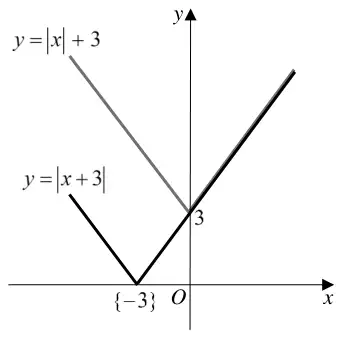 | B1 | 1.1b |
| Superimposes the graph of \(y = |x + 3|\) on top of the graph of \(y = |x| + 3\) | M1 | 3.1a |
| the graph of \(y = |x| + 3\) is either the same or above the graph of \(y = |x + 3|\) {for corresponding values of \(x\)} or when \(x \geqslant 0\), both graphs are equal (or the same) when \(x \lt 0\), the graph of \(y = |x| + 3\) is above the graph of \(y = |x + 3|\) | A1 | 2.4 |
| (3) | ||
| (5 marks) |
Notes
(b)(ii) Way 2
| Scheme | Marks | AO |
|---|---|---|
| Reason 1 When \(x \geqslant 0,\ |x| + 3 = |x + 3|\) Reason 2 When \(x \lt 0,\ |x| + 3 \gt |x + 3|\) | ||
| Any one of Reason 1 or Reason 2 | M1 | 3.1a |
| Both Reason 1 and Reason 2 | A1 | 2.4 |
(b)(ii) Way 3
| Scheme | Marks | AO |
|---|---|---|
| For \(x \gt 0,\ |x| + 3 = |x + 3|\) For \(-3 \lt x \lt 0\), as \(|x| + 3 \gt 3\) and \(\{0 \lt\}\ |x + 3| \lt 3\), then \(|x| + 3 \gt |x + 3|\) | M1 | 3.1a |
| For \(x \leqslant -3\), as \(|x| + 3 = -x + 3\) and \(|x + 3| = -x - 3\), then \(|x| + 3 \gt |x + 3|\) | A1 | 2.4 |
(b)(i) B1: See scheme
(b)(ii) M1: For constructing a method of comparing \(|x| + 3\) with \(|x + 3|\). See scheme.
A1: Explains fully why \(|x| + 3 \geqslant |x + 3|\). See scheme.
Note: Do not allow either \(x \gt 0,\ |x| + 3 \geqslant |x + 3|\) or \(x \geqslant 0,\ |x| + 3 \geqslant |x + 3|\) as a valid reason
Note: \(x = 0\) (or where necessary \(x = -3\)) need to be considered in their solutions for A1
Note: Do not allow an incorrect statement such as \(x \leqslant 0,\ |x| + 3 \gt |x + 3|\) for A1
Note: Allow M1A1 for \(x \gt 0,\ |x| + 3 = |x + 3|\) and for \(x \leqslant 0,\ |x| + 3 \geqslant |x + 3|\)
Note: Allow M1 for any of
- \(x\) is positive, \(|x| + 3 = |x + 3|\)
- \(x\) is negative, \(|x| + 3 \gt |x + 3|\)
- \(x \gt 0,\ |x| + 3 = |x + 3|\)
- \(x \leqslant 0,\ |x| + 3 \geqslant |x + 3|\)
- \(x \gt 0,\ |x| + 3\) and \(|x + 3|\) are equal
- \(x \geqslant 0,\ |x| + 3\) and \(|x + 3|\) are equal
- when \(x \geqslant 0\), both graphs are equal
- for positive values \(|x| + 3\) and \(|x + 3|\) are the same
Condone for M1
- \(x \leqslant 0,\ |x| + 3 \gt |x + 3|\)
- \(x \lt 0,\ |x| + 3 \geqslant |x + 3|\)