
June 2018 Paper 3 Q9
9.
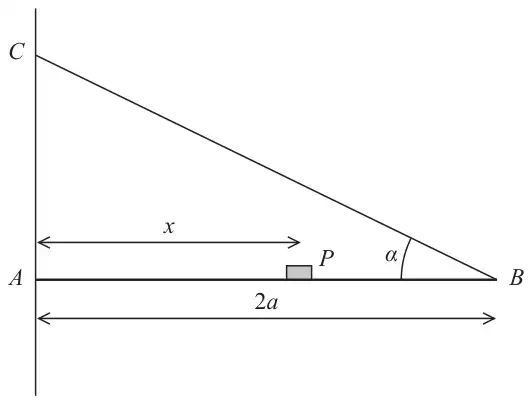
A plank, \(AB\), of mass \(M\) and length \(2a\), rests with its end \(A\) against a rough vertical wall. The plank is held in a horizontal position by a rope. One end of the rope is attached to the plank at \(B\) and the other end is attached to the wall at the point \(C\), which is vertically above \(A\).
A small block of mass \(3M\) is placed on the plank at the point \(P\), where \(AP = x\).
The plank is in equilibrium in a vertical plane which is perpendicular to the wall.
The angle between the rope and the plank is \(\alpha\), where \(\tan\alpha = \dfrac{3}{4}\), as shown in Figure 3.
The plank is modelled as a uniform rod, the block is modelled as a particle and the rope is modelled as a light inextensible string.
The magnitude of the horizontal component of the force exerted on the plank at \(A\) by the wall is \(2Mg\).
The force exerted on the plank at \(A\) by the wall acts in a direction which makes an angle \(\beta\) with the horizontal.
The rope will break if the tension in it exceeds \(5Mg\).
| Scheme | Marks | AO |
|---|---|---|
| Moments about \(A\) (or any other complete method) | M1 | 3.3 |
| \(T2a\sin\alpha = Mga + 3Mgx\) | A1 | 1.1b |
| \(T = \dfrac{Mg(a + 3x)}{2a \times \frac{3}{5}} = \dfrac{5Mg(3x + a)}{6a}\) * GIVEN ANSWER | A1* | 2.1 |
| (3) |
Notes
M1: Using M(\(A\)), with usual rules, or any other complete method to obtain an equation in \(a\), \(M\), \(x\) and \(T\) only.
A1: Correct equation
A1*: Correct PRINTED ANSWER, correctly obtained, need to see \(\sin\alpha = \dfrac{3}{5}\) used.
| Scheme | Marks | AO |
|---|---|---|
| \(\dfrac{5Mg(3x + a)}{6a}\cos\alpha = 2Mg\) OR \(2Mg.2a\tan\alpha = Mga + 3Mgx\) | M1 | 3.1b |
| \(x = \dfrac{2a}{3}\) | A1 | 2.2a |
| (2) |
Notes
M1: Using an appropriate strategy to find \(x\). e.g. Resolve horizontally with usual rules applying OR Moments about \(C\). Must use the given expression for \(T\).
A1: Accept \(0.67a\) or better
| Scheme | Marks | AO |
|---|---|---|
| Resolve vertically OR Moments about \(B\) | M1 | 3.1b |
| \(Y = 3Mg + Mg - \dfrac{5Mg\left(3.\frac{2a}{3} + a\right)}{6a}\sin\alpha\) OR \(2aY = Mga + 3Mg\left(2a - \frac{2a}{3}\right)\) Or: \(Y = 3Mg + Mg - \left(\dfrac{2Mg}{\cos\alpha}\right)\sin\alpha\) | A1ft | 1.1b |
| \(Y = \dfrac{5Mg}{2}\) N.B. May use \(R\sin\beta\) for \(Y\) and/or \(R\cos\beta\) for \(X\) throughout | A1 | 1.1b |
| \(\tan\beta = \dfrac{Y}{X}\) or \(\dfrac{R\sin\beta}{R\cos\beta} = \dfrac{\frac{5Mg}{2}}{2Mg}\) | M1 | 3.4 |
| \(= \dfrac{5}{4}\) | A1 | 2.2a |
| (5) |
Notes
M1: Using a complete method to find \(Y\) (or \(R\sin\beta\)) e.g. resolve vertically or Moments about \(B\), with usual rules
A1 ft: Correct equation with their \(x\) substituted in \(T\) expression or using \(T = \dfrac{2Mg}{\cos\alpha}\)
A1: \(Y\) (or \(R\sin\beta\)) \(= \dfrac{5Mg}{2}\) or \(2.5Mg\) or \(2.50Mg\)
M1: For finding an equation in \(\tan\beta\) only using \(\tan\beta = \dfrac{Y}{X}\) or \(\tan\beta = \dfrac{X}{Y}\)
This is independent but must have found a \(Y\).
A1: Accept \(\dfrac{-5}{4}\) if it follows from their working.
| Scheme | Marks | AO |
|---|---|---|
| \(\dfrac{5Mg(3x + a)}{6a} \leqslant 5Mg\) and solve for \(x\) | M1 | 2.4 |
| \(x \leqslant \dfrac{5a}{3}\) | A1 | 2.4 |
| For rope not to break, block can’t be more than \(\dfrac{5a}{3}\) from \(A\) oe Or just: \(x \leqslant \dfrac{5a}{3}\), if no incorrect statement seen. N.B. If the correct inequality is not found, their comment must mention ‘distance from \(A\)’. | B1 A1 | 2.4 |
| (3) | ||
| (13 marks) |
Notes
M1: Allow \(T = 5Mg\) or \(T \lt 5Mg\) and solves for \(x\), showing all necessary steps (M0 for \(T \gt 5Mg\))
A1: Allow \(x = \dfrac{5a}{3}\) or \(x \lt \dfrac{5a}{3}\). Accept \(1.7a\) or better.
B1: Treat as A1. For any appropriate equivalent fully correct comment or statement. E.g. maximum value of \(x\) is \(\dfrac{5a}{3}\)