17 The table shows information about the heights of 60 athletes.
Height, \(h\) (cm)
Frequency
\(150 \lt h \leqslant 160\)
4
\(160 \lt h \leqslant 170\)
12
\(170 \lt h \leqslant 180\)
35
\(180 \lt h \leqslant 190\)
7
\(190 \lt h \leqslant 200\)
2
(a) Complete the cumulative frequency table. [1 mark]
Height, \(h\) (cm)
Cumulative frequency
\(h \leqslant 150\)
0
\(h \leqslant 160\)
4
\(h \leqslant 170\)
16
\(h \leqslant 180\)
\(h \leqslant 190\)
\(h \leqslant 200\)
(b) Circle the class interval that contains the lower quartile. [1 mark]
\(150 \lt h \leqslant 160\)
\(160 \lt h \leqslant 170\)
\(170 \lt h \leqslant 180\)
\(180 \lt h \leqslant 190\)
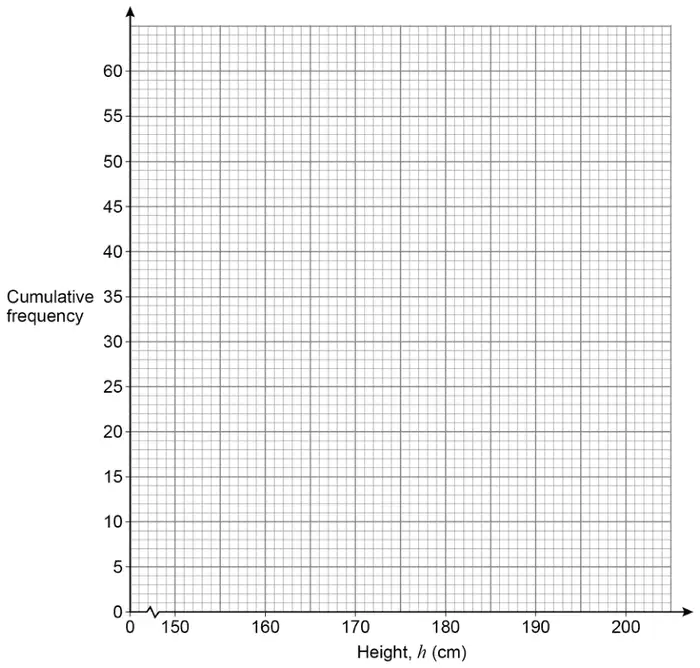
(c) Draw a cumulative frequency diagram to represent the data. [2 marks]
(d) Estimate the number of the athletes whose height is more than 176 cm [2 marks]
Mark scheme (a)
Answer
Mark
Comments
51, 58 and 60
B1
Mark scheme (b)
Answer
Mark
Comments
\(160 \lt h \leqslant 170\)
B1
Mark scheme (c)
Answer
Mark
Comments
Points plotted with upper class boundaries and cf values condone (150, 0) omitted or incorrectly plotted for this mark only
B1ft
\(\pm\dfrac{1}{2}\) square ft their cumulative frequencies, which must be increasing ignore bars drawn if points clearly plotted
Smooth curve or polygon
B1ft
ft their 5 or 6 points (point with cf 0 may be omitted) must be increasing and not a single straight line
Additional guidance
For the second mark, the points must be evenly spaced accept an omission of the point with cf 0, but do not accept an incorrect starting point for the pattern of their points accept a horizontal line drawn from their final point, but do not accept a continuation of the curve or polygon
Points plotted at lower class boundaries or midpoints, but with correct smooth curve or polygon for their points
B0B1
Bars drawn with correct curve
B1B1
Bars drawn without curve but with correct points clearly plotted
B1B0
Bars drawn without correct curve or correct points plotted
B0B0
Mark scheme (d)
Answer
Mark
Comments
Alternative method 1
Vertical line drawn from 176 to curve or polygon
M1
implied by correct reading for their increasing curve or polygon or mark at correct place on their increasing curve or polygon or on the vertical axis \(\pm\dfrac{1}{2}\) square
Correct value for \(60 -\) their reading or correct value for their \(60 -\) their reading
A1ft
ft their increasing curve or polygon answer must be an integer their 60 must be from an increasing curve or polygon
Alternative method 2
\(2 + 7 + \dfrac{4}{10} \times 35\) or \(2 + 7 + 14\) or \(4 + 12 + \dfrac{6}{10} \times 35\) or \(4 + 12 + 21\) or 37
M1
23
A1
Additional guidance
In alternative method 1 condone the curve or polygon drawn only for the required section (170 – 180) as long as the cumulative frequencies are increasing throughout
Answer 23 not from alternative method 2 must match their graph