(a) The equation\[x^3 = \mathrm{e}^{6 - 2x}\]has a single solution, \(x = \alpha\)
By considering a suitable change of sign, show that \(\alpha\) lies between 0 and 4 [2 marks]
(b) Show that the equation \(x^3 = \mathrm{e}^{6 - 2x}\) can be rearranged to give\[x = 3 - \frac{3}{2}\ln x\] [3 marks]
(c)
(i) Use the iterative formula\[x_{n+1} = 3 - \frac{3}{2}\ln x_n\]with \(x_1 = 4\), to find \(x_2\), \(x_3\) and \(x_4\)
Give your answers to three decimal places. [2 marks]
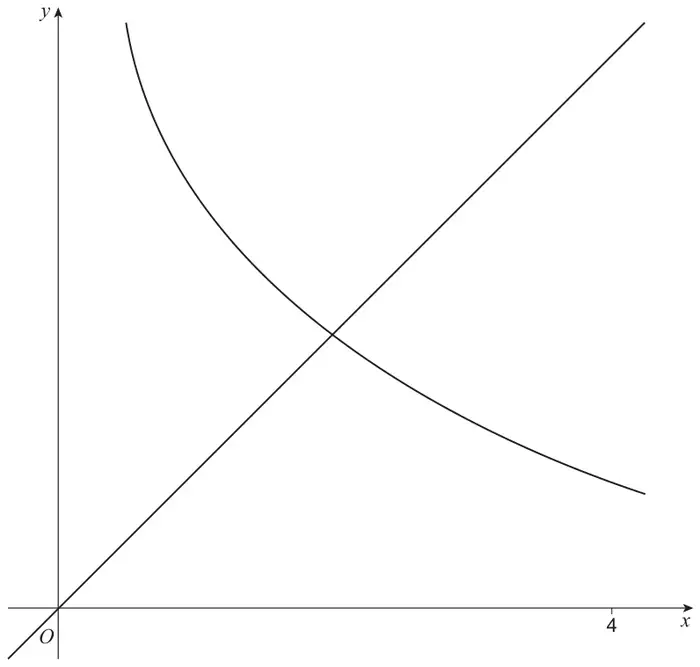
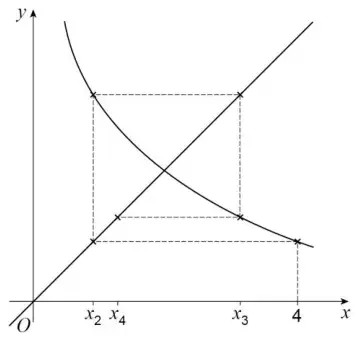
(ii)Figure 1 below shows a sketch of parts of the graphs of\[y = 3 - \frac{3}{2}\ln x \text{ and } y = x\]On Figure 1, draw a staircase or cobweb diagram to show how convergence takes place.
Label, on the \(x\)-axis, the positions of \(x_2\), \(x_3\) and \(x_4\) [2 marks]
Figure 1
(iii) Explain why the iterative formula\[x_{n+1} = 3 - \frac{3}{2}\ln x_n\]fails to converge to \(\alpha\) when the starting value is \(x_1 = 0\) [1 mark]
Mark scheme (a)
Scheme
Marks
AO
Rearranges the given equation to equal zero and evaluates their non-zero expression in the interval [0,4] at least once. Must have equated to zero.
M1
1.1a
Completes argument with two correct evaluations of their correct expression in the interval [0,4] either side of the solution, with comparison to zero or a comment about change of sign.
AND concludes that the solution \(\alpha\) lies between 0 and 4
Evaluations must be correct to at least two significant figures rounded or truncated. Accept exact evaluation at \(x = 0\).
(i) Obtains any correct value to at least 3 decimal places, ignoring labels.
M1
1.1a
Obtains \(x_2\), \(x_3\) and \(x_4\) correct to at least 3 decimal places If no labels only accept the three correct answers in the correct order with no extras seen beyond \(x_4\) \(x_2 = 0.92055\ldots\) \(x_3 = 3.12416\ldots\) \(x_4 = 1.29125\ldots\)
A1
1.1b
(2)
(ii) Draws correct cobweb diagram Condone missing vertical line at \(x = 4\)
M1
1.1a
Shows positions of \(x_2\), \(x_3\) and \(x_4\) on the \(x\)-axis Accept correct values in place of \(x_n\) AWRT 0.92, 3.12 and 1.29 Do not accept labels on \(y = x\) without indication on \(x\)-axis
A1
1.1b
(2)
(iii) Explains that (it is not possible to evaluate \(x_2\) as) ln 0 has no value or that \(y\) is undefined OE
E1
2.4
(1)
(10 marks)
Typical solution
(i)
\[x_2 = 0.921\]\[x_3 = 3.124\]\[x_4 = 1.291\]
(ii)
(iii)
It is not possible to evaluate \(x_2\) as ln 0 has no value