
June 2021 Paper 2 Q9
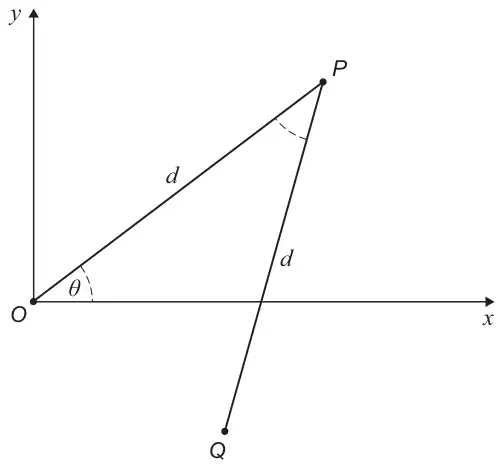
9 A robotic arm which is attached to a flat surface at the origin O, is used to draw a graphic design.
The arm is made from two rods OP and PQ, each of length \(d\), which are joined at P.
A pen is attached to the arm at Q.
The coordinates of the pen are controlled by adjusting the angle OPQ and the angle \(\theta\) between OP and the \(x\)-axis.
For this particular design the pen is made to move so that the two angles are always equal to each other with \(0 \leqslant \theta \leqslant \dfrac{\pi}{2}\) as shown in Figure 2.
[2 marks]
[2 marks]
State the greatest possible value of \(x\) and the corresponding value of \(\cos\theta\) [2 marks]
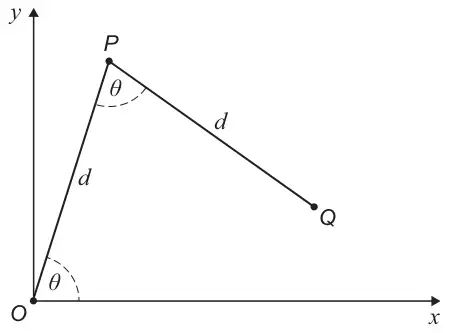
Find, in terms of \(d\), the exact distance OQ. [3 marks]
| Scheme | Marks | AO |
|---|---|---|
| Begins to find the required horizontal distance by considering an appropriate horizontal distance in a right-angled triangle For example: \(d\cos\theta\), \(d\cos 2\theta\) or \(d\sin\left(\frac{\pi}{2} - 2\theta\right)\) Award for correctly identifying at least one of the horizontal components required. This can be done on a sketch or by clearly stating which distance they are referring to | M1 | 3.3 |
| Completes correct manipulation to show required result AG | R1 | 2.1 |
| (2) |
Typical solution
\(QP\) makes angle of \(2\theta\) with horizontal
\[x = d\cos\theta - d\cos 2\theta\]\[x = d\cos\theta - d\sin\left(\frac{\pi}{2} - 2\theta\right)\]\[x = d\left(\cos\theta + \sin\left(2\theta - \frac{\pi}{2}\right)\right)\]| Scheme | Marks | AO |
|---|---|---|
| Uses a compound angle formula and expands \(\sin\left(2\theta - \frac{\pi}{2}\right)\) or Uses complementary angles to obtain the formula without \(\frac{\pi}{2}\) or States \(x = d(\cos\theta - \cos 2\theta)\) | M1 | 3.1a |
| Uses \(\cos 2\theta = 2\cos^2\theta - 1\) to show the required result AG | R1 | 2.1 |
| (2) |
Typical solution
\[x = d\left(\cos\theta + \sin\left(2\theta - \frac{\pi}{2}\right)\right)\]\[x = d(\cos\theta - \cos 2\theta)\]\[x = d\left(\cos\theta - \left(2\cos^2\theta - 1\right)\right)\]\[x = d\left(1 + \cos\theta - 2\cos^2\theta\right)\]| Scheme | Marks | AO |
|---|---|---|
| States greatest value = \(\frac{9d}{8}\) | B1 | 1.1b |
| States \(\cos\theta = \frac{1}{4}\) | B1 | 1.1b |
| (2) |
Typical solution
Greatest value = \(\dfrac{9d}{8}\)
\[\cos\theta = \frac{1}{4}\]| Scheme | Marks | AO |
|---|---|---|
| Begins to find OQ by either using the cosine rule or the sine rule with \(d\) and \(\theta\) Accept either \(OQ^2 = d^2 + d^2 - 2d^2\cos\theta\) or \(\dfrac{OQ}{\sin\theta} = \dfrac{d}{\sin\alpha}\) Note \(\alpha = \frac{\pi - \theta}{2}\) | M1 | 3.1a |
| Substitutes their exact value for \(\cos\theta\) into the cosine rule or Finds and substitutes their corresponding exact values for \(\sin\theta\) and \(\cos\frac{\theta}{2}\) into the sine rule Note When \(\cos\theta = \frac{1}{4}\), \(\sin\theta = \frac{\sqrt{15}}{4}\) and \(\cos\frac{\theta}{2} = \sqrt{\frac{5}{8}}\), | M1 | 1.1a |
| Obtains the correct exact value of \(OQ\) ACF | A1 | 1.1b |
| (3) | ||
| (9 marks) |