
June 2021 Paper 1 Q14
14 The curve \(C\) is defined for \(t \geqslant 0\) by the parametric equations
\[x = t^2 + t \quad \text{and} \quad y = 4t^2 - t^3\]\(C\) is shown in the diagram below.
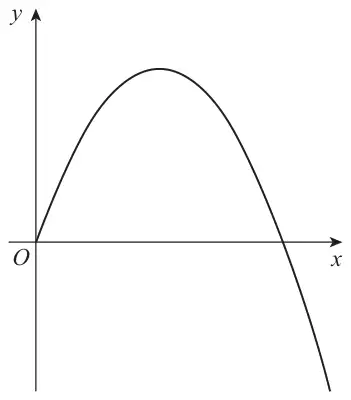
(a) Find the gradient of \(C\) at the point where it intersects the positive \(x\)-axis. [5 marks]
(b)
(i) The area \(A\) enclosed between \(C\) and the \(x\)-axis is given by\[A = \int_0^b y \,\mathrm{d}x\]
Find the value of \(b\). [1 mark]
(ii) Use the substitution \(y = 4t^2 - t^3\) to show that\[A = \int_0^4 \left(4t^2 + 7t^3 - 2t^4\right) \mathrm{d}t\]
[3 marks]
(iii) Find the value of \(A\). [1 mark]
| Scheme | Marks | AO |
|---|---|---|
| Uses \(y = 0\) to obtain a non-zero value of \(t\) | M1 | 3.1a |
| Obtains \(\dfrac{\mathrm{d}y}{\mathrm{d}t} = 8t - 3t^2\) or \(\dfrac{\mathrm{d}y}{\mathrm{d}t} = -16\) | B1 | 1.1b |
| Obtains \(\dfrac{\mathrm{d}x}{\mathrm{d}t} = 2t + 1\) or \(\dfrac{\mathrm{d}x}{\mathrm{d}t} = 9\) | B1 | 1.1b |
| Uses their \(\dfrac{\mathrm{d}y}{\mathrm{d}t} \div\) their \(\dfrac{\mathrm{d}x}{\mathrm{d}t} = \dfrac{\mathrm{d}y}{\mathrm{d}x}\) and their non-zero value of \(t\) to find a numerical expression or value for \(\dfrac{\mathrm{d}y}{\mathrm{d}x}\) | M1 | 3.1a |
| Obtains \(-\dfrac{16}{9}\) OE | A1 | 1.1b |
| (5) |
Typical solution
\[y = 0 \Rightarrow 4t^2 - t^3 = 0\]\[t = 0 \text{ or } 4\]\[\frac{\mathrm{d}y}{\mathrm{d}t} = 8t - 3t^2\]\[\frac{\mathrm{d}x}{\mathrm{d}t} = 2t + 1\]\[t = 4 \Rightarrow \frac{\mathrm{d}y}{\mathrm{d}x} = -\frac{16}{9}\]| Scheme | Marks | AO |
|---|---|---|
| (i) Deduces \(b = 20\) (FT \(t^2 + t\) for their value of \(t\)) | B1F | 2.2a |
| (1) | ||
| (ii) Substitutes their \(\mathrm{d}x = (2t + 1)\,\mathrm{d}t\) | M1 | 3.1a |
| Completes correct substitution for \(y\) and \(\mathrm{d}x\) Condone incorrect or omission of limits. | A1F | 1.1b |
| Completes rigorous argument, to show given result. t = 4 when x = 20 must be justified either here or in part (b)(i) | R1 | 2.1 |
| (3) | ||
| (iii) Evaluates \(A = 1856/15\) or AWRT 124 | B1 | 1.1b |
| (1) | ||
| (10 marks) |
Typical solution
(i)
\(b = 20\)
(ii)
\[\frac{\mathrm{d}x}{\mathrm{d}t} = 2t + 1 \Rightarrow \mathrm{d}x = (2t + 1)\,\mathrm{d}t\]\[A = \int_0^{20} y \,\mathrm{d}x\]\[= \int_0^4 \left(4t^2 - t^3\right)(2t + 1)\,\mathrm{d}t\]\[= \int_0^4 8t^3 + 4t^2 - 2t^4 - t^3 \,\mathrm{d}t\]\[= \int_0^4 4t^2 + 7t^3 - 2t^4 \,\mathrm{d}t\](iii)
\[A = \frac{1856}{15}\]