
June 2020 Paper 1 Q15
15 The region enclosed between the curves \(y = \mathrm{e}^x\), \(y = 6 - \mathrm{e}^{\frac{x}{2}}\) and the line \(x = 0\) is shown shaded in the diagram below.
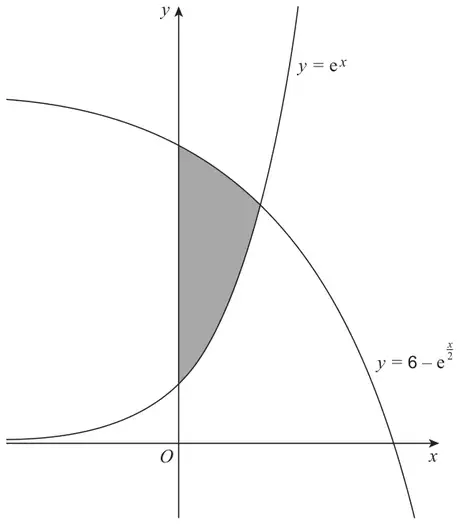
Show that the exact area of the shaded region is
\[6\ln 4 - 5\]Fully justify your answer. [10 marks]
| Scheme | Marks | AO |
|---|---|---|
| Forms a single equation eliminating \(x\) or \(y\) | M1 | 3.1a |
| Obtains a correct rearranged quadratic equation. Either \(e^x + e^{\frac{x}{2}} - 6 = 0\) or \(\left(e^{\frac{x}{2}} + 3\right)\left(e^{\frac{x}{2}} - 2\right) = 0\) or \(e^x + e^{\frac{x}{2}} + \frac{1}{4} = \frac{25}{4}\) OE | A1 | 1.1b |
| Solves ‘their’ quadratic Must be a quadratic in \(e^{\frac{x}{2}}\) or If squaring is used then it must be a quadratic in \(e^x\) or Obtains \(x = 1.386\) | M1 | 1.1a |
| Explains that \(e^{\frac{x}{2}} = -3\) is not valid as \(e^{\frac{x}{2}} \gt 0\) or If squaring is used they must clearly check both solutions by substituting and conclude that \(\ln 9\) is not valid OE | E1F | 2.4 |
| Obtains \(x = 2\ln 2\) or \(x = \ln 4\) | A1 | 1.1b |
| Forms any definite integral which would contribute to finding the required area This could be \(\displaystyle\int_0^{\ln 4} \left(6 - e^{\frac{x}{2}} - e^x\right) dx\) or \(\displaystyle\int_0^{\ln 4} \left(6 - e^{\frac{x}{2}}\right) dx\) or \(\displaystyle\int_0^{\ln 4} e^x\,dx\) or \(\displaystyle\int_0^{\ln 4} \left(e^x + e^{\frac{x}{2}} - 6\right) dx\) Follow through ‘their’ value of \(x\) for the upper limit | M1 | 1.1a |
| Forms a fully correct definite integral (or integrals) which would lead to evaluating the correct area Follow through ‘their’ incorrect upper limit | A1F | 3.1a |
| Integrates ‘their’ expressions involving exponentials fully correctly Follow through their exponential expressions – but must have integrated both \(e^x\) and \(e^{\frac{x}{2}}\) terms Condone missing/incorrect limits | B1F | 1.1b |
| Substitutes 0 and ‘their’ upper limits into ‘their’ integrated expression Must correctly use F (their upper limit) – F (0) for each integral | M1 | 1.1a |
| Completes rigorous argument by showing explicit evaluation of exponential terms before obtaining final answer AG This mark can be achieved without achieving the E1 mark | R1 | 2.1 |
| (10 marks) |
Typical solution
\[6 - e^{\frac{x}{2}} = e^x\]\[e^x + e^{\frac{x}{2}} - 6 = 0\]\[\left(e^{\frac{x}{2}} + 3\right)\left(e^{\frac{x}{2}} - 2\right) = 0\]\[e^{\frac{x}{2}} = -3 \text{ or } 2\]\(e^{\frac{x}{2}} \gt 0\) so \(-3\) is not a valid solution
\[\frac{x}{2} = \ln 2\]\[x = 2\ln 2 = \ln 4\]\[\int_0^{\ln 4} \left(6 - e^{\frac{x}{2}} - e^x\right) dx\]\[= \left[6x - 2e^{\frac{x}{2}} - e^x\right]_0^{\ln 4}\]\[= \left(6\ln 4 - 2e^{\frac{\ln 4}{2}} - e^{\ln 4}\right) - (-2 - 1)\]\[= 6\ln 4 - 4 - 4 + 3\]\[= 6\ln 4 - 5\]