
June 2019 Paper 2 Q7
7
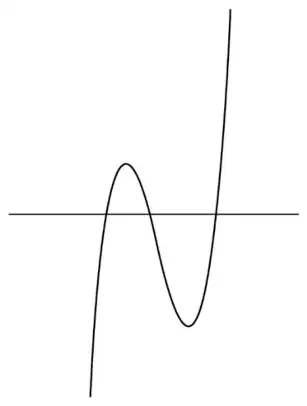
(a) Sketch the graph of any cubic function that has both three distinct real roots and a positive coefficient of \(x^3\) [2 marks]
(b) The function \(\mathrm{f}(x)\) is defined by\[\mathrm{f}(x) = x^3 + 3px^2 + q\]where \(p\) and \(q\) are constants and \(p \gt 0\)
(i) Show that there is a turning point where the curve crosses the \(y\)-axis. [3 marks]
(ii) The equation \(\mathrm{f}(x) = 0\) has three distinct real roots.
By considering the positions of the turning points find, in terms of \(p\), the range of possible values of \(q\). [5 marks]
| Scheme | Marks | AO |
|---|---|---|
| Sketches any cubic graph, crossing the \(x\)-axis in three places | B1 | 1.2 |
| Sketches any cubic graph with a positive coefficient of \(x^3\) | B1 | 1.2 |
Typical solution
| Scheme | Marks | AO |
|---|---|---|
| (i) Differentiates to obtain \(\mathrm{f}'(x)\) Two terms with at least one correct - either \(3x^2\) or \(6px\) | M1 | 1.1a |
| Solves \(3x^2 + 6px = 0\) to obtain \(x = 0\) or \(x = -2p\) or Substitutes \(x = 0\) in \(\mathrm{f}'(x) = 3x^2 + 6px\) and obtains 0 | A1 | 1.1b |
| Obtains the correct two roots \(x = 0\) and \(x = -2p\) OE and states why there must be a turning point referring to root \(x = 0\) | R1 | 2.4 |
| (ii) Deduces that turning point at \(x = -2p\) is a maximum or deduces that turning point \(x = 0\) is a minimum May have been seen in part (b)(i) Accept a sketch showing correct relative positions of turning points | B1 | 2.2a |
| Substitutes their \(x = -2p\) into \(\mathrm{f}(x)\) | M1 | 1.1a |
| Obtains correct \(\mathrm{f}(0) = q\) and \(\mathrm{f}(-2p) = 4p^3 + q\) | A1 | 1.1b |
| Deduces either \(q \lt 0\) or \(-4p^3 \lt q\) Condone \(\leqslant\) | R1 | 2.2a |
| Deduces \(-4p^3 \lt q \lt 0\) CAO | R1 | 2.2a |
| (10 marks) |
Typical solution
(i)
For a turning point \(\mathrm{f}'(x) = 0\)
\[\mathrm{f}(x) = x^3 + 3px^2 + q\]\[\mathrm{f}'(x) = 3x^2 + 6px\]\[3x^2 + 6px = 0\]\[3x\left(x + 2p\right) = 0\]\[x = 0\]\[x = -2p\]Since one of the roots is \(x = 0\) there must be a turning point on the y axis
(ii)
Since \(p \gt 0\)
\(x = -2p\) is the maximum
\(x = 0\) is the minimum
\[\mathrm{f}(0) = q\]\[\mathrm{f}(-2p) = (-2p)^3 + 3p(-2p)^2 + q\]\[= 4p^3 + q\]\[-4p^3 \lt q \lt 0\]