(a) \(y = \mathrm{e}^{-x}\left(\sin x + \cos x\right)\)
Find \(\dfrac{\mathrm{d}y}{\mathrm{d}x}\)
Simplify your answer. [3 marks]
(b) Hence, show that\[\int \mathrm{e}^{-x}\sin x\,\mathrm{d}x = a\mathrm{e}^{-x}\left(\sin x + \cos x\right) + c\]where \(a\) is a rational number. [2 marks]
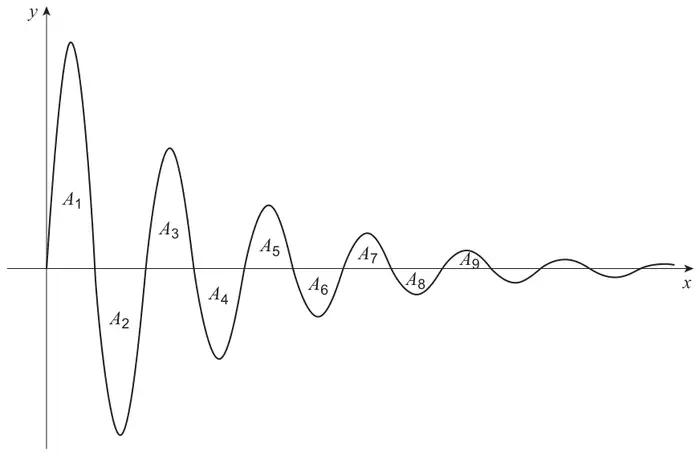
(c) A sketch of the graph of \(y = \mathrm{e}^{-x}\sin x\) for \(x \geqslant 0\) is shown below.
The areas of the finite regions bounded by the curve and the \(x\)-axis are denoted by \(A_1, A_2, \ldots, A_n, \ldots\)
(i) Find the exact value of the area \(A_1\) [3 marks]
(ii) Show that\[\frac{A_2}{A_1} = \mathrm{e}^{-\pi}\] [4 marks]
(iii) Given that\[\frac{A_{n+1}}{A_n} = \mathrm{e}^{-\pi}\]show that the exact value of the total area enclosed between the curve and the \(x\)-axis is\[\frac{1 + \mathrm{e}^{\pi}}{2\left(\mathrm{e}^{\pi} - 1\right)}\] [4 marks]
Mark scheme (a)
Scheme
Marks
AO
Chooses an appropriate technique to differentiate accept any evidence of product rule or quotient rule
M1
3.1a
Differentiates fully correctly
A1
1.1b
Obtains fully correct simplified answer.
A1
1.1b
Typical solution
\[\frac{\mathrm{d}y}{\mathrm{d}x} = -\mathrm{e}^{-x}\left(\sin x + \cos x\right) + \mathrm{e}^{-x}\left(\cos x - \sin x\right)\]\[= -2\mathrm{e}^{-x}\sin x\]
Mark scheme (b)
Scheme
Marks
AO
Uses their result from (a) in the form of \(B\mathrm{e}^{-x}\sin x\) showing an understanding of the fundamental theorem of calculus Condone missing constant.
M1
3.1a
Obtains \(\dfrac{1}{B}\mathrm{e}^{-x}\left(\sin x + \cos x\right)\)
(i) Writes the area as \(\dfrac{1}{B}\left[\mathrm{e}^{-x}\left(\sin x + \cos x\right)\right]_0^{\pi}\) Condone missing limits
M1
3.1a
Deduces correct limits and substitutes correctly
A1
2.2a
Obtains correct exact value from correct answer in part(b) CSO
A1
1.1b
(ii) Substitutes correct limits for A2 Into their \(\dfrac{1}{B}\left[\mathrm{e}^{-x}\left(\sin x + \cos x\right)\right]_0^{\pi}\) Or Writes \(A_2 = \pm\displaystyle\int_{\pi}^{2\pi}\left(\mathrm{e}^{-x}\sin x\right)\mathrm{d}x\) and uses the substitution \(u = x - \pi\)
M1
1.1a
Obtains correct exact area for \(\pm A_2\) CSO Or Makes complete substitution \(A_2 = \pm\displaystyle\int_0^{\pi}\left(\mathrm{e}^{-(u+\pi)}\sin\left(u + \pi\right)\right)du\)
A1
1.1b
Forms required ratio using their exact A1 and A2, may be unsimplified Or Extracts factor of \(\mathrm{e}^{-\pi}\) and uses \(\sin\left(u + \pi\right) = -\sin u\) To obtain \(A_2 = -\mathrm{e}^{-\pi}\displaystyle\int_0^{\pi}\mathrm{e}^{-u}\sin u\,du\)
M1
1.1a
Completes rigorous argument, with correct limits and negatives handled correctly CSO
R1
2.1
(iii) Deduces that the areas form a geometric series Accept any indication of this being geometric series
B1
2.2a
Uses \(\dfrac{A_1}{1 - e^{-\pi}}\)
M1
3.1a
Obtains a value for the geometric series first term using their (c)(i)
B1F
1.1a
Completes rigorous argument to achieve required result in correct form. CSO AG
We'd like to use Google Analytics cookies to count visits and see which pages help most. They're optional, and the site works exactly the same either way. Privacy policy