
June 2019 Paper 1 Q11
11 Jodie is attempting to use differentiation from first principles to prove that the gradient of \(y = \sin x\) is zero when \(x = \dfrac{\pi}{2}\)
Jodie’s teacher tells her that she has made mistakes starting in Step 4 of her working.
Her working is shown below.
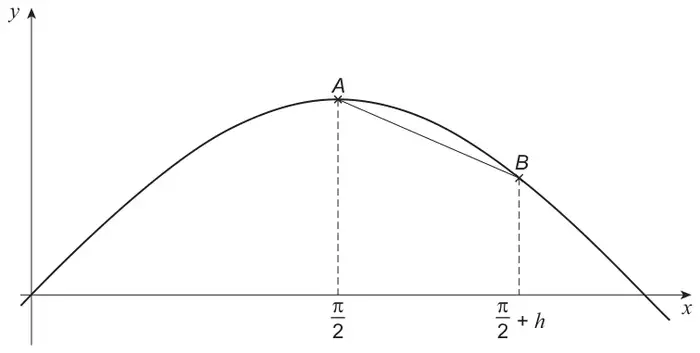
| Step 1 | Gradient of chord \(AB = \dfrac{\sin\left(\dfrac{\pi}{2} + h\right) - \sin\left(\dfrac{\pi}{2}\right)}{h}\) |
| Step 2 | \(= \dfrac{\sin\left(\dfrac{\pi}{2}\right)\cos(h) + \cos\left(\dfrac{\pi}{2}\right)\sin(h) - \sin\left(\dfrac{\pi}{2}\right)}{h}\) |
| Step 3 | \(= \sin\left(\dfrac{\pi}{2}\right)\left(\dfrac{\cos(h) - 1}{h}\right) + \cos\left(\dfrac{\pi}{2}\right)\dfrac{\sin(h)}{h}\) |
| Step 4 | For gradient of curve at \(A\), let \(h = 0\) then \(\dfrac{\cos(h) - 1}{h} = 0\) and \(\dfrac{\sin(h)}{h} = 0\) |
| Step 5 | Hence the gradient of the curve at \(A\) is given by \(\sin\left(\dfrac{\pi}{2}\right) \times 0 + \cos\left(\dfrac{\pi}{2}\right) \times 0 = 0\) |
Complete Steps 4 and 5 of Jodie’s working below, to correct her proof. [4 marks]
| Step 4 | For gradient of curve at \(A\), |
| Step 5 | Hence the gradient of the curve at \(A\) is given by |
| Scheme | Marks | AO |
|---|---|---|
| Replaces \(h = 0\) with \(h \to 0\) or better seen anywhere | M1 | 2.3 |
| Uses limit notation fully correctly Accept \(\dfrac{\sin(\mathrm{h})}{h} \to 0\) here Accept full limit notation here | A1 | 2.5 |
| \(\dfrac{\sin(\mathrm{h})}{h} = 1\) seen OE eg \(\sin(h) = h\) | B1 | 2.3 |
| Writes last line explicitly as \(\sin\left(\dfrac{\pi}{2}\right) \times 0 + \cos\left(\dfrac{\pi}{2}\right) \times 1 = 0\) Accept \(1 \times 0 + 0 \times 1 = 0\) | B1 | 2.2a |
| (4 marks) |
Typical solution
For gradient of curve at A,
let \(h \to 0\) then
\[\frac{\cos(h) - 1}{h} \to 0 \text{ and } \frac{\sin(h)}{h} \to 1\]Hence the gradient of the curve at A is given by
\[\sin\left(\frac{\pi}{2}\right) \times 0 + \cos\left(\frac{\pi}{2}\right) \times 1 = 0\]