
June 2018 Paper 2 Q7
7 A function \(\mathrm{f}\) has domain \(\mathbb{R}\) and range \(\{y \in \mathbb{R} : y \geqslant \mathrm{e}\}\)
The graph of \(y = \mathrm{f}(x)\) is shown.
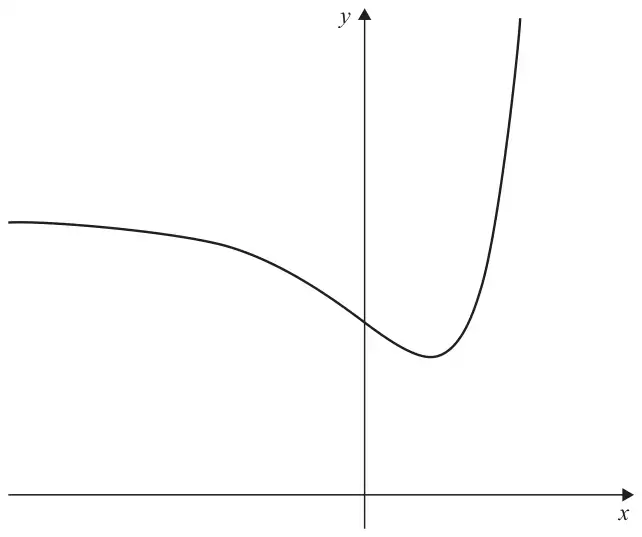
The gradient of the curve at the point \((x, y)\) is given by \(\dfrac{\mathrm{d}y}{\mathrm{d}x} = (x - 1)\mathrm{e}^x\)
Find an expression for \(\mathrm{f}(x)\).
Fully justify your answer. [8 marks]
| Scheme | Marks | AO |
|---|---|---|
| Integrates using integration by parts | M1 | AO3.1a |
| Applies integration by parts formula correctly to either of \((x - 1)\mathrm{e}^x\) or \(x\mathrm{e}^x\) | M1 | AO1.1a |
| Obtains fully correct integral, condone missing constant. | A1 | AO1.1b |
| Explains clearly why the minimum y value is e with reference to the range of the function OE | E1 | AO2.4 |
| Uses \(\dfrac{\mathrm{d}y}{\mathrm{d}x} = 0\) to find \(x\) coordinate of minimum | M1 | AO1.1a |
| Deduces that the curve passes through the point \((1, \mathrm{e})\) | A1 | AO2.2a |
| Uses their minimum point to find their \(c\) | M1 | AO1.1a |
| States the correct equation in any correct form Condone \(y\) instead of \(\mathrm{f}(x)\) CAO | A1 | AO1.1b |
| (8 marks) |
Typical solution
\[y = \int (x - 1)\mathrm{e}^x\,\mathrm{d}x\]\[u = x - 1 \qquad \frac{\mathrm{d}u}{\mathrm{d}x} = 1\]\[\frac{\mathrm{d}v}{\mathrm{d}x} = \mathrm{e}^x \qquad v = \mathrm{e}^x\]\[y = (x - 1)\mathrm{e}^x - \int \mathrm{e}^x\,\mathrm{d}x\]\[y = (x - 1)\mathrm{e}^x - \mathrm{e}^x + c\]Range \(\geqslant \mathrm{e} \Rightarrow\) at min \(y = \mathrm{e}\)
Min point when \(\dfrac{\mathrm{d}y}{\mathrm{d}x} = 0 \therefore x = 1\)
So curve passes through \((1, \mathrm{e})\)
\[\mathrm{e} = (1 - 1)\mathrm{e}^1 - \mathrm{e}^1 + c\]\[c = 2\mathrm{e}\]\[\therefore \mathrm{f}(x) = (x - 2)\mathrm{e}^x + 2\mathrm{e}\]Notes
(corrected from the printed mark scheme: the typical solution prints \(\dfrac{\mathrm{d}v}{\mathrm{d}x} = 1\) next to \(u = x - 1\); it should be \(\dfrac{\mathrm{d}u}{\mathrm{d}x} = 1\))