
June 2019 Paper 2 Q17
17 Lizzie is sat securely on a wooden sledge.
The combined mass of Lizzie and the sledge is \(M\) kilograms.
The sledge is being pulled forward in a straight line along a horizontal surface by means of a light inextensible rope, which is attached to the front of the sledge.
This rope stays inclined at an acute angle \(\theta\) above the horizontal and remains taut as the sledge moves forward.
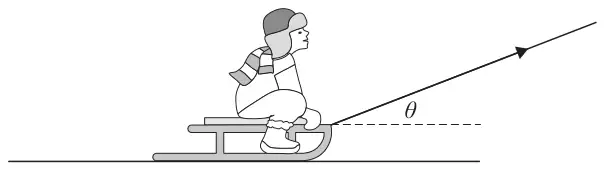
The sledge remains in contact with the surface throughout.
The coefficient of friction between the sledge and the surface is \(\mu\) and there are no other resistance forces.
Lizzie and the sledge move forward with constant acceleration, \(a\) m s−2
The tension in the rope is a constant \(T\) Newtons.
Lizzie uses these values with the relationship formed in part (a) to find the value for \(\mu\)
Explain why her value for \(\mu\) may be incorrect. [2 marks]
| Scheme | Marks | AO |
|---|---|---|
| Resolves vertically to form a three term equation Condone sign error or sin/cos error | M1 | 3.1b |
| Obtains fully correct equation for resolving vertically | A1 | 1.1b |
| Uses Newton’s second law horizontally to form a three term equation Condone sign error or consistent cos/sin error | M1 | 3.1b |
| Obtains fully correct equation for resolving horizontally | A1 | 1.1b |
| Uses \(F = \mu R\) to replace \(F\) with \(\mu R\) in their horizontal equation | B1 | 3.3 |
| Eliminates \(R\) to form a single equation | M1 | 1.1a |
| Completes rigorous argument to find required expression. Must see \(T\) as a factor before division e.g. \(T(\cos\theta + \mu\sin\theta)\) AG | R1 | 2.1 |
Typical solution
\[R + T\sin\theta = Mg\]\[T\cos\theta - F = Ma\]\[F = \mu R\]\[T\cos\theta - \mu R = Ma\]\[T\cos\theta - \mu\left(Mg - T\sin\theta\right) = Ma\]\[T\left(\cos\theta + \mu\sin\theta\right) = Ma + \mu Mg\]\[T = \frac{M(a + \mu g)}{\cos\theta + \mu\sin\theta}\]| Scheme | Marks | AO |
|---|---|---|
| Explains that the relationship may not be valid because the sledge is at rest | B1 | 2.4 |
| Identifies that friction may not be at its limiting value Accept reference to \(F \leqslant \mu R\) Sledge may not be on the point of slipping | B1 | 3.5b |
| (9 marks) |
Typical solution
The sledge is at rest so the relationship may not be valid as friction may not be acting at its limiting value