Hence if true for \(n = k\) and \(n = k + 1\) then true for \(n = k + 2\). As also true for \(n = 1\) and \(n = 2\), then true for all \(n \in \mathbb{N}\) by mathematical induction.
A1
2.4
(6)
Notes
B1: Checks the closed form works for \(n = 1\) and \(n = 2\). Allow if they use the recurrence to find \(u_3\) and check for \(n = 2\) and \(n = 3\), but a consecutive pair must be checked.
M1: Makes the inductive assumption. If not explicitly made, accept just stating “\(n = k\) and \(n = k + 1\)” as making the assumption these are true – or implied by use of the relevant formulae, as long as the assumption is made clear in the conclusion. May use e.g. \(n = k - 2\) and \(n = k - 1\) instead and show true for \(n = k\). It must be clear it is the closed forms they are assuming, not a recurrence form.
M1: Substitutes expression for \(n = k\) and \(n = k + 1\) (or equivalents) into the recurrence formula.
M1: Uses algebra in an attempt to achieve the required result
e.g. Uses the coefficients of 6 and 8 to
write as \(2^n\) terms as \(2^{k+2}\) and simplify.
write as \(4^n\) terms as \(4^{k+1}\) or \(4^{k+2}\) and simplify. Note this is a method mark so you may score for the attempt even if some of the working is incorrect as long as the intent to reach the correct form is clear and at least one bit of indec work is correct.
A1: Completes the process correctly to the required form
A1: Correct conclusion made at the end. Depends on all three M’s and the A being gained and an attempt at both \(n = 1\) and \(n = 2\) having been shown true. Must convey the underlined ideas of
true for \(n = 1\) and \(n = 2\)
if true for two successive cases, it is also true for the next case
a suitable conclusion that it is true for all positive \(n\)
though accept equivalent wordings for these.
Note Accept work with \(n\) instead of \(k\) throughout the inductive step.
Solves \(2^n = 2000 \Rightarrow n = \log_2 2000 = \ldots\{10.96\}\) \(2^n = 2000 \Rightarrow n = \tfrac{\log 2000}{\log 2} = \ldots\{10.96\}\) Alt: Solve the linear equation to find \(n\)
dM1
1.1b
\(u_{11} = -9830.4\) or \(-\dfrac{49152}{5}\)
A1
2.2a
(3)
(9 marks)
Notes
M1: Sets closed form = 0 or < 0 and solves to set up an inequality, or to find a non-zero value, for \(2^n\). Alternatively if the \(4^n\) is not written in terms of \(2^n\) score for a correct process for taking logs to get a linear equation in \(n\). Be tolerant with incorrect inequalities for the M marks.
dM1: Solves \(2^n = a\) where \(a > 0\) by any valid means. May be by inspection. In the Alt it is for proceeding to a value for \(n\) from the linear equation.
A1: Deduces the first negative term of the sequence
3. A loan of £180 000 is taken out to buy a house.
The monthly interest rate on the loan is 0.15%
The interest is added to the balance of the loan at the end of each month.
To repay the loan, £900 is repaid at the end of each month, immediately after the interest has been added.
Let \(B_n\) thousands of pounds be the balance of the loan at the end of month \(n\) after the interest has been added and the £900 repaid.
(a) Explain, in the context of the problem, why the balance of the loan, \(B_n\), can be modelled by the recurrence relation\[B_n = 1.0015B_{n-1} - 0.9 \qquad B_0 = 180 \qquad n \in \mathbb{Z}^+\] (2)
(b) State an assumption that must be made for this model to be valid. (1)
(c) Solve the recurrence relation to determine a closed form for \(B_n\) (5)
(d) Hence determine the time it will take to repay the loan. Give your answer in years and months to the nearest month. (2)
Mark scheme (a)
Scheme
Marks
AO
The loan amount is £180 000 before any interest is added or payments made so \(B_0 = 180\) as the units are 1000’s
Interest is added at 0.15% so the monthly balance is multiplied by 100.15% = 1.0015 to give \(1.0015B_{n-1}\) as the new balance
After the interest has been added, £900 is paid off which is 0.9 in thousands of pounds so \(B_n = 1.0015B_{n-1} - 0.9\)
B1 B1
2.4 3.3
(2)
Notes
B1: For explaining 2 of the 3 aspects as above. Allow attempts that convey the right idea even if not precisely described.
B1: All 3 aspects explained with sufficient detail shown. Must see the 1.0015 explained, not just “the 1.0015 is the 0.15%” or such.
Mark scheme (b)
Scheme
Marks
AO
E.g. The interest rate stays the same The monthly repayments stay the same
B1
3.5b
(1)
Notes
B1: See scheme for answers. Must refer to the model, do not accept answer about “rounding” values.
Mark scheme (c)
Scheme
Marks
AO
A complete method to solve the recurrence relation using \(B_n = \text{CF} + \text{PS} = a(1.0015)^n + b\)
M1
3.1a
\(\text{PS} = b \;\Rightarrow\; b = 1.0015b - 0.9\) leading to \(b = \ldots\)
M1
1.1b
\(b = 600\)
A1
1.1b
Uses \(B_0 = 180\) and their value for \(b\) to find the value of \(a\) \(180 = a(1.0015)^0 + 600\) \(a = \ldots(-420)\)
M1: A complete method to solve the recurrence relation using \(B_n = \text{CF} + \text{PS} = a(1.0015)^n + b\)
M1: Uses \(\text{PS} = b \Rightarrow b = 1.0015b - 0.9\) to find a value for \(b\) (corrected from the printed mark scheme: the printed note has \(b = 1.0015b - 900\), but \(B_n\) is in thousands of pounds, so the constant is 0.9 as in the scheme)
A1: \(b = 600\)
M1: Uses \(B_0\) and their value for \(b\) to find a value for \(a\)
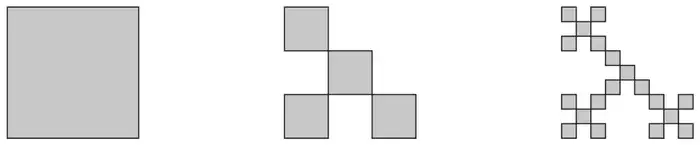
(c) determine the total area of all the squares in stage 8 of the pattern, giving your answer to 2 significant figures. (2)
Mark scheme (a)
Scheme
Marks
AO
In the first stage there is one square so \(u_1 = 1\)
Each square from \(u_n\) to \(u_{n+1}\) is replaced by 5 smaller squares, so \(u_{n+1} = 5u_n\)
But one of the squares is then removed, so \(u_{n+1} = 5u_n - 1\)
B1 B1
2.4 3.3
(2)
Notes
B1: For explaining any two of the three aspects in the scheme.
B1: All three aspects explained.
Mark scheme (b)
Scheme
Marks
AO
AE is \(\lambda - 5 = 0 \Rightarrow \lambda = 5\)
M1
1.1b
So CF is \(w_n = A \times 5^n\)
A1
1.1b
PS try \(v_n = k \Rightarrow k = 5k - 1 \Rightarrow k = \ldots \Rightarrow u_n = \text{“}A \times 5^n\text{”} + \text{“}\tfrac{1}{4}\text{”}\)
M1
1.1b
\(u_1 = 1 \Rightarrow 1 = A \times 5^1 + \dfrac{1}{4} \Rightarrow A = \dfrac{3}{20}\)
M1
3.4
So \(u_n = \dfrac{3}{20} \times 5^n + \dfrac{1}{4}\) or \(u_n = \dfrac{3}{4} \times 5^{n-1} + \dfrac{1}{4}\) oe
A1
1.1b
(5)
Notes
M1: Sets up and solves the auxiliary equation.
A1: Correct complementary part found.
M1: Selects correct form for particular solution and substitutes and combines result with their CF
M1: Uses the initial value to find the constant.
A1: Correct solution.
Mark scheme (c)
Scheme
Marks
AO
Each square in stage \(n\) has area \(\dfrac{25}{9^{n-1}}\) so total area is \(\dfrac{25}{9^7} \times u_8 = \dfrac{25}{9^7} \times \left(\dfrac{3}{4} \times 5^7 + \dfrac{1}{4}\right)\)
M1
3.1a
\(= 0.3062\ldots\) Accept awrt 0.31
A1
1.1b
(2)
(9 marks)
Notes
M1: Attempts a scale factor with their \(u_8\). Accept attempts at scaling by \(25 \times 3^{-k}\) or \(25 \times 9^{-k}\) where \(k\) is 7, 8 or 9.
M1: Selects the correct form for \(u_n\) for their roots of the equation. (If distinct real roots were found allow for \(u_n = A\alpha^n + B\beta^n\))
M1: Uses the values of \(u_1\) and \(u_2\) with the corresponding values of \(n\) used to form and uses a correct method to solve simultaneous equations to find the constants. If no method is shown, use of calculator, for solving the simultaneous equations the values must be correct for their equations.
A1: Correct roots – either Cartesian or polar form, award when first seen and isw.
A1ft: Correct complementary function, follow through on their first complex roots. (so A1A0 if roots initially correct but error simplifying leads to wrong CF). Note: use of power \(n + 1\) or \(n - 1\) in Cartesian form is also fine
M1: Correct form for the particular solution and a complete method to find the PS.
A1: Correct general solution, either form
M1. Substitutes \(n = 1\) and sets equal to 4 and substitutes \(n = 0\) and sets equal to 1. To find the values of the constants
4. A student takes out a loan for £1000 from a bank.
The bank charges 0.5% monthly interest on the amount of the loan yet to be repaid.
At the end of each month
the interest is added to the loan
the student then repays £50
Let \(U_n\) be the amount of money owed \(n\) months after the loan was taken out.
The amount of money owed by the student is modelled by the recurrence relation
\[U_n = 1.005U_{n-1} - A \qquad U_0 = 1000 \qquad n \in \mathbb{Z}^+\]
where \(A\) is a constant.
(a)
(i) State the value of the constant \(A\).
(ii) Explain, in the context of the problem, the value 1.005
(2)
Using the value of \(A\) found in part (a)(i),
(b) solve the recurrence relation\[U_n = 1.005U_{n-1} - A \qquad U_0 = 1000 \qquad n \in \mathbb{Z}^+\] (5)
(c) Hence determine, according to the model, the number of months it will take to completely repay the loan. (2)
Mark scheme (a)
Scheme
Marks
AO
\(A = 50\)
B1
3.3
Interest rate is 0.5% so multiplied by 1.005
B1
2.4
(2)
Notes
B1: Uses the model to state \(A = 50\)
B1: A correct explanation
Mark scheme (b)
Scheme
Marks
AO
A complete method to solve the recurrence relation using \(U_n = \text{CF} + \text{PS} = c(1.005)^n + \lambda\)
M1
3.1a
\(\text{PS} = \lambda \Rightarrow \lambda = 1.005\lambda - \text{“}50\text{”}\) leading to \(\lambda = \ldots\)
M1
1.1b
\(\lambda = 10000\)
A1
1.1b
Uses \(U_0 = 1000\) and their value of \(\lambda\) to find the value of \(c\) \(1000 = c(1.005)^0 + \text{“}10000\text{”}\) Leading to \(c = \ldots\{-9000\}\)
M1
1.1b
\(U_n = 10000 - 9000(1.005)^n\)
A1
1.1b
(5)
Notes
M1: A complete method to solve the recurrence relation using \(U_n = \text{CF} + \text{PS} = c(1.005)^n + \lambda\)
M1: Uses their value of \(A\) with \(\text{PS} = \lambda \Rightarrow \lambda = 1.005\lambda - \text{“}50\text{”}\) to find a value for \(\lambda\)
A1: \(\lambda = 10000\)
M1: Uses \(U_0 = 1000\) and their value of \(\lambda\) to find the value of \(c\)
A1: Fully correctly defined sequence \(U_n = 10000 - 9000(1.005)^n\)
Alternative
Scheme
Marks
AO
A complete method to solve the recurrence relation using \(U_n = \text{CF} + \text{PS} = c(1.005)^n + \lambda\)
3. In a model for the number of subscribers to a new social media channel it is assumed that
each week 20% of the subscribers at the start of the week cancel their subscriptions
between the start and end of week \(n\) the channel gains \(20n\) new subscribers
Given that at the end of week 1 there were 25 subscribers,
(a) explain why the number of subscribers at the end of week \(n\), \(U_n\), is modelled by the recurrence relation\[U_1 = 25 \qquad U_{n+1} = 0.8U_n + 20(n + 1) \qquad n = 1, 2, 3, \ldots\] (2)
(b) Prove by induction that for \(n \geqslant 1\)\[U_n = 325\left(\frac{4}{5}\right)^{n-1} + 100n - 400\] (5)
Given that 6 months after starting the channel there were approximately 1800 subscribers,
(c) evaluate the model in the light of this information. (2)
Mark scheme (a)
Scheme
Marks
AO
Two of
\(U_1 = 25\) because there are 25 subscribers at the end of week 1
20% of subscribers leave so 80% so \(0.8U_n\) remaining subscribers or \(U_n - 0.2U_n\)
At end of week \(n + 1\) there are a new \(20(n + 1)\) subscribers added to those from week \(n\)
M1
3.3
All three points above put together in conclusion Hence \(U_{n+1} = 0.8U_n + 20(n + 1),\ U_1 = 25\)
A1
2.4
(2)
Notes
M1: See scheme. Explains how the assumptions lead to at least two of the aspects indicated. Accept less formal explanations as long as the intent is clear.
A1: All three aspects explained and put together to set up the model.
Mark scheme (b)
Scheme
Marks
AO
\(n = 1 \Rightarrow U_1 = 325 \times 1 + 100 \times 1 - 400 = 325 - 300 = 25\) {so the result is true for \(n = 1\)}
Hence if the result is true for \(n = k\), then it is true for \(n = k + 1\), and as it is true for \(n = 1\), so it is true for all positive integers \(n\) or \(n \geqslant 1\)
A1
2.4
(5)
Notes
B1: Checks the case for \(n = 1\) holds.
M1: Makes the inductive assumption (may be implied by working) and substitutes the closed form for \(U_k\) into the recurrence relation for \(U_{k+1}\) or equivalent work with different variable (e.g. \(n\) instead of \(k\)) or indexing (e.g. from \(k - 1\) to \(k\)).
M1: Simplifies to the point of combining the powers of \(\dfrac{4}{5}\) to one term.
A1: For correct work leading to the form shown. The \(k + 1\) must be seen in the added term but allow just \(k\) for the power.
A1: For a completely correct proof (all previous marks must be gained) with a conclusion that includes all of the bold statements in the scheme or equivalents.
Alternative
Scheme
Marks
AO
\(n = 1 \Rightarrow U_1 = 325 \times 1 + 100 \times 1 - 400 = 325 - 300 = 25\) so the result is true for \(n = 1\)
Hence if the result is true for \(n = k\), then it is true for \(n = k + 1\), and as it is true for \(n = 1\), so it is true for all positive integers \(n\) or \(n \geqslant 1\)
A1
2.4
(5)
B1: Checks the case for \(n = 1\) holds.
M1: Writes out the term \(U_{k+1}\) and starts the process to write in terms of \(U_k\) by factorising out \(\dfrac{4}{5}\) from the first term.
M1: Factorises out \(\dfrac{4}{5}\) to form \(= \dfrac{4}{5} \times \left(325\left(\dfrac{4}{5}\right)^{k-1} + 100k - 400\right) + \ldots\)
A1: For correct work leading \(U_{k+1} = 0.8U_k + 20(k + 1)\)
A1: For a completely correct proof (all previous marks must be gained) with a conclusion that includes all of the bold statements in the scheme or equivalents.
Mark scheme (c)
Scheme
Marks
AO
An attempt at either \(U_{24} = 325 \times 0.8^{23} + 2400 - 400 = 2001.9\ldots\) Or \(U_{25} = 325 \times 0.8^{24} + 2500 - 400 = 2101.5\ldots\) or \(U_{26} = 325 \times 0.8^{25} + 2600 - 400 = 2201.2\ldots\) Or \(U_{27} = 325 \times 0.8^{26} + 2700 - 400 = 2300.98\ldots\)
M1
3.4
Correct value for their number of weeks 24, 25, 26 or 27. Compares the value after 6 months with 1800 and draws a conclusion e.g. This is overestimating the actual amount by 400 people and therefore not a very good model.
A1
3.5a
(2)
(9 marks)
Notes
M1: Evaluates \(U_{24}\) \(U_{25}\) \(U_{26}\) or \(U_{27}\). Allow attempts that deduce \(\left(\dfrac{4}{5}\right)^{n} \to 0\) and just evaluate \(100 \times 26 - 400 = 2200\)
\(u_n = A + Bn + 4(2)^n\) or \(u_n = A + Bn + (2)^{n+2}\)
A1
1.1b
(4)
Notes
M1: Forms and solves the auxiliary equation.
A1: Correct complementary function.
M1: Correct form for the particular solution, substitutes into the recurrence relation to find the PS.
A1: Correct general solution
(corrected from the printed mark scheme: the first line is printed in a garbled symbol font)
Mark scheme (b)
Scheme
Marks
AO
Uses the information to find the values of the constants For example \(u_0 = 2u_1 \Rightarrow A + 4 = 2(A + B + 4(2)) \Rightarrow \ldots \{A + 2B = -12\}\) \(u_4 = 3u_2 \Rightarrow A + 4B + \text{‘}4\text{’}(2)^4 = 3(A + 2B + 4(2)^2) \Rightarrow \ldots \{2A + 2B = 16\}\) Solves simultaneous equations to find values for \(A\) and \(B\).
Note: They must have two constants to score any marks in this part
M1: A complete method to find the constants using the information given. Form two equations and solves simultaneously to find values for \(A\) and \(B\).
5. A person takes a course of a particular vitamin.
Before the course there was none of the vitamin in the person’s body.
During the course, vitamin tablets are taken at the same time each day.
Initially two tablets are taken and on each following day only one tablet is taken.
Each tablet contains 10 mg of the vitamin.
Between doses the amount of the vitamin in the person’s body decreases naturally by 60%
Let \(u_n\) mg be the amount of the vitamin in the person’s body immediately after a tablet is taken, \(n\) days after the initial two tablets were taken.
B1: Uses particular solution is constant to find \(b\)
M1: Substitutes for \(n = 0\) or \(n = 1\) and sets equal to 20 in the general form to form an equation in \(a\)
A1: Correct equation follow through their \(b\).
A1: \(a\) correct.
Mark scheme (c)
Scheme
Marks
AO
In long term \(u_n = \dfrac{10}{3}(0.4)^n + \dfrac{50}{3} \to \dfrac{50}{3}\) as \((0.4)^n \to 0\)
M1
3.4
Minimum amount of vitamin occurs just before a tablet is taken, so is \(\dfrac{50}{3} - 10 = \dfrac{20}{3} = 6\tfrac{2}{3}\) mg
M1
3.1b
This is greater than 6 mg and so there is always at least 6 mg of the vitamin in the person. The course of vitamin will be effective.
A1
3.2a
(3)
(9 marks)
Notes
M1: Uses the model to work out the long-term behaviour or the amount of vitamin in the person. Accept identifying \(\dfrac{50}{3}\) as a lower limit for \(u_n\).
M1: Finds the lower bound for the amount of vitamin in the person, subtracting 10 from their long-term value or multiplying the \(\dfrac{50}{3}\) limit by 0.4 to find amount just before next tablet.
A1: Concludes the course of vitamin will be effective following correct work and reasoning.
NB: Attempts that set \(u_n = 6\) and try to solve for \(n\) score no marks. Attempts that set \(u_n - 10 = 6\) and try to solve for \(n\) can score the second M only. Long term behaviour needs to be considered for first M.
If true for \(n = k\) then it is true for \(n = k + 1\) and as it is true for \(n = 1\), the statement is true for all \(n\). (Allow ‘for all values’)
A1
2.2a
(6)
Notes
B1: Shows the statement is true for \(n = 1\). Needs to show that \(p_1 = 0\) and conclusion true for \(n = 1\), this statement can be recovered in their conclusion if says e.g. true for \(n = 1\)
M1: Makes a statement that assumes the result is true for \(n = k\). Assume (true for) \(n = k\) is sufficient. This mark may be recovered in their conclusion if they say e.g. if true for \(n = k\) then …etc
M1: Finds an expression for \(p_{k+1}\) using the recurrence relation and substitutes in for \(p_k\)
A1: Correct complete conclusion. This mark is dependent on previous four marks, the B mark is not required. It is gained by conveying the ideas of all underlined points either at the end of their solution or as a narrative in their solution.
Hence if true for \(n = k\) and \(n = k + 1\) then true for \(n = k + 2\). As also true for \(n = 1\) and \(n = 2\), then true for all \(n \in \mathbb{N}\) by mathematical induction.
A1
2.4
(6)
(6 marks)
Notes
B1: Checks the closed form works for \(n = 1\) and \(n = 2\)
M1: Makes the inductive assumption. May use e.g. \(n = k - 2\) and \(n = k - 1\) instead and show true for \(n = k\). It must be clear it is the closed forms they are assuming, not a recurrence form.
M1: Substitutes expression for \(n = k\) and \(n = k + 1\) (or equivalents) into the recurrence formula.
M1: Takes out common factors of at least \((-3)^k k!\) in their expression, or equivalent for their assumed true values. Treatment of the \((-3)\) must be correct, but condone invisible brackets if recovered.
Note: they may well take out more at this stage, which is fine, e.g. \(u_{k+2} = 9(k+1)^2\left((-3)^k k!\right) - 3\left((-3)^{k+1}(k+1)!\right) = (-3)^{k+2}(k+1)!\left[(k+1) + 1\right]\)
A1: Simplifies correctly to the required form for their assumed true values.
A1: Correct conclusion made. Depends on all three M’s and the A being gained. Must convey the ideas of 1) true for \(n = 1\) and \(n = 2\), 2) if true for two successive cases, it is also true for the next case and 3) a suitable conclusion that it is true for all positive \(n\).
4. Sam borrows £10 000 from a bank to pay for an extension to his house. The bank charges 5% annual interest on the portion of the loan yet to be repaid. Immediately after the interest has been added at the end of each year and before the start of the next year, Sam pays the bank a fixed amount, £\(F\).
Given that £\(A_n\) (where \(A_n \geqslant 0\)) is the amount owed at the start of year \(n\),
(a) write down an expression for \(A_{n+1}\) in terms of \(A_n\) and \(F\), (1)
(b) prove, by induction that, for \(n \geqslant 1\)\[A_n = (10\,000 - 20F)1.05^{n-1} + 20F\] (5)
(c) Find the smallest value of \(F\) for which Sam can repay all of the loan by the start of year 16. (4)
M1: Forms the correct complementary function for their (real) root(s) to the equation, \((A + Bn)r^n\) if repeated root, or allow \(Ar_1^{\,n} + Br_2^{\,n}\) if distinct real roots are found.
M1: Attempts to use a particular solution of the correct form (ie \(an + b\) or a higher order polynomial in \(n\) containing this) in the recurrence relation.
dM1: Expands and solves for \(a\) and \(b\)
A1: Correct values for \(a\) and \(b\)
B1ft: Forms the general solution as the sum of their complementary function and a particular solution of correct form with their \(a\) and \(b\)
M1: Applies the initial values and solves for the constants
5. On Jim’s 11th birthday his parents invest £1000 for him in a savings account.
The account earns 2% interest each year.
On each subsequent birthday, Jim’s parents add another £500 to this savings account.
Let \(U_n\) be the amount of money that Jim has in his savings account \(n\) years after his 11th birthday, once the interest for the previous year has been paid and the £500 has been added.
(a) Explain, in the context of the problem, why the amount of money that Jim has in his savings account can be modelled by the recurrence relation of the form\[U_n = 1.02U_{n-1} + 500 \qquad\qquad U_0 = 1000 \qquad n \in \mathbb{Z}^+\] (3)
(b) State an assumption that must be made for this model to be valid. (1)
(c) Solve the recurrence relation\[U_n = 1.02U_{n-1} + 500 \qquad\qquad U_0 = 1000 \qquad n \in \mathbb{Z}^+\] (5)
Jim hopes to be able to buy a car on his 18th birthday.
(d) Use the answer to part (c) to find out whether Jim will have enough money in his savings account to buy a car that costs £4 500 (2)
Mark scheme (a)
Scheme
Marks
AO
\(U_{n-1}\) is the amount in the saving account \(n - 1\) years after Jim’s 11th birthday. This is increased by 2% each year, so is multiplied by 1.02 to give \(1.02U_{n-1}\)
B1
3.3
Jim’s parents invest £500 for each subsequent birthday so 500 is added
B1
3.4
\(U_0 = 1000\) as this is the amount invested on Jim’s 11th birthday
B1
1.1b
(3)
Notes
B1: Need to explain that 2% interest rate linked to multiplication by scale factor 1.02
B1: Need to explain that 500 is added due to receiving £500 each year
B1: Needs to explain that \(U_0 = 1000\) is the initial amount invested
Mark scheme (b)
Scheme
Marks
AO
To use this model, one of, for example The interest rate stays the same each year Jim does not withdraw any money from the savings account Jim only saves the birthday money +£500 in this saving account, he does not invest any other money.
B1
3.5b
(1)
Notes
B1: See main scheme
Mark scheme (c)
Scheme
Marks
AO
A complete method to solve the recurrence relation using \(U_n = \text{CF} + \text{PS} = c(1.02)^n + \lambda\)
M1
3.1a
\(\text{PS} = \lambda \quad \Rightarrow \lambda = 1.02\lambda + 500\) leading to \(\lambda = \ldots\)
M1
1.1b
\(\lambda = -25\,000\)
A1
1.1b
Uses \(U_0 = 1000\) and their value for \(\lambda\) to find the value of \(1000 = c(1.02)^0 - 25\,000\) \(c = \ldots(26\,000)\)
3. The number of visits to a website, in any particular month, is modelled as the number of visits received in the previous month plus \(k\) times the number of visits received in the month before that, where \(k\) is a positive constant.
Given that \(V_n\) is the number of visits to the website in month \(n\),
(a) write down a general recurrence relation for \(V_{n+2}\) in terms of \(V_{n+1}\), \(V_n\) and \(k\). (1)
For a particular website you are given that
\(k = 0.24\)
In month 1, there were 65 visits to the website.
In month 2, there were 71 visits to the website.
(b) Show that\[V_n = 50(1.2)^n - 25(-0.2)^n\] (5)
This model predicts that the number of visits to this website will exceed one million for the first time in month \(N\).
(c) Find the value of \(N\). (2)
Mark scheme (a)
Scheme
Marks
AO
\(V_{n+2} = V_{n+1} + kV_n\)
B1
3.3
(1)
Notes
B1: A correct expression for the model using the information given
M1: Forms and solves the auxiliary equation for their answer to (a) with \(k = 0.24\)
A1: The correct closed form deduced from their solutions. This must be consistent with their equation. Note the answer is given so check carefully. This is not a follow through mark.
B1ft: Applies initial conditions to their general equation – correct two equations for their general form with \(V_1 = 65\) and \(V_2 = 71\)
M1: Attempts to solve their equations showing a correct method, reaching a value for at least one variable. It is a show that question and answers are on the paper, so method is needed. Look for one equation multiplied through to give same coefficients before attempting eliminating or substitution. If a matrix system is used the inverse must be found, not just solutions stated.
A1*: Correct expression formed following suitable working with no errors seen. With fractions instead of decimals is fine.
So \(V_{k+2} = 50(1.2)^{k+2} - 25(-0.2)^{k+2}\) Hence true for \(n = k + 2\). So the result is true for \(n = 1\) and \(n = 2\), and if true for \(n = k\) and \(n = k + 1\) then it is true for \(n = k + 2\). Hence by mathematical induction, for all \(n \in \mathbb{N}\) \(V_n = 50(1.2)^n - 25(-0.2)^n\) *
A1*
1.1b
(5)
M1: Substitutes into equation for \(n = 1\) and \(n = 2\) to verify true for these cases.
A1: Deduces true for base cases and makes a correct assumption statement. This must include two successive cases assumed true, so e.g. as in scheme, or with \(k - 2\) and \(k - 1\) etc, or may assume true for all (integers) \(k \leqslant n\). But do not allow if assumed true for just \(k\).
B1ft: Substitutes the formula for \(k\) and \(k + 1\) (or their successive values) into the recurrence formula, follow through their equation from part (a).
M1: Rearranges to the form \(a(1.2)^{(k+2)} + b(-0.2)^{k+2}\)
A1*: Correct work leading to the correct equation for \(V_{k+2}\) and makes suitable inductive conclusion, including the ideas of “true for \(n = 1\) and \(n = 2\)”, “if true for \(n = k\) and \(n = k + 1\) then true for \(n = k + 2\)” and “hence true for all integers”.
Mark scheme (c)
Scheme
Marks
AO
\(50(1.2)^N \gt 10^6 \Rightarrow N = \ldots\)
M1
3.1b
\(\Rightarrow N = 55\) i.e. month 55
A1
3.2a
(2)
(8 marks)
Notes
M1: Selects a suitable method to solve the problem. For example, realises that in the model, \((-0.2)^n\) is negligible for large \(n\) and so attempts to solve e.g. \(50(1.2)^N = 10^6\), or tries at least one value either side of \(N = 55\) as a process of trial and improvement, or uses a calculator/graphical approach – implied by a value of \(N = 55\) or \(N = 54\) stated.
A1: \(N = 55\).
The correct answer will imply both marks for this part. Ignore erroneous working if correct answer is stated as a restart.
3. A tree at the bottom of a garden needs to be reduced in height. The tree is known to increase in height by 15 centimetres each year.
On the first day of every year, the height is measured and the tree is immediately trimmed by 3% of this height.
When the tree is measured, before trimming on the first day of year 1, the height is 6 metres.
Let \(H_n\) be the height of the tree immediately before trimming on the first day of year \(n\).
(a) Explain, in the context of the problem, why the height of the tree may be modelled by the recurrence relation\[H_{n+1} = 0.97H_n + 0.15, \quad H_1 = 6, \quad n \in \mathbb{Z}^+\] (3)
(b) Prove by induction that \(H_n = 0.97^{n-1} + 5, \quad n \geqslant 1\) (4)
(c) Explain what will happen to the height of the tree immediately before trimming in the long term. (1)
(d) By what fixed percentage should the tree be trimmed each year if the height of the tree immediately before trimming is to be 4 metres in the long term? (2)
Mark scheme (a)
Scheme
Marks
AO
\(H_n\) is the measured height at the start of year \(n\) and this is decreased by 3% at the start of year \(n\), so is multiplied by 97% = 0.97 to give \(0.97H_n\) as the new height due to trimming
B1
3.3
0.15 is added to \(0.97H_n\) as 0.15 is 15 cm in m and this is how much the tree grows in a year.
B1
3.4
And \(H_1 = 6\) is the height of the tree at the start of year 1 before trimming
B1
1.1b
(3)
Notes
B1: Need to see 3% decrease linked to scale factor of 0.97
B1: Need to see that adding 0.15 corresponds to the yearly growth in metres. There must be some reference to the units for this mark.
B1: An explanation that \(H_1\) is the first term (the starting height) and this is 6m
Mark scheme (b)
Scheme
Marks
AO
\(n = 1 \Rightarrow H_1 = (0.97)^{1-1} + 5 = 6\) So true for \(n = 1\)
B1
2.1
Assume true for \(n = k\) so \(H_k = (0.97)^{k-1} + 5\) so \(H_{k+1} = 0.97\left((0.97)^{k-1} + 5\right) + 0.15\)
If true for \(n = k\) then true for \(n = k + 1\), true for \(n = 1\) so true for all (positive integers) \(n\) (Allow “for all values”)
B1
2.2a
(4)
Notes
B1: Begins proof by induction by considering \(n = 1\) and obtains \(H_1 = 6\)
M1: Assumes true for \(n = k\) and uses iterative formula to consider \(n = k + 1\)
A1: Reaches \((0.97)^k + 5\) with no errors
B1: Correct conclusion. This mark is dependent on all previous marks apart from the first B mark. It is gained by conveying the ideas of all four underlined points either at the end of their solution or as a narrative in their solution.
Mark scheme (c)
Scheme
Marks
AO
The height will approach 5m
B1
1.1b
(1)
Notes
B1: States the height will approach 5m
Mark scheme (d)
Scheme
Marks
AO
Require \(4 = 4x + 0.15\)
M1
3.1b
\(x = 0.9625\) so 3.75%
A1
1.1b
(2)
(10 marks)
Notes
M1: Uses the model to adopt a correct strategy to find the required percentage
A1: Interprets their answer correctly in terms of the original context