
A2 June 2022 Q3
3.
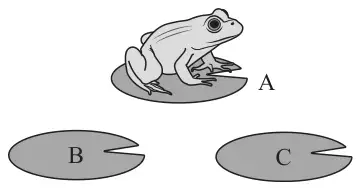
There are three lily pads on a pond. A frog hops repeatedly from one lily pad to another.
The frog starts on lily pad A, as shown in Figure 1.
In a model, the frog hops from its position on one lily pad to either of the other two lily pads with equal probability.
Let \(p_n\) be the probability that the frog is on lily pad A after \(n\) hops.
The probability \(p_n\) satisfies the recurrence relation
\[p_{n+1} = \frac{1}{2}\left(1 - p_n\right) \qquad n \geqslant 1 \quad \text{where } p_1 = 0\]| Scheme | Marks | AO |
|---|---|---|
Implies moves from A
| B1 | 2.4 |
| (1) |
Notes
B1: Explains has to move from A
| Scheme | Marks | AO |
|---|---|---|
| \(p_1 = \frac{2}{3}\left(-\frac{1}{2}\right)^1 + \left(\frac{1}{3}\right) = 0\) Minimum needed \(p_1 = \frac{2}{3}\left(-\frac{1}{2}\right) + \left(\frac{1}{3}\right) = 0\) | B1 | 2.1 |
| Assume result is true for \(n = k\) Or \(p_k = \frac{2}{3}\left(-\frac{1}{2}\right)^k + \left(\frac{1}{3}\right)\) | M1 | 2.4 |
| Finds an expression for \(p_{k+1} = \frac{1}{2}\left(1 - \left[\frac{2}{3}\left(-\frac{1}{2}\right)^k + \left(\frac{1}{3}\right)\right]\right)\) | M1 | 1.1b |
| \(p_{k+1} = \dfrac{1}{3} + \dfrac{2}{3}\left(-\frac{1}{2}\right)\left(-\frac{1}{2}\right)^k\) or \(\dfrac{1}{2} - \dfrac{1}{6} + \dfrac{2}{3}\left(-\frac{1}{2}\right)\left(-\frac{1}{2}\right)^k\) \(p_{k+1} = \dfrac{1}{3} - \dfrac{1}{3} \times -2\left(-\frac{1}{2}\right)^{k+1}\) or \(\dfrac{1}{2} - \dfrac{1}{6} - \dfrac{1}{3} \times -2\left(-\frac{1}{2}\right)^{k+1}\) | M1 | 2.1 |
| \(p_{k+1} = \frac{2}{3}\left(-\frac{1}{2}\right)^{k+1} + \left(\frac{1}{3}\right)\) | A1 | 1.1b |
| If true for \(n = k\) then it is true for \(n = k + 1\) and as it is true for \(n = 1\), the statement is true for all \(n\). (Allow ‘for all values’) | A1 | 2.2a |
| (6) |
Notes
B1: Shows the statement is true for \(n = 1\). Needs to show that \(p_1 = 0\) and conclusion true for \(n = 1\), this statement can be recovered in their conclusion if says e.g. true for \(n = 1\)
M1: Makes a statement that assumes the result is true for \(n = k\). Assume (true for) \(n = k\) is sufficient. This mark may be recovered in their conclusion if they say e.g. if true for \(n = k\) then …etc
M1: Finds an expression for \(p_{k+1}\) using the recurrence relation and substitutes in for \(p_k\)
M1: Shows a correct intermediate stage \(p_{k+1} = \frac{1}{3} + \frac{2}{3}\left(-\frac{1}{2}\right)\left(-\frac{1}{2}\right)^k\)
Condone \(\frac{1}{3} - \frac{2}{3}\left(\frac{1}{2}\right)\left(-\frac{1}{2}\right)^k\)
A1: \(p_{k+1} = \frac{2}{3}\left(-\frac{1}{2}\right)^{k+1} + \left(\frac{1}{3}\right)\) cso
A1: Correct complete conclusion. This mark is dependent on previous four marks, the B mark is not required. It is gained by conveying the ideas of all underlined points either at the end of their solution or as a narrative in their solution.
Note Using \(p_{k+1} = \frac{1}{2} - \frac{1}{2}p_k = \frac{1}{2} - \frac{1}{2}\left[\frac{2}{3}\left(-\frac{1}{2}\right)^k + \left(\frac{1}{3}\right)\right] = \frac{1}{2} + \frac{2}{3}\left(-\frac{1}{2}\right)^{k+1} - \left(\frac{1}{6}\right)\) scores 2nd M1 3rd M1
| Scheme | Marks | AO |
|---|---|---|
| As \(n \to \infty,\ \left(-\frac{1}{2}\right)^n \to 0 \therefore p_n \to \dfrac{1}{3}\) | B1 | 3.4 |
| (1) | ||
| (8 marks) |
Notes
B1: see scheme