Groups

Edexcel

AS June 2025 Q2

EdexcelCurrent spec8 marksGroupsNumber Theory

2.

(i) Using a suitable algorithm and without performing any division, determine whether 13 306 617 is divisible by 9 (2)
(ii) The group \(G = \{1, 3, 7, 9, 11, 13, 17, 19\}\) has multiplication modulo 20 as its operation.
(a) Complete the following Cayley table for \(G\)
\(\times_{20}\)137911131719
1137911131719
3311911
7711713
99311713
1111191
131311917
1717113
19191393
(3)
(b) State the inverse of the element 7 (1)
(c) Determine the order of the element 13 (1)
(d) Write down a subgroup of \(G\) of order 4 (1)

A2 June 2025 Q1

EdexcelCurrent spec7 marksGroups

1. The set \(S = \{1, 3, 5, 9, 11, 13\}\) forms the group \(G\), under the operation multiplication modulo 14

(a) Complete the Cayley table below for the group \(G\)
\(\times_{14}\)13591113
113591113
339113511
55111
991311
111159
1313111
(3)
(b) Write down a subgroup of \(G\) of order 2 (1)

The group \(H\) is defined by the Cayley table below.

\(*\)\(p\)\(q\)\(r\)\(s\)\(t\)\(u\)
\(p\)\(p\)\(q\)\(r\)\(s\)\(t\)\(u\)
\(q\)\(q\)\(t\)\(u\)\(r\)\(s\)\(p\)
\(r\)\(r\)\(u\)\(t\)\(q\)\(p\)\(s\)
\(s\)\(s\)\(r\)\(q\)\(p\)\(u\)\(t\)
\(t\)\(t\)\(s\)\(p\)\(u\)\(r\)\(q\)
\(u\)\(u\)\(p\)\(s\)\(t\)\(q\)\(r\)
(c) Show that \(G\) and \(H\) are isomorphic. (3)

A2 June 2024 Q7

EdexcelCurrent spec10 marksGroups

7. The set of matrices \(G = \{\mathbf{I}, \mathbf{A}, \mathbf{B}, \mathbf{C}, \mathbf{D}, \mathbf{E}\}\) where

\[\mathbf{I} = \begin{pmatrix} 1 & 0 \\ 0 & 1 \end{pmatrix} \quad \mathbf{A} = \begin{pmatrix} 0 & 1 \\ 1 & 0 \end{pmatrix} \quad \mathbf{B} = \begin{pmatrix} 1 & 1 \\ 1 & 0 \end{pmatrix} \quad \mathbf{C} = \begin{pmatrix} 1 & 1 \\ 0 & 1 \end{pmatrix} \quad \mathbf{D} = \begin{pmatrix} 1 & 0 \\ 1 & 1 \end{pmatrix} \quad \mathbf{E} = \begin{pmatrix} 0 & 1 \\ 1 & 1 \end{pmatrix}\]

with the operation \(\otimes_2\) of matrix multiplication with entries evaluated modulo 2, forms a group.

(a) Show that \(\mathbf{B}\) is an element of order 3 in \(G\). (2)
(b) Determine the orders of the other elements of \(G\). (3)
(c) Give a reason why \(G\) is not isomorphic to
(i) a cyclic group of order 6
(ii) the group of symmetries of a regular hexagon. (2)

The group \(H\) of permutations of the numbers 1, 2 and 3 contains the following elements, denoted in two-line notation,

\[e = \begin{pmatrix} 1 & 2 & 3 \\ 1 & 2 & 3 \end{pmatrix} \qquad a = \begin{pmatrix} 1 & 2 & 3 \\ 2 & 3 & 1 \end{pmatrix} \qquad b = \begin{pmatrix} 1 & 2 & 3 \\ 3 & 1 & 2 \end{pmatrix}\]\[c = \begin{pmatrix} 1 & 2 & 3 \\ 1 & 3 & 2 \end{pmatrix} \qquad d = \begin{pmatrix} 1 & 2 & 3 \\ 2 & 1 & 3 \end{pmatrix} \qquad f = \begin{pmatrix} 1 & 2 & 3 \\ 3 & 2 & 1 \end{pmatrix}\]
(d) Determine an isomorphism between the groups \(G\) and \(H\). (3)

AS June 2024 Q1

EdexcelCurrent spec9 marksGroups

1.

(i) The table below is a Cayley table for the group \(G\) with operation \(\circ\)
\(\circ\)\(a\)\(b\)\(c\)\(d\)\(e\)\(f\)
\(a\)\(d\)\(c\)\(b\)\(a\)\(f\)\(e\)
\(b\)\(e\)\(f\)\(a\)\(b\)\(c\)\(d\)
\(c\)\(f\)\(e\)\(d\)\(c\)\(b\)\(a\)
\(d\)\(a\)\(b\)\(c\)\(d\)\(e\)\(f\)
\(e\)\(b\)\(a\)\(f\)\(e\)\(d\)\(c\)
\(f\)\(c\)\(d\)\(e\)\(f\)\(a\)\(b\)
(a) State which element is the identity of the group. (1)
(b) Determine the inverse of the element \((b \circ c)\) (2)
(c) Give a reason why the set \(\{a, b, e, f\}\) cannot be a subgroup of \(G\). You must justify your answer. (1)
(d) Show that the set \(\{b, d, f\}\) is a subgroup of \(G\). (2)
(ii) Given that \(H\) is a group with an element \(x\) of order 3 and an element \(y\) of order 6 satisfying\[yx = xy^5\]show that \(y^3xy^3x^2\) is the identity element. (3)

A2 June 2023 Q7

EdexcelCurrent spec6 marksGroups

7. The set \(G = \mathbb{R} - \left\{-\dfrac{3}{2}\right\}\) with the operation of \(x \bullet y = 3(x + y + 1) + 2xy\) forms a group.

(a) Determine the identity element of this group. (2)
(b) Determine the inverse of a general element \(x\) in this group. (3)
(c) Explain why the value \(-\dfrac{3}{2}\) must be excluded from \(G\) in order for this to be a group. (1)

AS June 2023 Q1

EdexcelCurrent spec8 marksGroups

1. The operation \(*\) is defined on the set \(G = \{0, 1, 2, 3\}\) by

\[x * y \equiv x + y - 2xy \pmod{4}\]
(a) Complete the Cayley table below.
\(*\)0123
0
1
2
3
(2)
(b) Show that \(G\) is a group under the operation \(*\)
(You may assume the associative law is satisfied.) (3)
(c) State the order of each element of \(G\). (2)
(d) State whether \(G\) is a cyclic group, giving a reason for your answer. (1)

AS June 2022 Q3

EdexcelCurrent spec9 marksGroupsNumber Theory

3.

(i) Let \(G\) be a group of order 5 291 848
Without performing any division, use proof by contradiction to show that \(G\) cannot have a subgroup of order 11 (3)
(ii)
(a) Complete the following Cayley table for the set \(X = \{2, 4, 8, 14, 16, 22, 26, 28\}\) with the operation of multiplication modulo 30
\(\times_{30}\)2481416222628
24816282142226
4822814
8162814
1428221684
16241416
2214264216
26221448
282614288
(b) Hence determine whether the set \(X\) with the operation of multiplication modulo 30 forms a group.
[You may assume multiplication modulo \(n\) is an associative operation.]
(6)

A2 June 2022 Q1

EdexcelCurrent spec6 marksGroups

1. The group \(\mathrm{S}_4\) is the set of all possible permutations that can be performed on the four numbers 1, 2, 3 and 4, under the operation of composition.

For the group \(\mathrm{S}_4\)

(a) write down the identity element, (1)
(b) write down the inverse of the element \(a\), where\[a = \begin{pmatrix} 1 & 2 & 3 & 4 \\ 3 & 4 & 2 & 1 \end{pmatrix}\] (1)
(c) demonstrate that the operation of composition is associative using the following elements\[a = \begin{pmatrix} 1 & 2 & 3 & 4 \\ 3 & 4 & 2 & 1 \end{pmatrix} \quad b = \begin{pmatrix} 1 & 2 & 3 & 4 \\ 2 & 4 & 3 & 1 \end{pmatrix} \quad \text{and } c = \begin{pmatrix} 1 & 2 & 3 & 4 \\ 4 & 1 & 2 & 3 \end{pmatrix}\] (2)
(d) Explain why it is possible for the group \(\mathrm{S}_4\) to have a subgroup of order 4
You do not need to find such a subgroup. (2)

A2 October 2021 Q4

EdexcelCurrent spec7 marksGroupsNumber Theory

4. Let \(G\) be a group of order \(46^{46} + 47^{47}\)

Using Fermat’s Little Theorem and explaining your reasoning, determine which of the following are possible orders for a subgroup of \(G\)

(i) 11
(ii) 21

(7)

A2 October 2021 Q2

EdexcelCurrent spec8 marksGroups

2. A binary operation \(\bigstar\) on the set of non-negative integers, \(\mathbb{Z}_0^+\), is defined by

\[m \mathbin{\bigstar} n = |m - n| \qquad m, n \in \mathbb{Z}_0^+\]
(a) Explain why \(\mathbb{Z}_0^+\) is closed under the operation \(\bigstar\) (1)
(b) Show that 0 is an identity for \((\mathbb{Z}_0^+, \bigstar)\) (2)
(c) Show that all elements of \(\mathbb{Z}_0^+\) have an inverse under \(\bigstar\) (2)
(d) Determine if \(\mathbb{Z}_0^+\) forms a group under \(\bigstar\), giving clear justification for your answer. (3)

A2 October 2020 Q6

EdexcelCurrent spec10 marksGroups

6.

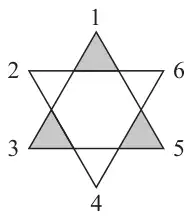
Figure 3: six-pointed star with vertices labelled 1 (top), 2, 3, 4 (bottom), 5, 6 anticlockwise; the triangles at vertices 1, 3 and 5 are shaded
Figure 3

Figure 3 shows a plane shape made up of a regular hexagon with an equilateral triangle joined to each edge and with alternate equilateral triangles shaded.

The symmetries of this shape are the rotations and reflections of the plane that preserve the shape and its shading.

The symmetries of the shape can be represented by permutations of the six vertices labelled 1 to 6 in Figure 3. The set of these permutations with the operation of composition form a group, \(G\).

(a) Describe geometrically the symmetry of the shape represented by the permutation\[\begin{pmatrix} 1 & 2 & 3 & 4 & 5 & 6 \\ 3 & 4 & 5 & 6 & 1 & 2 \end{pmatrix}\] (2)
(b) Write down, in similar two-line notation, the remaining elements of the group \(G\). (4)
(c) Explain why each of the following statements is false, making your reasoning clear.
(i) \(G\) has a subgroup of order 4
(ii) \(G\) is cyclic.
(2)

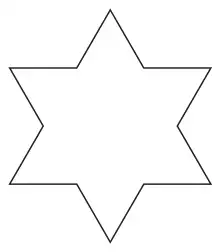
Diagram 1, below, shows an unshaded shape with the same outline as the shape in Figure 3.

Diagram 1: unshaded six-pointed star with the same outline as Figure 3
Diagram 1
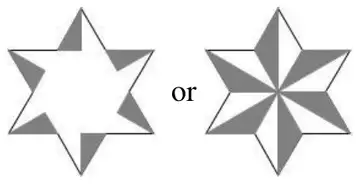
(d) Shade the shape in Diagram 1 in such a way that the group of symmetries of the resulting shaded shape is isomorphic to the cyclic group of order 6 (2)

AS October 2020 Q1

EdexcelCurrent spec8 marksGroups

1. The set \(G = \{1, 3, 7, 9, 11, 13, 17, 19\}\) under the binary operation of multiplication modulo 20 forms a group.

(a) Find the inverse of each element of \(G\). (3)
(b) Find the order of each element of \(G\). (3)
(c) Find a subgroup of \(G\) of order 4 (1)
(d) Explain how the subgroup you found in part (c) satisfies Lagrange’s theorem. (1)

A2 June 2019 Q6

EdexcelCurrent spec12 marksGroups

6.

(i) A binary operation \(*\) is defined on positive real numbers by\[a \mathbin{*} b = a + b + ab\]Prove that the operation \(*\) is associative. (4)
(ii) The set \(G = \{1, 2, 3, 4, 5, 6\}\) forms a group under the operation of multiplication modulo 7
(a) Show that \(G\) is cyclic. (2)

The set \(H = \{1, 5, 7, 11, 13, 17\}\) forms a group under the operation of multiplication modulo 18

(b) List all the subgroups of \(H\). (3)
(c) Describe an isomorphism between \(G\) and \(H\). (3)

AS June 2019 Q4

EdexcelCurrent spec7 marksGroups

4. The set \(\{e, p, q, r, s\}\) forms a group, \(A\), under the operation \(*\)

Given that \(e\) is the identity element and that

\[p * p = s \qquad s * s = r \qquad p * p * p = q\]
(a) show that
(i) \(p * q = r\)
(ii) \(s * p = q\)
(2)
(b) Hence complete the Cayley table below.
\(*\)\(e\)\(p\)\(q\)\(r\)\(s\)
\(e\)
\(p\)
\(q\)
\(r\)
\(s\)
(2)
(c) Use your table to find \(p * q * r * s\) (1)

A student states that there is a subgroup of \(A\) of order 3

(d) Comment on the validity of this statement, giving a reason for your answer. (2)

AS June 2018 Q2

EdexcelCurrent spec10 marksGroups

2.

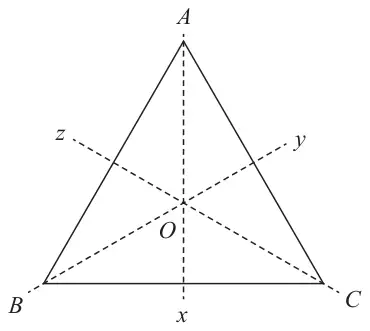
Figure 1: equilateral triangle ABC with A at the top, B bottom left and C bottom right; dashed lines x (through A, vertical), y (through B) and z (through C) meet at O
Figure 1

Figure 1 shows an equilateral triangle \(ABC\). The lines \(x\), \(y\) and \(z\) and their point of intersection, \(O\), are fixed in the plane. The triangle \(ABC\) is transformed about these fixed lines and the fixed point \(O\). The lines \(x\), \(y\) and \(z\) each pass through a vertex of the triangle and the midpoint of the opposite side.

The transformations \(I\), \(X\), \(Y\), \(Z\), \(R_1\) and \(R_2\) of the plane containing triangle \(ABC\) are defined as follows:

  • \(I\): Do nothing
  • \(X\): Reflect in the line \(x\)
  • \(Y\): Reflect in the line \(y\)
  • \(Z\): Reflect in the line \(z\)
  • \(R_1\): Rotate \(120^\circ\) anticlockwise about \(O\)
  • \(R_2\): Rotate \(240^\circ\) anticlockwise about \(O\)

The operation \(*\) is defined as ‘followed by’ on the set \(T = \{I, X, Y, Z, R_1, R_2\}\).
For example, \(X * Y\) means a reflection in the line \(x\) followed by a reflection in the line \(y\).

(a)
(i) Complete the Cayley table below
Second transformation
\(*\)\(I\)\(X\)\(Y\)\(Z\)\(R_1\)\(R_2\)
First
Transformation
\(I\)
\(X\)\(I\)\(Z\)
\(Y\)
\(Z\)
\(R_1\)\(Y\)
\(R_2\)

Given that the associative law is satisfied,

(ii) show that \(T\) is a group under the operation \(*\)
(6)
(b) Show that the element \(R_2\) has order 3 (2)
(c) Explain why \(T\) is not a cyclic group. (1)
(d) Write down the elements of a subgroup of \(T\) that has order 3 (1)