
A2 October 2020 Q6
6.
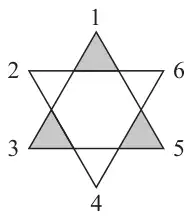
Figure 3 shows a plane shape made up of a regular hexagon with an equilateral triangle joined to each edge and with alternate equilateral triangles shaded.
The symmetries of this shape are the rotations and reflections of the plane that preserve the shape and its shading.
The symmetries of the shape can be represented by permutations of the six vertices labelled 1 to 6 in Figure 3. The set of these permutations with the operation of composition form a group, \(G\).
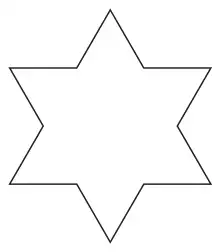
Diagram 1, below, shows an unshaded shape with the same outline as the shape in Figure 3.
| Scheme | Marks | AO |
|---|---|---|
| A rotation \(\ldots\) | M1 | 1.1b |
| \(\ldots\) about the centre of the shape, though an angle 120° anticlockwise. | A1 | 1.1b |
| (2) |
Notes
M1: For identifying the permutation as representing a rotation.
A1: A complete description including rotation, centre, angle (degrees or radians) and direction.
| Scheme | Marks | AO |
|---|---|---|
| \(\begin{pmatrix} 1 & 2 & 3 & 4 & 5 & 6 \\ 5 & 6 & 1 & 2 & 3 & 4 \end{pmatrix}\) | B1 | 1.1b |
| One of \(\begin{pmatrix} 1 & 2 & 3 & 4 & 5 & 6 \\ 1 & 6 & 5 & 4 & 3 & 2 \end{pmatrix}, \begin{pmatrix} 1 & 2 & 3 & 4 & 5 & 6 \\ 3 & 2 & 1 & 6 & 5 & 4 \end{pmatrix}\) or \(\begin{pmatrix} 1 & 2 & 3 & 4 & 5 & 6 \\ 5 & 4 & 3 & 2 & 1 & 6 \end{pmatrix}\) | M1 | 1.1b |
| Two of \(\begin{pmatrix} 1 & 2 & 3 & 4 & 5 & 6 \\ 1 & 6 & 5 & 4 & 3 & 2 \end{pmatrix}, \begin{pmatrix} 1 & 2 & 3 & 4 & 5 & 6 \\ 3 & 2 & 1 & 6 & 5 & 4 \end{pmatrix}\) & \(\begin{pmatrix} 1 & 2 & 3 & 4 & 5 & 6 \\ 5 & 4 & 3 & 2 & 1 & 6 \end{pmatrix}\) | A1 | 1.1b |
| All the above and \(\begin{pmatrix} 1 & 2 & 3 & 4 & 5 & 6 \\ 1 & 2 & 3 & 4 & 5 & 6 \end{pmatrix}\) and no extra symmetries given. Two line form required for this mark. | A1 | 2.5 |
| (4) |
Notes
NB accept in cycle form for the first two marks in (b).
B1: For giving the other rotation of order 3 (rotation through 240° anticlockwise).
M1: For one of the three reflections correctly given.
A1: For one of the other two reflections.
A1: For all reflections and the identity, and no extra symmetries given, and all in two-line notation.
| Scheme | Marks | AO |
|---|---|---|
| \(G\) has order 6 so can have no subgroup of order 4 by Lagrange’s Theorem. | B1 | 2.4 |
| There is no element of order 6 that generates the group. | B1 | 2.4 |
| (2) |
Notes
B1: Correct reason given. Stating there are no elements of order 4 is not sufficient. A longer, valid method would be to state a subgroup of order 4 would need to comprise of the identity and the three elements of order 2 (as it cannot contain any of order 3), but this is not closed as the composite of any two reflection is a rotation.
B1: Refers to there being no element (of order 6) to generate the group. May reason using orders of elements or via geometric restrictions (e.g. cannot generate a rotation from a single reflection and vice versa).
| Scheme | Marks | AO |
|---|---|---|
E.g.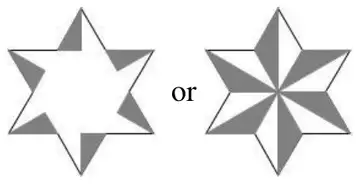 A1 – keeps all rotations and no reflections | M1 A1 | 3.1a 1.1b |
| (2) | ||
| (10 marks) |
Notes
M1: Realises that the shape needs only the rotations preserved so shades in a way that breaks the reflection symmetries, but which preserves at least one non-trivial rotation.
A1: Any correctly shaded shape, e.g. the ones shown above. There are many variations!