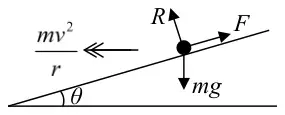
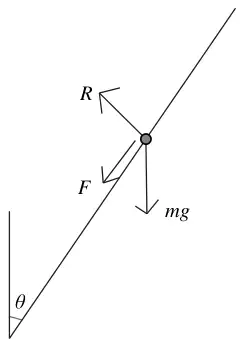
4. A car is travelling round a circular track. The car moves with constant speed in a horizontal circle of radius \(r\).
In an initial model,
the car and driver are modelled as a single particle
the track is modelled as being rough, so that there is sideways friction between the tyres of the car and the track with coefficient of friction \(\mu\)
the track is modelled as being horizontal
Using this model, the maximum speed at which the car can move round the circle of radius \(r\) without slipping sideways is \(\dfrac{1}{2}\sqrt{gr}\).
(a) Show that \(\mu = \dfrac{1}{4}\) (5)
In a refined model,
the car and driver are modelled as a single particle
the track is modelled as being rough, so that there is sideways friction between the tyres of the car and the track with coefficient of friction \(\dfrac{1}{4}\)
the track is modelled as being banked at an angle \(\theta\) to the horizontal
Using this model, the minimum speed at which the car can move round the circle of radius \(r\) without slipping sideways is \(\sqrt{\dfrac{4rg}{35}}\)
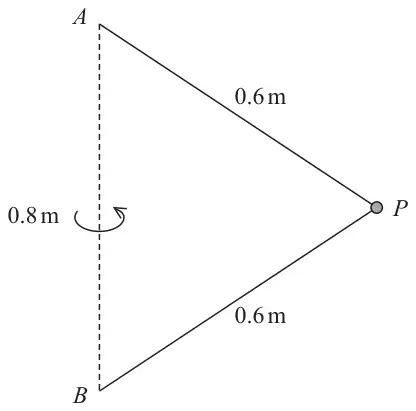
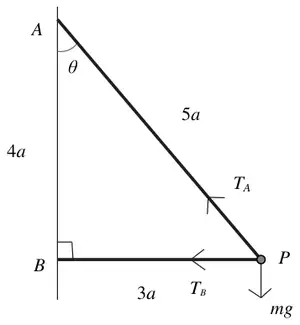
A particle \(P\) of mass 0.2 kg is attached to one end of a light inextensible string of length 0.6 m. The other end of the string is attached to the fixed point \(A\). A second light inextensible string of length 0.6 m has one end attached to \(P\) and the other end attached to the fixed point \(B\). The point \(B\) is vertically below \(A\) such that \(AB = 0.8\) m, as shown in Figure 4.
The particle moves in a horizontal circle with constant angular speed \(\omega\) radians per second, with both strings taut.
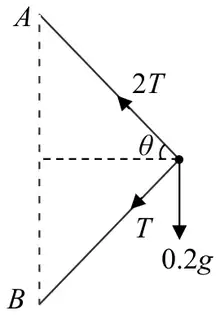
Given that the tension in the string from \(P\) to \(A\) is twice the tension in the string from \(P\) to \(B\), find the value of \(\omega\). (7)
M1: Correct number of terms. Condone sin/cos confusion and sign errors
A1: Correct unsimplified equation. Accept \(T_A\sin\theta = 0.2g + T_B\sin\theta\) Allow \(m\) in place of 0.2 and their numerical \(\sin\theta\) / \(\cos\theta\)
M1: Circular motion. Correct number of terms. Condone sin/cos confusion. Acceleration must be \(r\omega^2\) or \(v^2/r\)
A1: Unsimplified equation with at most one error. Allow \(m\) in place of 0.2 and their numerical \(\sin\theta\) / \(\cos\theta\)
A1: Correct unsimplified equation. Accept \(0.2r\omega^2 = T_A\cos\theta + T_B\cos\theta\) Allow \(m\) in place of 0.2 and their numerical \(\sin\theta\) / \(\cos\theta\)
DM1: Complete strategy to form sufficient equations to solve for \(\omega\) including upper tension being twice lower tension and a method to find \(r\). Dependent on both previous M marks.
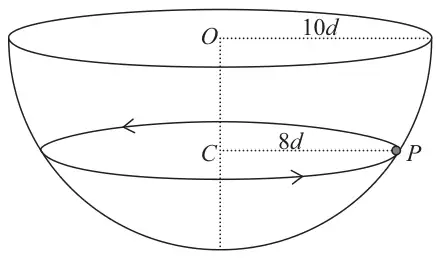
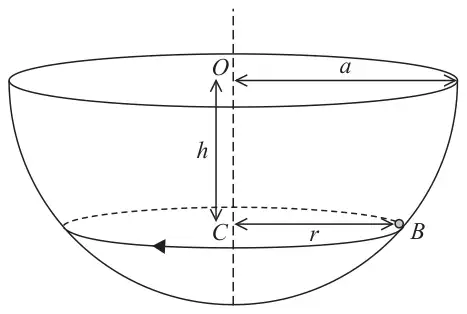
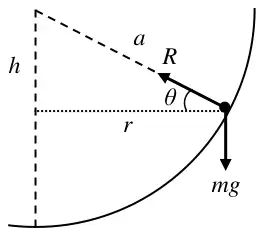
A thin hollow hemisphere, with centre \(O\) and radius \(a\), is fixed with its axis vertical, as shown in Figure 2.
A small ball \(B\) of mass \(m\) moves in a horizontal circle on the inner surface of the hemisphere. The circle has centre \(C\) and radius \(r\). The point \(C\) is vertically below \(O\) such that \(OC = h\).
The ball moves with constant angular speed \(\omega\)
The inner surface of the hemisphere is modelled as being smooth and \(B\) is modelled as a particle. Air resistance is modelled as being negligible.
(a) Show that \(\omega^2 = \dfrac{g}{h}\) (6)
Given that the magnitude of the normal reaction between \(B\) and the surface of the hemisphere is \(3mg\)
(b) find \(\omega\) in terms of \(g\) and \(a\). (3)
(c) State how, apart from ignoring air resistance, you have used the fact that \(B\) is modelled as a particle. (1)
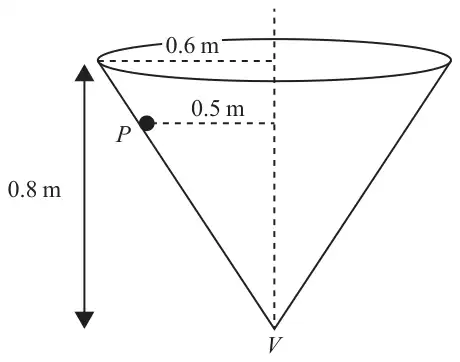
A hollow right circular cone, of internal base radius 0.6 m and height 0.8 m, is fixed with its axis vertical and its vertex \(V\) pointing downwards, as shown in Figure 4.
A particle \(P\) of mass \(m\) kg moves in a horizontal circle of radius 0.5 m on the rough inner surface of the cone.
The particle \(P\) moves with constant angular speed \(\omega\ \text{rad s}^{-1}\)
The coefficient of friction between the particle \(P\) and the inner surface of the cone is 0.25
Find the greatest possible value of \(\omega\) (9)
M1: Need all terms. Condone sign errors and sin/cos confusion.
A1: Unsimplified equation with at most one error.
A1: Correct unsimplified equation.
M1: Need all terms. Condone sign errors and sin/cos confusion in \(R\) or their \(R\).
A1: Unsimplified equation with at most one error.
A1: Correct unsimplified equation in \(R\) or their \(R\).
NB: if \(F\) in wrong direction count this as one error (not one in each equation) and deduct one accuracy mark in the first equation affected. Either / both equation(s) could be replaced with equations for resolving parallel and perpendicular to the surface. Perpendicular: \(R = mg\sin\theta + mr\omega^2\cos\theta \quad \left(R = \dfrac{3}{5}mg + \dfrac{2}{5}m\omega^2\right)\) Parallel: \(F + mg\cos\theta = mr\omega^2\sin\theta \quad \left(F + \dfrac{4}{5}mg = \dfrac{3}{10}m\omega^2\right)\) If they have more than 2 equations, mark the correct equations. If they go on to use an incorrect equation then DM0.
M1: Use of \(F = \mu R\) to eliminate \(F\) or \(R\) Condone inequality
DM1: Complete method including substitution of trig values to obtain a value for \(\omega\)
A1: 2 s.f or 3 s.f only \(\sqrt{\dfrac{19g}{4}}\) is A0 Must be an equation
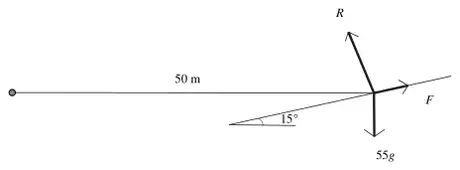
3. A girl is cycling round a circular track. The girl and her bicycle have a combined mass of 55 kg. The coefficient of friction between the track surface and the tyres of the bicycle is \(\mu\).
The track is banked at an angle of \(15^\circ\) to the horizontal.
The girl and her bicycle are modelled as a particle moving in a horizontal circle of radius 50 m The minimum speed at which the girl can cycle round this circle without slipping is \(4.5\ \text{m s}^{-1}\)
Using the model, find the value of \(\mu\). (9)
Mark scheme
Scheme
Marks
AO
They need to form two equations, they could be in either order. Mark in the order seen.
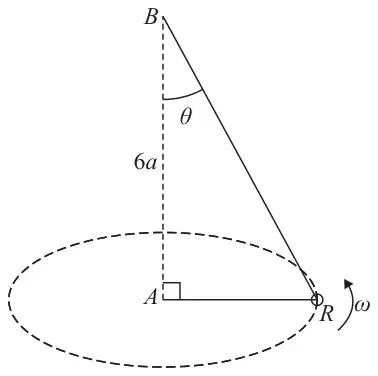
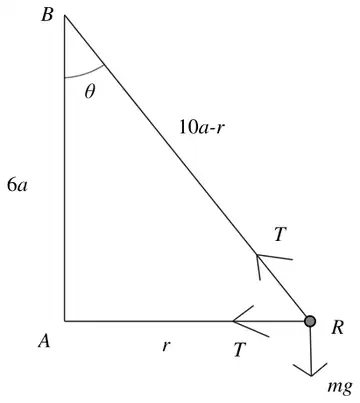
A small smooth ring \(R\) of mass \(m\) is threaded onto a light inextensible string. One end of the string is attached to a fixed point \(A\) and the other end of the string is attached to the fixed point \(B\) such that \(B\) is vertically above \(A\) and \(AB = 6a\)
The ring moves with constant angular speed \(\omega\) in a horizontal circle with centre \(A\). The string is taut and \(BR\) makes a constant angle \(\theta\) with the downward vertical, as shown in Figure 2.
The ring is modelled as a particle.
Given that \(\tan\theta = \dfrac{8}{15}\)
(a) find, in terms of \(m\) and \(g\), the magnitude of the tension in the string, (3)
(b) find \(\omega\) in terms of \(a\) and \(g\) (5)
M1: Equation for circular motion. Need all terms and dimensionally correct. Condone sin/cos confusion and sign errors. Any correct form for acceleration
M1: Clear attempt to substitute for trig and tension or divide their two equations to solve for \(\omega\) or \(\omega^2\) in terms of \(a\) and \(g\) Independent M mark but requires an equation using tension and trig.
A1: Any equivalent form \(0.72\sqrt{\dfrac{g}{a}}\) or better \((0.7216\ldots)\)
3. A cyclist is travelling around a circular track which is banked at an angle \(\alpha\) to the horizontal, where \(\tan\alpha = \dfrac{3}{4}\)
The cyclist moves with constant speed in a horizontal circle of radius \(r\).
In an initial model,
the cyclist and her cycle are modelled as a particle
the track is modelled as being rough so that there is sideways friction between the tyres of the cycle and the track, with coefficient of friction \(\mu\), where \(\mu \lt \dfrac{4}{3}\)
Using this model, the maximum speed that the cyclist can travel around the track in a horizontal circle of radius \(r\), without slipping sideways, is \(V\).
(a) Show that \(V = \sqrt{\dfrac{(3+4\mu)rg}{4-3\mu}}\) (7)
In a new simplified model,
the cyclist and her cycle are modelled as a particle
the motion is now modelled so that there is no sideways friction between the tyres of the cycle and the track
Using this new model, the speed that the cyclist can travel around the track in a horizontal circle of radius \(r\), without slipping sideways, is \(U\).
(b) Find \(U\) in terms of \(r\) and \(g\). (2)
(c) Show that \(U \lt V\). (2)
Mark scheme (a)
Scheme
Marks
AO
Resolving vertically
M1
3.4
\(R\cos\alpha - F\sin\alpha = mg\)
A1
1.1b
Equation of motion horizontally
M1
3.4
\(R\sin\alpha + F\cos\alpha = \dfrac{mV^2}{r}\)
A1
1.1b
Use of \(F = \mu R\)
M1
3.4
Solve for \(V\)
M1
3.1b
\(V = \sqrt{\dfrac{(3+4\mu)rg}{4-3\mu}}\) *
A1*
1.1b
(7)
Notes
M1: Correct no. of terms, dim correct, condone sin/cos confusion and sign errors
A1: Correct equation
M1: Correct no. of terms, dim correct, condone sin/cos confusion and sign errors
A1: Correct equation
M1: Independent but must be used in an equation
M1: Substitute for trig and solve for \(V\). Dependent on preceding M marks.
A1*: Correct given answer correctly obtained
Mark scheme (b)
Scheme
Marks
AO
Use of \(\mu = 0\) oe
M1
2.1
\(U = \sqrt{\dfrac{3rg}{4}}\)
A1
1.1b
(2)
Notes
M1: If they don’t use \(\mu = 0\), we need to see the first 6 marks from (a), without friction
A1: cao
Mark scheme (c)
Scheme
Marks
AO
Since \(3 + 4\mu \gt 3\) and \(4 - 3\mu \lt 4\) oe
M1
2.1
\(\dfrac{3}{4} \lt \dfrac{3+4\mu}{4-3\mu}\) and hence \(U \lt V\) *
A1*
2.2a
(2)
(11 marks)
Notes
M1: Any convincing argument
A1*: Given answer correctly obtained
SC: Allow M1A0 if they work in reverse to show that if \(U \lt V\) then \(\mu \gt 0\) and make an appropriate comment
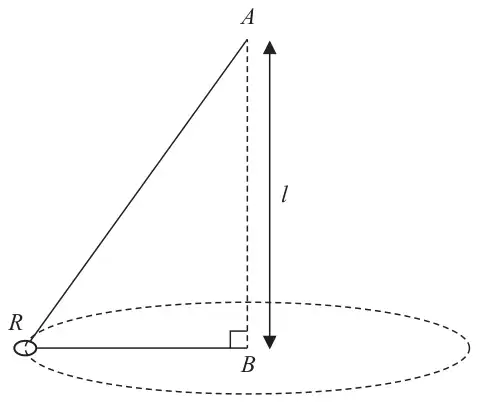
One end of a light inextensible string of length \(2l\) is attached to a fixed point \(A\). A small smooth ring \(R\) of mass \(m\) is threaded on the string and the other end of the string is attached to a fixed point \(B\). The point \(B\) is vertically below \(A\), with \(AB = l\). The ring is then made to move with constant speed \(V\) in a horizontal circle with centre \(B\). The string is taut and \(BR\) is horizontal, as shown in Figure 4.
(a) Show that \(BR = \dfrac{3l}{4}\) (2)
Given that air resistance is negligible,
(b) find, in terms of \(m\) and \(g\), the tension in the string, (4)
(c) find \(V\) in terms of \(g\) and \(l\). (4)
Mark scheme (a)
Scheme
Marks
AO
\(l^2 + r^2 = (2l - r)^2\), using Pythagoras
M1
1.1b
\(BR = \dfrac{3l}{4}\) *
A1*
1.1b
(2)
Notes
M1: Use of Pythagoras with one unknown
A1*: Correct length
Mark scheme (b)
Scheme
Marks
AO
Resolve vertically
M1
2.1
\(T\cos\alpha = mg\)
A1
1.1b
Overall strategy to solve problem: substitute for \(\cos\alpha\) and solve for \(T\)
M1
3.1b
\(T = \dfrac{5mg}{4}\)
A1
1.1b
(4)
Notes
M1: Allow sin/cos confusion
A1: Correct equation
M1: Substituting for their trig ratio and solving for \(T\)
A1: cao
Mark scheme (c)
Scheme
Marks
AO
Equation of motion horizontally
M1
2.1
\(T + T\sin\alpha = \dfrac{mV^2}{r}\)
A1
1.1b
Overall strategy to solve problem: substitute for \(T\), \(\sin\alpha\) and \(r\) and solve for \(V\)
M1
3.1b
\(V = \sqrt{\dfrac{3gl}{2}}\)
A1
1.1b
(4)
(10 marks)
Notes
M1: Correct no. of terms, dimensionally correct
A1: Correct equation
M1: Substitute for \(T\), \(\sin\alpha\) and \(r\) and solve for \(V\)
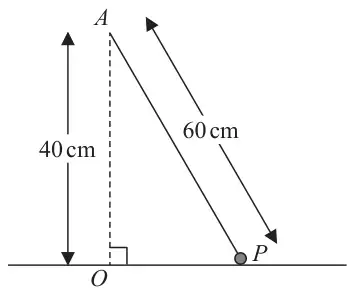
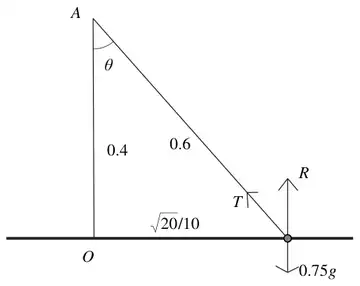
A particle \(P\) of mass 0.75 kg is attached to one end of a light inextensible string of length 60 cm. The other end of the string is attached to a fixed point \(A\) that is vertically above the point \(O\) on a smooth horizontal table, such that \(OA = 40\) cm. The particle remains in contact with the table, with the string taut, and moves in a horizontal circle with centre \(O\), as shown in Figure 4.
The particle is moving with a constant angular speed of 3 radians per second.
(a) Find
(i) the tension in the string,
(ii) the normal reaction between \(P\) and the table. (7)
The angular speed of \(P\) is now gradually increased.
(b) Find the angular speed of \(P\) at the instant \(P\) loses contact with the table. (4)
Second A1 line: corrected from the printed mark scheme: the printed line reads \(0.75\times\sin\theta\times 9 = T\sin\theta\), missing the radius \(0.6\sin\theta\) (the bracketed line and part (b) both use it).
M1: Correct number of terms
A1: Correct unsimplified equation
M1: Circular motion. Condone confusion over units. \(\dfrac{\sqrt{20}}{10}\) might not be seen as \(r\) cancels.
A1: Correct unsimplified equation
M1: Complete strategy to form sufficient equations to solve for \(T\) and \(R\).
A1: One force correct
A1: Both correct (Finding value for \(R\) involves \(g\))
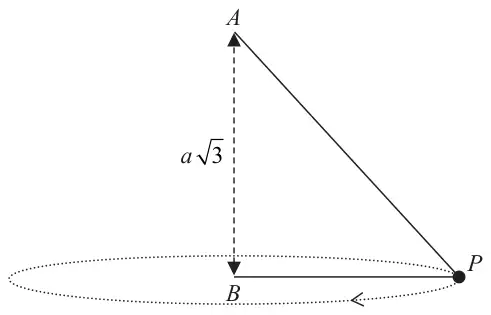
One end of a string of length \(3a\) is attached to a point \(A\) and the other end is attached to a point \(B\) on a smooth horizontal table. The point \(B\) is vertically below \(A\) with \(AB = a\sqrt{3}\) A small smooth bead, \(P\), of mass \(m\) is threaded on to the string. The bead \(P\) moves on the table in a horizontal circle, with centre \(B\), with constant speed \(U\). Both portions, \(AP\) and \(BP\), of the string are taut, as shown in Figure 2.
The string is modelled as being light and inextensible and the bead is modelled as a particle.
(a) Show that \(AP = 2a\) (2)
(b) Find, in terms of \(m\), \(U\) and \(a\), the tension in the string. (4)
(c) Show that \(U^2 \lt ag\sqrt{3}\) (5)
(d) Describe what would happen if \(U^2 \gt ag\sqrt{3}\) (1)
(e) State briefly how the tension in the string would be affected if the string were not modelled as being light. (1)
Mark scheme (a)
Scheme
Marks
AO
\((a\sqrt{3})^2 + (3a - AP)^2 = AP^2\)
M1
1.1b
\(AP = 2a\) *
A1*
1.1b
(2)
Notes
M1: Use of Pythagoras \(3a^2 + 9a^2 - 6a \times AP + AP^2 = AP^2 \Rightarrow 6a \times AP = 12a^2\)
A1: \(AP = 2a\). GIVEN ANSWER
Mark scheme (b)
Scheme
Marks
AO
Equation of motion horizontally
M1
3.1b
\(T + T \times \dfrac{1}{2} = \dfrac{mU^2}{a}\)
A1 A1
1.1b 1.1b
\(T = \dfrac{2mU^2}{3a}\)
A1
2.2a
(4)
Notes
M1: Use of horizontal equation to solve the problem, with correct no. of terms etc
A1: Equation with at most one error
A1: Correct equation
A1: Correct answer
Mark scheme (c)
Scheme
Marks
AO
Resolving vertically
M1
3.1b
\(R + T \times \dfrac{\sqrt{3}}{2} = mg\)
A1
1.1b
On the table \(\Rightarrow R \gt 0\)
M1
2.1
\(mg - \dfrac{2mU^2\sqrt{3}}{3a \times 2} \gt 0\)
A1
1.1b
\(U^2 \lt ag\sqrt{3}\) *
A1*
2.2a
(5)
Notes
M1: Use of vertical resolution to solve the problem, with correct no. of terms etc
3. A light inextensible string has length \(8a\). One end of the string is attached to a fixed point \(A\) and the other end of the string is attached to a fixed point \(B\), with \(A\) vertically above \(B\) and \(AB = 4a\). A small ball of mass \(m\) is attached to a point \(P\) on the string, where \(AP = 5a\).
The ball moves in a horizontal circle with constant speed \(v\), with both \(AP\) and \(BP\) taut.
The string will break if the tension in it exceeds \(\dfrac{3mg}{2}\) By modelling the ball as a particle and assuming the string does not break,
(a) show that \(\dfrac{9ag}{4} \lt v^2 \leqslant \dfrac{27ag}{4}\) (7)
(b) find the least possible time needed for the ball to make one complete revolution. (2)
Mark scheme (a)
Scheme
Marks
AO
No vertical motion: \(T_A\cos\theta = mg\)
M1
1.1b
\(T_A = \dfrac{5mg}{4}\)
A1
1.1b
Circular motion: \(T_B + T_A\sin\theta = m \times \dfrac{v^2}{r}\)
N.B. If they have the same tension in both parts of the string, can score ONLY first M1A1 for a correct equation.
N.B. If no right angle at \(B\), could score max: M1A0M1A0DM1DM1A0
M1: One equation in \(T_A\) and / or \(T_B\). Dimensionally correct, with all relevant terms. Condone sign errors and sin/cos oe confusion
A1: Correct equation (no trig)
M1: Form a second equation in \(T_A\) and / or \(T_B\). Dimensionally correct, with all relevant terms. Condone sign errors and sin/cos oe confusion. Allow \(mr\omega^2\)
A1: Correct equation (no trig)
DM1: Use the model to form one inequality or equation in \(v^2\), \(a\) and \(g\) only, dependent on both M’s
DM1: Use the model to form a second inequality or equation in \(v^2\), \(a\) and \(g\) only dependent on both M’s Allow use of \(T_B = \dfrac{3mg}{2}\) or \(T_B \lt \dfrac{3mg}{2}\)
A1*: Deduce the given answer from correct working. Only available if working with inequalities throughout and fully correct
Mark scheme (b)
Scheme
Marks
AO
Use \(v^2 = \dfrac{27ag}{4}\) and \(T = \dfrac{2\pi r}{v}\) oe
M1
3.1b
\(T = 4\pi\sqrt{\dfrac{a}{3g}}\)
A1
1.1b
(2)
(9 marks)
Notes
M1: Correct method to find \(T\) in terms of \(a\) and (\(g\)) only. They may sub 9.8 for \(g\) of course
A1: Any equivalent form but no fractions within fractions. If they use 9.8 for \(g\), the numerical part needs to be to 2 sf or 3sf. i.e \(2.3\sqrt{a}\) or \(2.32\sqrt{a}\)
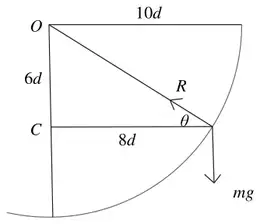
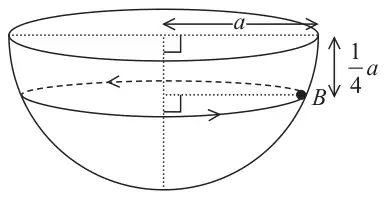
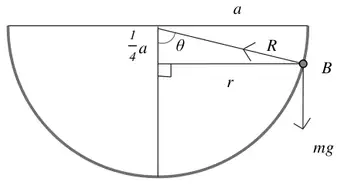
A hemispherical shell of radius \(a\) is fixed with its rim uppermost and horizontal. A small bead, \(B\), is moving with constant angular speed, \(\omega\), in a horizontal circle on the smooth inner surface of the shell. The centre of the path of \(B\) is at a distance \(\dfrac{1}{4}a\) vertically below the level of the rim of the hemisphere, as shown in Figure 1.
Find the magnitude of \(\omega\), giving your answer in terms of \(a\) and \(g\). (6)
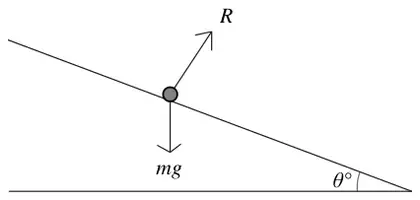
2. A car moves round a bend which is banked at a constant angle of \(\theta^\circ\) to the horizontal.
When the car is travelling at a constant speed of \(80\ \text{km h}^{-1}\) there is no sideways frictional force on the car. The car is modelled as a particle moving in a horizontal circle of radius \(500\ \text{m}\).
(a) Find the value of \(\theta\). (7)
(b) Identify one limitation of this model. (1)
The speed of the car is increased so that it is now travelling at a constant speed of \(90\ \text{km h}^{-1}\) The car is still modelled as a particle moving in a horizontal circle of radius \(500\ \text{m}\).
(c) Describe the extra force that will now be acting on the car, stating the direction of this force. (1)