
AS June 2019 Q3
3. A light inextensible string has length \(8a\). One end of the string is attached to a fixed point \(A\) and the other end of the string is attached to a fixed point \(B\), with \(A\) vertically above \(B\) and \(AB = 4a\). A small ball of mass \(m\) is attached to a point \(P\) on the string, where \(AP = 5a\).
The ball moves in a horizontal circle with constant speed \(v\), with both \(AP\) and \(BP\) taut.
The string will break if the tension in it exceeds \(\dfrac{3mg}{2}\)
By modelling the ball as a particle and assuming the string does not break,
| Scheme | Marks | AO |
|---|---|---|
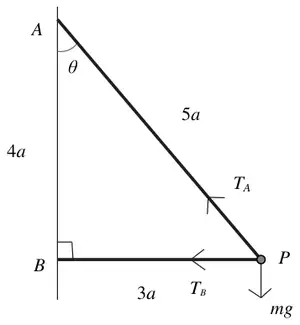 | ||
| No vertical motion: \(T_A\cos\theta = mg\) | M1 | 1.1b |
| \(T_A = \dfrac{5mg}{4}\) | A1 | 1.1b |
| Circular motion: \(T_B + T_A\sin\theta = m \times \dfrac{v^2}{r}\) | M1 | 3.1b |
| \(T_B + \dfrac{3}{5}T_A = m\dfrac{v^2}{3a}\) | A1 | 1.1b |
| \(T_B \gt 0\ \left(\Rightarrow v^2 \gt \dfrac{9ag}{4}\right)\) | DM1 | 2.1 |
| \(T_B \leqslant \dfrac{3mg}{2} \Rightarrow m\dfrac{v^2}{3a} - \dfrac{3}{4}mg \leqslant \dfrac{3}{2}mg,\ \left(m\dfrac{v^2}{3a} \leqslant \dfrac{9mg}{4}\right)\) | DM1 | 2.1 |
| \(\Rightarrow \dfrac{9ag}{4} \lt v^2 \leqslant \dfrac{27ag}{4}\) * | A1* | 2.2a |
| (7) |
Notes
N.B. If they have the same tension in both parts of the string, can score ONLY first M1A1 for a correct equation.
N.B. If no right angle at \(B\), could score max: M1A0M1A0DM1DM1A0
M1: One equation in \(T_A\) and / or \(T_B\). Dimensionally correct, with all relevant terms. Condone sign errors and sin/cos oe confusion
A1: Correct equation (no trig)
M1: Form a second equation in \(T_A\) and / or \(T_B\). Dimensionally correct, with all relevant terms. Condone sign errors and sin/cos oe confusion. Allow \(mr\omega^2\)
A1: Correct equation (no trig)
DM1: Use the model to form one inequality or equation in \(v^2\), \(a\) and \(g\) only, dependent on both M’s
DM1: Use the model to form a second inequality or equation in \(v^2\), \(a\) and \(g\) only dependent on both M’s
Allow use of \(T_B = \dfrac{3mg}{2}\) or \(T_B \lt \dfrac{3mg}{2}\)
A1*: Deduce the given answer from correct working. Only available if working with inequalities throughout and fully correct
| Scheme | Marks | AO |
|---|---|---|
| Use \(v^2 = \dfrac{27ag}{4}\) and \(T = \dfrac{2\pi r}{v}\) oe | M1 | 3.1b |
| \(T = 4\pi\sqrt{\dfrac{a}{3g}}\) | A1 | 1.1b |
| (2) | ||
| (9 marks) |
Notes
M1: Correct method to find \(T\) in terms of \(a\) and (\(g\)) only.
They may sub 9.8 for \(g\) of course
A1: Any equivalent form but no fractions within fractions.
If they use 9.8 for \(g\), the numerical part needs to be to 2 sf or 3sf. i.e \(2.3\sqrt{a}\) or \(2.32\sqrt{a}\)