2. A van of mass 900 kg is moving along a straight horizontal road.
When the speed of the van is \(v\ \text{m s}^{-1}\), the resistance to the motion of the van is modelled as a force of magnitude \(50v\) N.
The engine of the van is working at a constant rate of 12 kW.
At the instant when the speed of the van is \(V\ \text{m s}^{-1}\), the acceleration of the van is \(0.2\ \text{m s}^{-2}\)
Using the model,
(a) find the value of \(V\). (4)
Later on, the van is moving up a straight road that is inclined at an angle \(\alpha\) to the horizontal, where \(\sin\alpha = \dfrac{1}{12}\). When the speed of the van is \(v\ \text{m s}^{-1}\), the resistance to the motion of the van from non-gravitational forces is modelled as a force of magnitude \(50v\) N.
When the van has constant speed \(U\ \text{m s}^{-1}\), the engine of the van is working at a constant rate of 15 kW.
Using the model,
(b) find the value of \(U\). (4)
Mark scheme (a)
Scheme
Marks
AO
Equation of motion of the van
M1
3.3
\(F - 50V = 900 \times 0.2\)
A1
1.1b
Use of \(P = FV\) \(\left(\dfrac{12000}{V} - 50V = 900 \times 0.2\right)\)
M1: Form an equation of motion for the van to produce an equation in \(V\) only or form an equation of motion for the van to produce an equation in \(V\) and \(F\) only where \(F\) is the driving force of the van’s engine. Must be dimensionally correct with required terms. Condone sign errors.
A1: Correct unsimplified equation.
M1: Use of \(P = FV\) where \(F\) is the driving force of the van’s engine. Implied by use of \(\dfrac{12000}{V}\) with their equation of motion. Condone use of 12 or a slip with the number of zeros for this M mark.
A1: Obtain only 14 or better (correctly rounded). Calculator display gives 13.79615337. If a negative value is seen, it must be rejected.
M1: Form equation of motion for the van with \(a = 0\) to produce an equation in \(U\) only or in \(U\) and \(F\) only. Must be dimensionally correct with required terms. Condone sign errors and sin/cos confusion. Condone use of another letter instead of \(U\) throughout. Condone use of 15 or a slip with the number of zeros. M0 if the answer from (a) is used in (b). M0 for use of \(P = 12\,000\)
A1: Unsimplified equation in \(F\) and \(U\) (or \(U\) only) with at most one error. Trig and \(F\) do not need not be replaced.
A1: Correct unsimplified equation in \(U\) only (trig and \(F\) replaced).
A1: Obtain only 11 or 11.5 (2 or 3sf after use of 9.8). If a negative value is seen, it must be rejected. A0 if the answer follows use of \(g = 9.81\ \text{m s}^{-2}\)
1. A car of mass 1000 kg moves along a straight horizontal road at a constant speed \(U\ \text{m s}^{-1}\). The engine of the car is working at a rate of 20 kW.
The total resistance to the motion of the car is modelled as a constant force of magnitude 1600 N.
Using the model,
(a) find the value of \(U\). (3)
Later on, the car moves down a straight road which is inclined to the horizontal at an angle \(\alpha\), where \(\sin\alpha = \dfrac{1}{49}\)
The total resistance to the motion of the car is again modelled as a constant force of magnitude 1600 N.
At the instant when the engine of the car is working at a rate of 20 kW and the speed of the car is \(8\ \text{m s}^{-1}\), the acceleration of the car is \(a\ \text{m s}^{-2}\)
Using the model,
(b) find the value of \(a\). (4)
(c) State one improvement to the model that would make it more realistic. (1)
Mark scheme (a)
Scheme
Marks
AO
Equation of motion
M1
3.4
\(\dfrac{20000}{U} - 1600 = 0\)
A1
1.1b
\(U = 12.5\)
A1
1.1b
(3)
Notes
M1: Allow \(F - 1600 = 0\) or \(F = 1600\)
A1: Correct equation in \(U\) only.
A1: Allow 13 N.B. A correct answer only, with no working, can score all 3 marks.
Mark scheme (b)
Scheme
Marks
AO
\(\dfrac{20000}{8} = F\), the driving force
B1
3.3
Equation of motion
M1
3.1b
\(F + 1000g\sin\alpha - 1600 = 1000a\)
A1
1.1b
\(a = 1.1\)
A1
1.1b
(4)
Notes
B1: Seen or implied. Allow 20 instead of 20000. B0 if they use \(\dfrac{20000}{8}\) as the resultant force not the driving force.
M1: Correct no. of terms, condone sign errors and sin/cos confusion.
A1: Correct equation.
A1: cao
Mark scheme (c)
Scheme
Marks
AO
E.g. Make the resistance dependent on the speed. Make the resistance variable (not constant)
B1
3.5c
B0: Anything which is not related to the model i.e. to the total resistance being constant. e.g. Model the road as rough, include friction, include air resistance, unevenness of the road, more accurate value of \(g\), make air resistance dependent on the speed. N.B. If there is more than one answer, penalise incorrect extras once e.g. one correct, one incorrect is B0.
3. A car of mass 1000 kg moves in a straight line along a horizontal road at a constant speed of \(72\ \text{km h}^{-1}\)
The resistance to the motion of the car is modelled as a constant force of magnitude 900 N
The engine of the car is working at a constant rate of \(P\) kW.
Using the model,
(a) find the value of \(P\). (3)
The car now travels in a straight line up a road which is inclined to the horizontal at an angle \(\alpha\), where \(\sin\alpha = \dfrac{2}{49}\)
In a refined model, the resistance to the motion of the car from non-gravitational forces is now modelled as a force of magnitude \(20v\) newtons, where \(v\ \text{m s}^{-1}\) is the speed of the car
At the instant when the engine of the car is working at a constant rate of 30 kW and the car is moving up the road at \(10\ \text{m s}^{-1}\), the acceleration of the car is \(a\ \text{m s}^{-2}\)
Using the refined model,
(b) find the value of \(a\). (4)
Later on, when the engine of the car is again working at a constant rate of 30 kW, the car is moving up the road at a constant speed \(U\ \text{m s}^{-1}\)
Using the refined model,
(c) find the value of \(U\). (5)
Mark scheme (a)
Scheme
Marks
AO
Use \(F = \dfrac{1000P}{v}\) where \(v = \dfrac{72000}{3600}\ (= 20)\)
M1
3.3
Use equation of motion: \(F - 900 = 0\) to give equation in \(P\) only: Eg \(\dfrac{1000P}{20} = 900\)
M1
3.1b
\(P = 18\)
A1
1.1b
(3)
Notes
M1: Use of \(P = Fv\), condone \(\dfrac{P}{72}\) or \(\dfrac{P}{20}\)
M1: Use equation of motion to give equation in \(P\) only. Condone use of \(P\) instead of \(1000P\) and condone 72 instead of 20 for method mark. \(\dfrac{1000P}{20} = 900\) or \(\dfrac{P}{20} = 900\)
A1: Cao Allow \(P = 18\,000\) leading to a final answer of \(P = 18\). Ignore units.
Mark scheme (b)
Scheme
Marks
AO
Use equation of motion for car and power equation to give equation in \(a\) only
NB: Only penalise use of \(g = 9.81\) once per question
M1: Use equation of motion for the car and power equation to give a dimensionally correct equation in \(a\) only. All required terms present and no extras, resolving only where necessary. Condone \(\pm\) sign errors and cos/sin confusion. M0 if a term is missing or if weight is not resolved.
A1: Correct equation in \(a\) only with at most one error.
A1: Correct equation in \(a\) only
A1: Answer of 2.4 only A0 for \(\tfrac{12}{5}\) (when using \(g = 9.8\), answers must be rounded to 2/3sf, not given in exact form) A0 for use of \(g = 9.81\)
NB: Only penalise use of \(g = 9.81\) once per question
M1: Use of \(P = Fv\), condone incorrect number of zeros M0 if using speed of 10 from part (b)
M1: Equation of motion for the car: all required terms present and no extras, resolving only where necessary, dimensionally correct. Condone \(\pm\) sign errors and cos/sin confusion. M0 if a term is missing or if weight is not resolved. M0 if using resistance of 200 from part (b)
A1: A correct unsimplified equation, \(F\) does not need to be substituted, sin/cos does not need to be substituted.
In all circumstances, when the speed of the lorry is \(v\ \text{m s}^{-1}\), the resistance to motion of the lorry from non-gravitational forces is modelled as having magnitude \(490v\) newtons.
The lorry moves along a straight horizontal road at \(12\ \text{m s}^{-1}\), with its engine working at a constant rate of 84 kW.
Using the model,
(a) find the acceleration of the lorry. (4)
Another straight road is inclined to the horizontal at an angle \(\alpha\) where \(\sin\alpha = \dfrac{1}{14}\)
With its engine again working at a constant rate of 84 kW, the lorry can maintain a constant speed of \(V\ \text{m s}^{-1}\) up the road.
Using the model,
(b) find the value of \(V\). (4)
Mark scheme (a)
Scheme
Marks
AO
Use of \(F = \dfrac{84000}{12}\)
M1
3.4
Equation of motion horizontally
M1
3.1b
\(\dfrac{84000}{12} - 490 \times 12 = 5000a\)
A1
1.1b
\(\dfrac{28}{125}\) or 0.224 or 0.22 \((\text{m s}^{-2})\)
A1
1.1b
(4)
Notes
M1: Allow use of 84
M1: Correct no. of terms, condone sign errors. Allow if they use 84 or 84000 as the driving force
A1: Correct equation
A1: Accept 0.22
Mark scheme (b)
Scheme
Marks
AO
Use of \(D = \dfrac{84000}{V}\)
M1
3.4
Equation of motion parallel to the road: \(D - 490V - 5000g\sin\alpha = 0\)
M1
2.1
\(\dfrac{84000}{V} - 490V - 5000g\sin\alpha = 0\)
A1
1.1b
\(V = 10\) only
A1
1.1b
(4)
(8 marks)
Notes
M1: Allow use of 84
M1: Equation in \(V\) only with correct no. of terms, condone sign errors and sin/cos confusion and omitted \(g\) with \(D\) in terms of \(V\).
2. A car of mass 1000 kg moves in a straight line along a horizontal road at a constant speed \(U\ \text{m s}^{-1}\). The resistance to the motion of the car is a constant force of magnitude 400 N.
The engine of the car is working at a constant rate of 16 kW.
(a) Find the value of \(U\). (3)
The car now pulls a trailer of mass 600 kg in a straight line along the road using a tow rope which is parallel to the direction of motion. The resistance to the motion of the car is again a constant force of magnitude 400 N. The resistance to the motion of the trailer is a constant force of magnitude 300 N.
The engine of the car is working at a constant rate of 16 kW.
The tow rope is modelled as being light and inextensible.
Using the model,
(b) find the tension in the tow rope at the instant when the speed of the car is \(\dfrac{20}{3}\ \text{m s}^{-1}\) (5)
Mark scheme (a)
Scheme
Marks
AO
\(F = \dfrac{16000}{v}\)
M1
3.3
Equation of motion: \(F - 400 = 0\)
M1
3.1b
\(U = 40\)
A1
1.1b
(3)
Notes
M1: Correct use of \(P = Fv\). The expression \(\dfrac{16000}{v}\) may be on a diagram or embedded in their \(F = ma\). Condone use of 16 000 or 16 for the method mark.
M1: Correct unsimplified equation of motion with \(a = 0\) or equilibrium equation. \(F\) does not need to be substituted.
A1: cao
Mark scheme (b)
Scheme
Marks
AO
\(F = \dfrac{16000}{\left(\frac{20}{3}\right)}\)
M1
3.3
Equation of motion for system or car or trailer:
M1
3.1b
\(F - 700 = 1600a\) or \(F - 400 - T = 1000a\) or \(T - 300 = 600a\)
A1
1.1b
Second equation of motion
A1
1.1b
\(T = 940\) or \(938\) or \(937.5\) or \(\dfrac{1875}{2}\) oe (N)
A1
1.1b
(5)
(8 marks)
Notes
M1: Correct use of \(P = Fv\) with \(v = \dfrac{20}{3}\). This expression may be on the diagram or embedded in their \(F = ma\). Condone use of 16 000 or 16 for the method mark.
M1: An equation of motion for the whole system or car or trailer. Must have all terms and be dimensionally correct. Condone sign errors. M0 if \(a = 0\) is used. NB: Full marks in (b) can be scored if consistent extra \(g\)’s (must be present in both ‘\(ma\)’ terms in a complete solution). Otherwise penalise as A error.
A1: One correct unsimplified equation.
A1: Two correct unsimplified equations. Note: \(a = \dfrac{17}{16}\) but does not need to be seen.
2. A racing car of mass 750 kg is moving along a straight horizontal road at a constant speed of \(U\) km h−1. The engine of the racing car is working at a constant rate of 60 kW.
The resistance to the motion of the racing car is modelled as a force of magnitude \(37.5v\) N, where \(v\ \text{m s}^{-1}\) is the speed of the racing car.
Using the model,
(a) find the value of \(U\) (4)
Later on, the racing car is accelerating up a straight road which is inclined to the horizontal at an angle \(\alpha\), where \(\sin\alpha = \dfrac{5}{49}\). The engine of the racing car is working at a constant rate of 60 kW.
The total resistance to the motion of the racing car from non-gravitational forces is modelled as a force of magnitude \(37.5v\) N, where \(v\ \text{m s}^{-1}\) is the speed of the racing car. At the instant when the acceleration of the racing car is \(2\ \text{m s}^{-2}\), the speed of the racing car is \(V\ \text{m s}^{-1}\)
Using the model,
(b) find the value of \(V\) (4)
Mark scheme (a)
Scheme
Marks
AO
\(F = \dfrac{60000}{v}\)
M1
3.3
Equation of motion parallel to the road, \(F - 37.5v = 0\)
M1
3.1b
\(\dfrac{60000}{v} - 37.5v = 0\) (Allow \(v\) replaced by \(U\))
A1
1.1b
\(U = 144\)
A1
1.1b
(4)
Notes
M1: Use of \(P = Fv\) with \(P = 60\) or 60000. Allow \(U\) instead of \(v\). N.B. Allow if seen in (b).
M1: Equation of motion with correct no. of terms, condone sign errors, and allow \(U\) instead of \(v\). Neither \(v\) nor \(F\) need to be substituted. N.B. M0 for \(60000 - 37.5v = 0\)
A1: Correct unsimplified equation in \(v\) only, seen or implied. A0 if they replace only one of the \(v\)’s by \(U\)
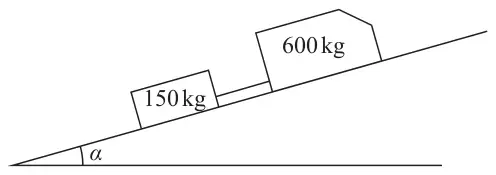
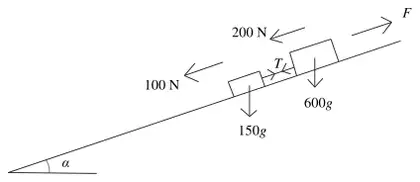
A van of mass 600 kg is moving up a straight road which is inclined at an angle \(\alpha\) to the horizontal, where \(\sin\alpha = \dfrac{1}{15}\). The van is towing a trailer of mass 150 kg. The van is attached to the trailer by a towbar which is parallel to the direction of motion of the van and the trailer, as shown in Figure 1.
The resistance to the motion of the van from non-gravitational forces is modelled as a constant force of magnitude 200 N. The resistance to the motion of the trailer from non-gravitational forces is modelled as a constant force of magnitude 100 N.
The towbar is modelled as a light rod.
The engine of the van is working at a constant rate of 12 kW.
Find the tension in the towbar at the instant when the speed of the van is \(9\ \text{m s}^{-1}\) (8)
M1: Need all terms and no extras (the inclusion of \(+T\) \(-T\) is not an error). Dimensionally correct. Condone sign errors and sin/cos confusion Must have non-zero acceleration and include the driving force
A1: Unsimplified equation in \(F\) or their \(F\) (and \(T\) if relevant) with at most one error
A1: Correct unsimplified equation in \(F\) or their \(F\) (and \(T\) if relevant)
M1: Need all terms. Dimensionally correct. Condone sign errors and sin/cos confusion Or a second equation of motion involving the driving force.
A1: Correct unsimplified equation (in \(T\) and / or \(F\) or their \(F\) if relevant)
M1:Use of \(P = Fv\) seen or implied.
M1:Complete method to find \(T\) \(\big(\text{FYI}: a = 0.72(4)\big)\)
A1: Tension correct to 3 sf or 2 sf A fractional answer \(\left(\dfrac{920}{3}\right)\) is not acceptable because this result follows the use of \(g = 9.8\)
1. A car of mass 1200 kg moves up a straight road that is inclined to the horizontal at an angle \(\alpha\), where \(\sin\alpha = \dfrac{1}{15}\)
The total resistance to the motion of the car from non-gravitational forces is modelled as a constant force of magnitude \(R\) newtons.
At the instant when the engine of the car is working at a rate of 32 kW and the speed of the car is \(20\ \text{m s}^{-1}\), the acceleration of the car is \(0.5\ \text{m s}^{-2}\)
Find the value of \(R\) (5)
Mark scheme
Scheme
Marks
AO
\(F = \dfrac{32000}{20}\)
M1
3.3
Equation of motion
M1
3.1b
\(F - 1200g\sin\alpha - R = 1200 \times 0.5\)
A1
1.1b
Substitute for \(g\), trig and \(F\) and solve for \(R\)
DM1
1.1b
\(R = 216\) or 220 (N)
A1
1.1b
(5)
(5 marks)
Notes
M1: Use of \(P = Fv\). Allow \(\dfrac{32}{20}\). Allow \(32000 = 20F\) or \(32 = 20F\), followed by an error when dividing M0 for \(32000 = 20(F - R)\) or similar
M1: Correct no. of terms, condone sign errors and sin/cos confusion M0 if they use power in equation of motion
A1: Correct equation
DM1: Dependent on second M1 (allow if \(g\) missing)
1. A van of mass 900 kg is moving along a straight horizontal road.
At the instant when the speed of the van is \(v\ \text{m s}^{-1}\), the resistance to the motion of the van is modelled as a force of magnitude \((500 + 7v)\) N.
When the engine of the van is working at a constant rate of 18 kW, the van is moving along the road at a constant speed \(V\ \text{m s}^{-1}\)
(a) Find the value of \(V\). (5)
Later on, the van is moving up a straight road that is inclined to the horizontal at an angle \(\theta\), where \(\sin\theta = \dfrac{1}{21}\)
At the instant when the speed of the van is \(v\ \text{m s}^{-1}\), the resistance to the motion of the van from non-gravitational forces is modelled as a force of magnitude \((500 + 7v)\) N.
The engine of the van is again working at a constant rate of 18 kW.
(b) Find the acceleration of the van at the instant when \(v = 15\) (4)
Mark scheme (a)
Scheme
Marks
AO
Equation of motion: \(F = 500 + 7V\)
M1
3.3
Use of \(18000 = F \times V\)
M1
3.4
\(\Rightarrow \dfrac{18000}{V} = 500 + 7V\)
A1
1.1b
\(\Rightarrow 7V^2 + 500V - 18000 = 0\)
M1
1.1b
\(V = 26\ \ (26.309\ldots)\)
A1
1.1b
(5)
Notes
M1: Dimensionally correct. Condone sign errors. Must be using \(a = 0\)
M1: Correct use of \(P = Fv\)
A1: Correct unsimplified equation. Allow with \(F\). Allow with 18K
2. A truck of mass 1200 kg is moving along a straight horizontal road.
At the instant when the speed of the truck is \(v\ \text{m s}^{-1}\), the resistance to the motion of the truck is modelled as a force of magnitude \((900 + 9v)\) N.
The engine of the truck is working at a constant rate of 25 kW.
(a) Find the deceleration of the truck at the instant when \(v = 25\) (4)
Later on, the truck is moving up a straight road that is inclined at an angle \(\theta\) to the horizontal, where \(\sin\theta = \dfrac{1}{20}\)
At the instant when the speed of the truck is \(v\ \text{m s}^{-1}\), the resistance to the motion of the truck from non-gravitational forces is modelled as a force of magnitude \((900 + 9v)\) N.
When the engine of the truck is working at a constant rate of 25 kW the truck is moving up the road at a constant speed of \(V\ \text{m s}^{-1}\).
2. A car of mass 1000 kg moves along a straight horizontal road.
In all circumstances, when the speed of the car is \(v\ \text{m s}^{-1}\), the resistance to the motion of the car is modelled as a force of magnitude \(cv^2\) N, where \(c\) is a constant.
The maximum power that can be developed by the engine of the car is 50 kW.
At the instant when the speed of the car is \(72\ \text{km h}^{-1}\) and the engine is working at its maximum power, the acceleration of the car is \(2.25\ \text{m s}^{-2}\)
(a) Convert \(72\ \text{km h}^{-1}\) into \(\text{m s}^{-1}\) (1)
(b) Find the acceleration of the car at the instant when the speed of the car is \(144\ \text{km h}^{-1}\) and the engine is working at its maximum power. (7)
The maximum speed of the car when the engine is working at its maximum power is \(V\ \text{km h}^{-1}\).
(c) Find, to the nearest whole number, the value of \(V\). (4)
Mark scheme (a)
Scheme
Marks
AO
\(72\ \text{km h}^{-1} = 20\ \text{m s}^{-1}\)
B1
1.1b
(1)
Notes
B1: \(20\ \text{m s}^{-1}\) seen
Mark scheme (b)
Scheme
Marks
AO
Use of \(F = \dfrac{P}{v}\) and using the model
M1
3.4
Equation of motion and using the model to form equation in \(c\)
4. A car of mass 600 kg pulls a trailer of mass 150 kg along a straight horizontal road. The trailer is connected to the car by a light inextensible towbar, which is parallel to the direction of motion of the car. The resistance to the motion of the trailer is modelled as a constant force of magnitude 200 N. At the instant when the speed of the car is \(v\ \text{m s}^{-1}\), the resistance to the motion of the car is modelled as a force of magnitude \((200 + \lambda v)\) N, where \(\lambda\) is a constant.
When the engine of the car is working at a constant rate of 15 kW, the car is moving at a constant speed of \(25\ \text{m s}^{-1}\)
(a) Show that \(\lambda = 8\) (4)
Later on, the car is pulling the trailer up a straight road inclined at an angle \(\theta\) to the horizontal, where \(\sin\theta = \dfrac{1}{15}\)
The resistance to the motion of the trailer from non-gravitational forces is modelled as a constant force of magnitude 200 N at all times. At the instant when the speed of the car is \(v\ \text{m s}^{-1}\), the resistance to the motion of the car from non-gravitational forces is modelled as a force of magnitude \((200 + 8v)\) N.
The engine of the car is again working at a constant rate of 15 kW.
When \(v = 10\), the towbar breaks. The trailer comes to instantaneous rest after moving a distance \(d\) metres up the road from the point where the towbar broke.
(b) Find the acceleration of the car immediately after the towbar breaks. (4)
(c) Use the work-energy principle to find the value of \(d\). (4)
Mark scheme (a)
Scheme
Marks
AO
Use of \(P = Fv\): \(F = \dfrac{15000}{25}\ (= 600)\)
B1
3.3
Equation of motion:
M1
3.4
\(F - (200 + 200 + 25\lambda) = 0\)
A1
1.1b
\(\lambda = 8\) *
A1*
2.2a
(4)
Notes
B1: 600 or equivalent
M1: Use the model to form the equation of motion If they start with two separate equations each one must be correct.
M1: Use the model to form the equation of motion for the car (with \(v = 10\) used). All terms required. Dimensionally correct. Condone sign error and sin/cos confusion
A1 A1: Unsimplified equation with at most one error. Correct unsimplified equation
1. A lorry of mass 16 000 kg moves along a straight horizontal road.
The lorry moves at a constant speed of \(25\ \text{m s}^{-1}\)
In an initial model for the motion of the lorry, the resistance to the motion of the lorry is modelled as having constant magnitude 16 000 N.
(a) Show that the engine of the lorry is working at a rate of 400 kW. (4)
The model for the motion of the lorry along the same road is now refined so that when the speed of the lorry along the same road is \(V\ \text{m s}^{-1}\), the resistance to the motion of the lorry is modelled as having magnitude \(640V\) newtons.
Assuming that the engine of the lorry is working at the same rate of 400 kW
(b) use the refined model to find the speed of the lorry when it is accelerating at \(2.1\ \text{m s}^{-2}\) (6)
Mark scheme (a)
Scheme
Marks
AO
Equation of motion parallel to the road with \(a = 0\) and using the model
M1
3.3
\(F - 16000 = 0\)
A1
1.1b
\(P = 16\,000 \times 25\)
M1
3.4
\(= 400\,000 = 400\ \text{kW}\) *
A1*
1.1b
(4)
Notes
M1: Correct no. of terms with \(a = 0\), condone sign errors Given answer, so step must be seen, but allow if in verbal form or on a diagram.
A1: Correct equation
M1: Use of \(P = Fv\) Independent mark - could be the first mark seen
A1*: Obtain given answer from correct working
Mark scheme (b)
Scheme
Marks
AO
Use of \(\dfrac{400\,000}{V}\)
M1
3.3
Equation of motion parallel to the road and using the refined model
\(V = 10\) (i.e. speed is \(10\ \text{m s}^{-1}\))
A1
1.1b
(6)
(10 marks)
Notes
M1: Use of \(P = Fv\)
M1: Correct no. of terms, condone sign errors. Dimensionally correct
A1: Correct unsimplified equation
A1: Correct 3 term quadratic
M1: For solving a 3 term quadratic – this mark can be implied by a correct value of \(V\) but otherwise can only be earned for evidence of an explicit method being used.
3. A van of mass 750 kg is moving along a straight horizontal road. At the instant when the van is moving at \(v\ \text{m s}^{-1}\), the resistance to the motion of the van is modelled as a force of magnitude \(\lambda v\) N, where \(\lambda\) is a constant.
The engine of the van is working at a constant rate of 18 kW. At the instant when \(v = 15\), the acceleration of the van is \(0.6\ \text{m s}^{-2}\)
(a) Show that \(\lambda = 50\) (4)
The van now moves up a straight road inclined at an angle to the horizontal, where \(\sin\alpha = \dfrac{1}{15}\) At the instant when the van is moving at \(v\ \text{m s}^{-1}\), the resistance to the motion of the van from non-gravitational forces is modelled as a force of magnitude \(50v\) N. When the engine of the van is working at a constant rate of 12 kW, the van is moving at a constant speed \(V\ \text{m s}^{-1}\)
(b) Find the value of \(V\). (5)
Mark scheme (a)
Scheme
Marks
AO
Use of \(P = Fv\)
B1
1.1a
Equation of motion: \(F - \lambda v = 750 \times 0.6\)
B1: Use of \(P = Fv\) seen or implied. Allow in (b) if not seen in (a)
M1: Requires all three terms. Must be dimensionally correct. Need not have substituted for \(F\). Condone sign errors. Allow if equation not seen but all steps in working correct. The method needs to show that \(\lambda = 50\) is the only solution.
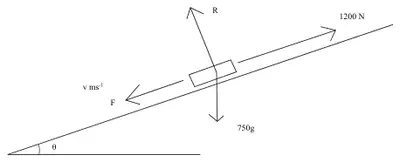
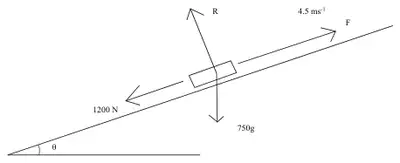
1. A truck of mass 750 kg is moving with constant speed \(v\) m s\(^{-1}\) down a straight road inclined at an angle \(\theta\) to the horizontal, where \(\sin\theta = \dfrac{3}{49}\). The resistance to motion of the truck is modelled as a constant force of magnitude 1200 N. The engine of the truck is working at a constant rate of 9 kW.
(a) Find the value of \(v\). (4)
On another occasion the truck is moving up the same straight road. The resistance to motion of the truck from non-gravitational forces is modelled as a constant force of magnitude 1200 N. The engine of the truck is working at a constant rate of 9 kW.
(b) Find the acceleration of the truck at the instant when it is moving with speed 4.5 m s\(^{-1}\). (4)
2. A truck of mass 900 kg is towing a trailer of mass 150 kg up an inclined straight road with constant speed 15 m s\(^{-1}\). The trailer is attached to the truck by a light inextensible towbar which is parallel to the road. The road is inclined at an angle \(\theta\) to the horizontal, where \(\sin\theta = \dfrac{1}{9}\). The resistance to motion of the truck from non-gravitational forces has constant magnitude 200 N and the resistance to motion of the trailer from non-gravitational forces has constant magnitude 50 N.
(a) Find the rate at which the engine of the truck is working. (5)
When the truck and trailer are moving up the road at 15 m s\(^{-1}\) the towbar breaks, and the trailer is no longer attached to the truck. The rate at which the engine of the truck is working is unchanged. The resistance to motion of the truck from non-gravitational forces and the resistance to motion of the trailer from non-gravitational forces are still forces of constant magnitudes 200 N and 50 N respectively.
(b) Find the acceleration of the truck at the instant after the towbar breaks. (3)
(c) Use the work-energy principle to find out how much further up the road the trailer travels before coming to instantaneous rest. (4)
Mark scheme (a)
Scheme
Marks
Constant speed \(\Rightarrow\) no acceleration. Driving force \(= 200 + 50 + 900g\sin\theta + 150g\sin\theta\)
M1
Or \(D - T - 200 - 900g\sin\theta = 0\) and \(T - 50 - 150g\sin\theta = 0\)
M1 Equation of motion for the truck at instant after the towbar breaks. All terms required & dimensionally correct. Allow for an equation to find acceleration down the slope
A1ft Correct for their driving force \(\left(1393\dfrac{1}{3}\right)\).
A1 Accept 0.24, not \(\dfrac{32}{135}\) must be +ve
2. A car of mass 800 kg is moving on a straight road which is inclined at an angle \(\theta\) to the horizontal, where \(\sin\theta = \dfrac{1}{20}\). The resistance to the motion of the car from non-gravitational forces is modelled as a constant force of magnitude \(R\) newtons. When the car is moving up the road at a constant speed of 12.5 m s\(^{-1}\), the engine of the car is working at a constant rate of \(3P\) watts. When the car is moving down the road at a constant speed of 12.5 m s\(^{-1}\), the engine of the car is working at a constant rate of \(P\) watts.
(a) Find
(i) the value of \(P\),
(ii) the value of \(R\). (6)
When the car is moving up the road at 12.5 m s\(^{-1}\) the engine is switched off and the car comes to rest, without braking, in a distance \(d\) metres. The resistance to the motion of the car from non-gravitational forces is still modelled as a constant force of magnitude \(R\) newtons.
(b) Use the work-energy principle to find the value of \(d\). (4)
4. A car of mass 900 kg is moving along a straight horizontal road with the engine of the car working at a constant rate of 22.5 kW. At time \(t\) seconds, the speed of the car is \(v\) m s\(^{-1}\) \((0 < v < 30)\) and the total resistance to the motion of the car has magnitude \(25v\) newtons.
(a) Show that when the speed of the car is \(v\) m s\(^{-1}\), the acceleration of the car is \[\frac{900 - v^2}{36v}\ \text{m s}^{-2}\] (3)
The time taken for the car to accelerate from 10 m s\(^{-1}\) to 20 m s\(^{-1}\) is \(T\) seconds.
(b) Show that \[T = 18\ln\frac{8}{5}\] (5)
(c) Find the distance travelled by the car as it accelerates from 10 m s\(^{-1}\) to 20 m s\(^{-1}\) (6)
Mark scheme (a)
Scheme
Marks
Equation of motion: \(900a = \dfrac{22500}{v} - 25v\)
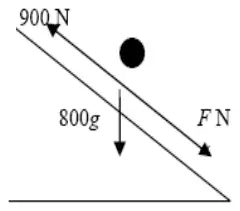
1. A van of mass 900 kg is moving down a straight road that is inclined at an angle \(\theta\) to the horizontal, where \(\sin\theta = \dfrac{1}{30}\). The resistance to motion of the van has constant magnitude 570 N. The engine of the van is working at a constant rate of 12.5 kW.
At the instant when the van is moving down the road at 5 m s\(^{-1}\), the acceleration of the van is \(a\) m s\(^{-2}\).
Find the value of \(a\). (5)
Mark scheme
Scheme
Marks
\(12500 = 5F\)
B1
\(F + 900g\sin\theta - 570 = 900a\)
M1 A2
\(a = 2.47\ \ (2.5)\)
A1
(5)
Notes
B1 Use of \(P = Fv\)
M1 Use of \(F = ma\) parallel to the slope. All 4 terms required. Condone sign errors and sin/cos confusion. 12500 in place of F is M0 – dimensionally incorrect
A2 Correct unsimplified equation. -1 each error
Working with the positive direction up the slope is acceptable for the first 4 marks, but their final answer must be positive.
1. A van of mass 600 kg is moving up a straight road inclined at an angle \(\theta\) to the horizontal, where \(\sin\theta = \dfrac{1}{16}\). The resistance to motion of the van from non-gravitational forces has constant magnitude \(R\) newtons. When the van is moving at a constant speed of 20 m s\(^{-1}\), the van’s engine is working at a constant rate of 25 kW.
(a) Find the value of \(R\). (4)
The power developed by the van’s engine is now increased to 30 kW. The resistance to motion from non-gravitational forces is unchanged. At the instant when the van is moving up the road at 20 m s\(^{-1}\), the acceleration of the van is \(a\) m s\(^{-2}\).
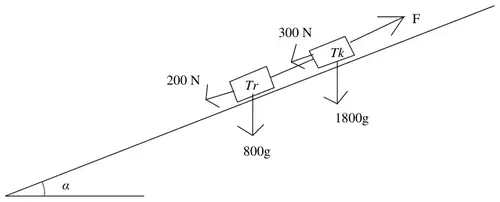
4. A truck of mass 1800 kg is towing a trailer of mass 800 kg up a straight road which is inclined to the horizontal at an angle \(\alpha\), where \(\sin\alpha = \dfrac{1}{20}\). The truck is connected to the trailer by a light inextensible rope which is parallel to the direction of motion of the truck. The resistances to motion of the truck and the trailer from non-gravitational forces are modelled as constant forces of magnitudes 300 N and 200 N respectively. The truck is moving at constant speed \(v\) m s\(^{-1}\) and the engine of the truck is working at a rate of 40 kW.
(a) Find the value of \(v\). (5)
As the truck is moving up the road the rope breaks.
(b) Find the acceleration of the truck immediately after the rope breaks. (4)
M1 Complete method to an equation in “\(F\)”. Requires all the terms, including resolution of the weights. Condone sign errors and sin/cos confusion. \(g\) missing from both weights is a single error. Penalise trig once only.
A2 -1 each error. i.e. A1A1 if no errors A1A0 one error seen, A0A0 two or more errors
M1Use of \(P = Fv\). Allow with \(F\) or their \(F\). Independent of the first M1
M1 New equation of motion for the truck. Follow their 1774. Requires all the terms, including resolution of the weights. Condone sign errors and sin/cos confusion.
A2 Allow with their 1774. -1 each error. i.e. A1A1 no errors, A1A0 one error, A0A0 two or more errors
2. A car of mass 1000 kg is moving along a straight horizontal road. The engine of the car is working at a constant rate of 25 kW. When the speed of the car is \(v\) m s\(^{-1}\), the resistance to motion has magnitude \(10v\) newtons.
(a) Show that, at the instant when \(v = 20\), the acceleration of the car is 1.05 m s\(^{-2}\). (3)
(b) Find the distance travelled by the car as it accelerates from a speed of 10 m s\(^{-1}\) to a speed of 20 m s\(^{-1}\). (8)
A1 Or better \(\left(2500\ln\left(\dfrac{14}{9}\right) - 1000\right)\)
(Corrected from the printed mark scheme: the first line of alt2 is printed as \(100\left(v - 50\,\text{arc}\tanh\left(\frac{v}{50}\right)\right)\), with the signs reversed.)
NB A correct numerical answer that does not follow from integration scores no marks.
5. A van of mass 1200 kg travels along a straight horizontal road against a resistance to motion which is proportional to the speed of the van. The engine of the van is working at a constant rate of 40 kW. The van starts from rest at time \(t = 0\). At time \(t\) seconds, the speed of the van is \(v\) m s\(^{-1}\). When the speed of the van is 40 m s\(^{-1}\), the acceleration of the van is 0.3 m s\(^{-2}\).
(a) Show that \[75v\frac{\mathrm{d}v}{\mathrm{d}t} = 2500 - v^2\] (6)
1. A caravan of mass 600 kg is towed by a car of mass 900 kg along a straight horizontal road. The towbar joining the car to the caravan is modelled as a light rod parallel to the road. The total resistance to motion of the car is modelled as having magnitude 300 N. The total resistance to motion of the caravan is modelled as having magnitude 150 N. At a given instant the car and the caravan are moving with speed 20 m s\(^{-1}\) and acceleration 0.2 m s\(^{-2}\).
(a) Find the power being developed by the car’s engine at this instant. (5)
(b) Find the tension in the towbar at this instant. (2)
Mark scheme (a)
Scheme
Marks
\(F - 150 - 300 = 1500 \times 0.2\)
M1 A1
\(F = 750\)
A1
\(P = 750 \times 20 = 15000\) watts
M1 A1
(5)
Notes
M1 Needs total mass and both resistances. Condone sign errors
A1 Correct unsimplified equation
M1 Independent M. 20 x their driving force
Mark scheme (b)
Use their mass as a guide to which of these two alternatives is being used.
Scheme
Marks
For caravan: \(T - 150 = 600 \times 0.2\)
M1
\(T = 270\) N
A1
(2)
(7 marks)
Notes
M1 Requires all forces acting on caravan. Condone sign error(s)
Or (b)
For car: \(F - T - 300 = 900 \times 0.2\)
M1
\(T = 270\) N
A1
M1 Requires all forces acting on car. Condone sign error(s)
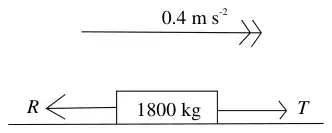
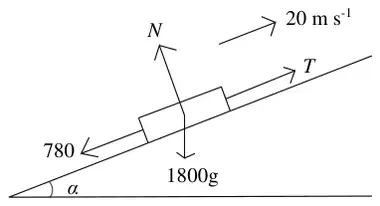
2. A lorry of mass 1800 kg travels along a straight horizontal road. The lorry’s engine is working at a constant rate of 30 kW. When the lorry’s speed is 20 m s\(^{-1}\), its acceleration is 0.4 m s\(^{-2}\). The magnitude of the resistance to the motion of the lorry is \(R\) newtons.
(a) Find the value of \(R\). (4)
The lorry now travels up a straight road which is inclined at an angle \(\alpha\) to the horizontal, where \(\sin\alpha = \dfrac{1}{12}\). The magnitude of the non-gravitational resistance to motion is \(R\) newtons. The lorry travels at a constant speed of 20 m s\(^{-1}\).
(b) Find the new rate of working of the lorry’s engine. (5)
6. A car of mass 1200 kg pulls a trailer of mass 400 kg up a straight road which is inclined to the horizontal at an angle \(\alpha\), where \(\sin\alpha = \dfrac{1}{14}\). The trailer is attached to the car by a light inextensible towbar which is parallel to the road. The car’s engine works at a constant rate of 60 kW. The non-gravitational resistances to motion are constant and of magnitude 1000 N on the car and 200 N on the trailer.
At a given instant, the car is moving at 10 m s\(^{-1}\). Find
(a) the acceleration of the car at this instant, (5)
(b) the tension in the towbar at this instant. (4)
The towbar breaks when the car is moving at 12 m s\(^{-1}\).
(c) Find, using the work-energy principle, the further distance that the trailer travels before coming instantaneously to rest. (5)
M1 Use of \(F = ma\) parallel to the slope for the car
A1 ft At most one error (their \(a\))
A1 ft All correct (their \(a\))
A1 only
OR (b) (following OR (a))
\(-800a = 2T + 800g\sin\alpha + 800 - 6000\)
M1A1A1
\(2T = 5200 - 800g\sin\alpha - 800 \times 2.3\)
\(T = 1400\)
A1
M1A1A1 Subtract and / or substitute to eliminate \(a\)
Mark scheme (c)
Scheme
Marks
\(200d = \dfrac{1}{2}400.12^2 - 400gd\sin\alpha\)
M1 A1 A1
\(d = 60\) (m)
DM1 A1
(5)
(14 marks)
Notes
M1 Use of work-energy. Must have all three terms. Do not accept duplication of terms, but condone sign errors. Equation in only one unknown, but could be vertical distance.
A1 At most one error in the equation
A1 All correct in one unknown
DM1 Solve for \(d\) – dependent on M for work-energy equation.
A1 only
For vertical distance \(\left(= \dfrac{60}{14} = 4.29\right)\) allow 3/5
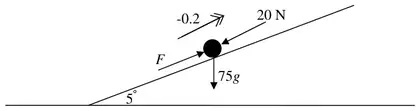
3. A cyclist and her cycle have a combined mass of 75 kg. The cyclist is cycling up a straight road inclined at 5\(^\circ\) to the horizontal. The resistance to the motion of the cyclist from non-gravitational forces is modelled as a constant force of magnitude 20 N. At the instant when the cyclist has a speed of 12 m s\(^{-1}\), she is decelerating at 0.2 m s\(^{-2}\).
(a) Find the rate at which the cyclist is working at this instant. (5)
When the cyclist passes the point \(A\) her speed is 8 m s\(^{-1}\). At \(A\) she stops working but does not apply the brakes. She comes to rest at the point \(B\). The resistance to motion from non-gravitational forces is again modelled as a constant force of magnitude 20 N.
(b) Use the work-energy principle to find the distance \(AB\). (5)
Mark scheme (a)
Scheme
Marks
Driving force = F
M1
Resolving parallel to the plane: \(\ F - 20 - 75g\sin 5 = -75 \times 0.2 = -15\)
A2 – 1ee
\(F = 5 + 75g\sin 5^\circ\)
\(P = Fv\quad \therefore\) working at \(\ 12 \times \left(5 + 75g\sin 5^\circ\right) = 828.7\ldots\)
DM1
\(\approx 830\) W
A1
(5)
Mark scheme (b)
Scheme
Marks
Loss in KE = gain in GPE + work done against resistance
M1
\(\dfrac{1}{2} \times 75 \times 64 = 75 \times 9.8 \times \sin 5^\circ d + 20d = d \times 84.059\ldots\)
1. A car of mass 1000 kg moves with constant speed \(V\) m s\(^{-1}\) up a straight road inclined at an angle \(\theta\) to the horizontal, where \(\sin\theta = \dfrac{1}{30}\). The engine of the car is working at a rate of 12 kW. The resistance to motion from non-gravitational forces has magnitude 500 N.
1. A cyclist starts from rest and moves along a straight horizontal road. The combined mass of the cyclist and his cycle is 120 kg. The resistance to motion is modelled as a constant force of magnitude 32 N. The rate at which the cyclist works is 384 W. The cyclist accelerates until he reaches a constant speed of \(v\) m s\(^{-1}\).
Find
(a) the value of \(v\), (3)
(b) the acceleration of the cyclist at the instant when the speed is 9 m s\(^{-1}\). (3)
Mark scheme (a)
Scheme
Marks
Constant speed \(\Rightarrow\) Driving force \(=\) resistance, \(\ F = 32\).
B1
\(P = F \times v = 32v = 384\)
M1
\(v = 12\ \left(\text{ms}^{-1}\right)\)
A1
(3)
Mark scheme (b)
Scheme
Marks
\(P = F \times v \Rightarrow\ 384 = F \times 9,\ F = \dfrac{384}{9}\)
4. A car of mass 750 kg is moving up a straight road inclined at an angle \(\theta\) to the horizontal, where \(\sin\theta = \dfrac{1}{15}\). The resistance to motion of the car from non-gravitational forces has constant magnitude \(R\) newtons. The power developed by the car’s engine is 15 kW and the car is moving at a constant speed of 20 m s\(^{-1}\).
(a) Show that \(R = 260\). (4)
The power developed by the car’s engine is now increased to 18 kW. The magnitude of the resistance to motion from non-gravitational forces remains at 260 N. At the instant when the car is moving up the road at 20 m s\(^{-1}\) the car’s acceleration is \(a\) m s\(^{-2}\).
5. A cyclist and her bicycle have a total mass of 70 kg. She cycles along a straight horizontal road with constant speed 3.5 m s\(^{-1}\). She is working at a constant rate of 490 W.
(a) Find the magnitude of the resistance to motion. (4)
The cyclist now cycles down a straight road which is inclined at an angle \(\theta\) to the horizontal, where \(\sin\theta = \dfrac{1}{14}\), at a constant speed \(U\) m s\(^{-1}\). The magnitude of the non-gravitational resistance to motion is modelled as \(40U\) newtons. She is now working at a constant rate of 24 W.
3. A truck of mass of 300 kg moves along a straight horizontal road with a constant speed of 10 m s\(^{-1}\). The resistance to motion of the truck has magnitude 120 N.
(a) Find the rate at which the engine of the truck is working. (2)
On another occasion the truck moves at a constant speed up a hill inclined at \(\theta\) to the horizontal, where \(\sin\theta = \dfrac{1}{14}\). The resistance to motion of the truck from non-gravitational forces remains of magnitude 120 N. The rate at which the engine works is the same as in part (a).
(b) Find the speed of the truck. (4)
Mark scheme (a)
Scheme
Marks
Constant v \(\Rightarrow\) driving force = resistance \(\Rightarrow F = 120\) (N)
M1
\(\Rightarrow P = 120 \times 10 = 1200\) W
M1
(2)
Mark scheme (b)
Scheme
Marks
Resolving parallel to the slope, zero acceleration:
\(\dfrac{P}{v} = 120 + 300g\sin\theta\ (= 330)\)
M1A1A1
\(\Rightarrow v = \dfrac{1200}{330} = 3.6\) (m s\(^{-1}\))
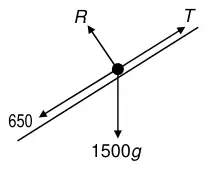
1. A car of mass 1500 kg is moving up a straight road, which is inclined at an angle \(\theta\) to the horizontal, where \(\sin\theta = \dfrac{1}{14}\). The resistance to the motion of the car from non-gravitational forces is constant and is modelled as a single constant force of magnitude 650 N. The car’s engine is working at a rate of 30 kW.
Find the acceleration of the car at the instant when its speed is 15 m s\(^{-1}\). (5)
Mark scheme
Scheme
Marks
F = ma parallel to the slope, \(T - 1500g\sin\theta - 650 = 1500a\)
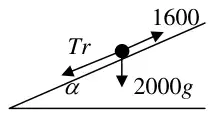
1. A lorry of mass 2000 kg is moving down a straight road inclined at angle \(\alpha\) to the horizontal, where \(\sin\alpha = \dfrac{1}{25}\). The resistance to motion is modelled as a constant force of magnitude 1600 N. The lorry is moving at a constant speed of 14 m s\(^{-1}\).
Find, in kW, the rate at which the lorry’s engine is working. (6)
3. A car of mass 1000 kg is moving at a constant speed of 16 m s\(^{-1}\) up a straight road inclined at an angle \(\theta\) to the horizontal. The rate of working of the engine of the car is 20 kW and the resistance to motion from non-gravitational forces is modelled as a constant force of magnitude 550 N.
(a) Show that \(\sin\theta = \dfrac{1}{14}\). (5)
When the car is travelling up the road at 16 m s\(^{-1}\), the engine is switched off. The car comes to rest, without braking, having moved a distance \(y\) metres from the point where the engine was switched off. The resistance to motion from non-gravitational forces is again modelled as a constant force of magnitude 550 N.
(b) Find the value of \(y\). (4)
Mark scheme (a)
Scheme
Marks
\(20\,000 = 16F\ \ (F = 1250)\)
M1 A1
\(\nearrow\) \(F = 550 + 1000 \times 9.8\sin\theta\) ft their \(F\)
1. A cyclist and his bicycle have a combined mass of 90 kg. He rides on a straight road up a hill inclined at an angle \(\alpha\) to the horizontal, where \(\sin\alpha = \dfrac{1}{21}\). He works at a constant rate of 444 W and cycles up the hill at a constant speed of 6 m s\(^{-1}\).
Find the magnitude of the resistance to motion from non-gravitational forces as he cycles up the hill. (4)
Mark scheme
Scheme
Marks
Force exerted \(= 444/6\ \ (= 74\) N\()\)
B1
\(R + 90g\sin\alpha = 444/6\)
M1 A1
\(\Rightarrow R = 32\) N
A1
(4)
(4 marks)
Notes
B1 444/6 seen or implied
M1 Resolve parallel to the slope for a 3 term equation – condone sign errors and sin/cos confusion
A1 All three terms correct – expression as on scheme or exact equivalent
2. A car of mass 800 kg is moving at a constant speed of 15 m s\(^{-1}\) down a straight road inclined at an angle \(\alpha\) to the horizontal, where \(\sin\alpha = \tfrac{1}{24}\). The resistance to motion from non-gravitational forces is modelled as a constant force of magnitude 900 N.
(a) Find, in kW, the rate of working of the engine of the car. (4)
When the car is travelling down the road at 15 m s\(^{-1}\), the engine is switched off. The car comes to rest in time \(T\) seconds after the engine is switched off. The resistance to motion from non-gravitational forces is again modelled as a constant force of magnitude 900 N.
* If they are using their F from (a) then they need to have scored the M1 in (a) in order to score the M1 here.
Alternative for (b)
WD: \(573\dfrac{1}{3}s = \dfrac{1}{2} \times 800 \times 15^2\) \(s = 157\) Use of \(v^2 = u^2 + 2as\) M1 for getting as far as an equation in \(a\). \(a = 0.72\) A1 finish as above.
2nd Alternative for (b)
\(Ft\) = Change in momentum: M1 Using the correct \(F\) M1 Use of the method to form an equation A1 Equation correct unsimplified but fully substituted A1 \(T \approx 21\)
2. A car of mass 1200 kg moves along a straight horizontal road with a constant speed of 24 m s\(^{-1}\). The resistance to motion of the car has magnitude 600 N.
(a) Find, in kW, the rate at which the engine of the car is working. (2)
The car now moves up a hill inclined at \(\alpha\) to the horizontal, where \(\sin\alpha = \tfrac{1}{28}\). The resistance to motion of the car from non-gravitational forces remains of magnitude 600 N. The engine of the car now works at a rate of 30 kW.
(b) Find the acceleration of the car when its speed is 20 m s\(^{-1}\). (4)
Mark scheme (a)
Scheme
Marks
\(\dfrac{P}{24} = 600\) or \(\dfrac{1000P}{24} = 600\ \ \Rightarrow\ \ P = 14.4\,kW\)
3. A car of mass 1000 kg is moving along a straight horizontal road. The resistance to motion is modelled as a constant force of magnitude \(R\) newtons. The engine of the car is working at a rate of 12 kW. When the car is moving with speed 15 m s\(^{-1}\), the acceleration of the car is 0.2 m s\(^{-2}\).
(a) Show that \(R = 600\). (4)
The car now moves with constant speed \(U\) m s\(^{-1}\) downhill on a straight road inclined at \(\theta\) to the horizontal, where \(\sin\theta = \tfrac{1}{40}\). The engine of the car is now working at a rate of 7 kW. The resistance to motion from non-gravitational forces remains of magnitude \(R\) newtons.
(b) Calculate the value of \(U\). (5)
Mark scheme (a)
Scheme
Marks
\(T_r = \dfrac{12000}{15}\ \ (= 800)\)
M1
N2L \(800 - R = 1000 \times 0.2\) ft their 800
M1 A1ft
\(R = 600\ \ *\) cso
A1
(4)
Mark scheme (b)
Scheme
Marks
\(1000g \times \dfrac{1}{40} + T_r = R\)
M1 A1
\(T_r = \dfrac{7000}{U}\)
M1
\(U \approx 20\) accept 19.7
M1 A1
(5)
(9 marks)
Notes
(The question paper prints this part as (c); there is no part (b) on the paper.)
1. A car of mass 1200 kg moves along a straight horizontal road. The resistance to motion of the car from non-gravitational forces is of constant magnitude 600 N. The car moves with constant speed and the engine of the car is working at a rate of 21 kW.
(a) Find the speed of the car. (3)
The car moves up a hill inclined at an angle \(\alpha\) to the horizontal, where \(\sin\alpha = \tfrac{1}{14}\). The car’s engine continues to work at 21 kW, and the resistance to motion from non-gravitational forces remains of magnitude 600 N.
(b) Find the constant speed at which the car can move up the hill. (4)
Mark scheme (a)
Scheme
Marks
Driving force \(= \dfrac{P}{v}\)
B1
\(\dfrac{21000}{v} = 600\ \Rightarrow\ v = 35\) m s\(^{-1}\)
M1 A1
(3)
Mark scheme (b)
Scheme
Marks
\(\dfrac{P}{v} = 600 + 1200.g.\dfrac{1}{14}\)
M1 A1
\((= 1440\ \text{N})\)
\(\dfrac{21000}{v} = 1440 \Rightarrow v = \dfrac{21000}{1440} \approx 14.6\) or 15 m s\(^{-1}\)
5. A car of mass 1000 kg is towing a trailer of mass 1500 kg along a straight horizontal road. The tow-bar joining the car to the trailer is modelled as a light rod parallel to the road. The total resistance to motion of the car is modelled as having constant magnitude 750 N. The total resistance to motion of the trailer is modelled as of magnitude \(R\) newtons, where \(R\) is a constant. When the engine of the car is working at a rate of 50 kW, the car and the trailer travel at a constant speed of 25 m s\(^{-1}\).
(a) Show that \(R = 1250\). (3)
When travelling at 25 m s\(^{-1}\) the driver of the car disengages the engine and applies the brakes. The brakes provide a constant braking force of magnitude 1500 N to the car. The resisting forces of magnitude 750 N and 1250 N are assumed to remain unchanged. Calculate
(b) the deceleration of the car while braking, (3)
(c) the thrust in the tow-bar while braking, (2)
(d) the work done, in kJ, by the braking force in bringing the car and the trailer to rest. (4)
(e) Suggest how the modelling assumption that the resistances to motion are constant could be refined to be more realistic. (1)
Mark scheme (a)
Scheme
Marks
\(50\,000 = F \times 25\ \ (F = 2000)\) or equivalent
M1
\(\rightarrow\) \(F = R + 750\)
M1
\(R = 1250\ \ *\) cso
A1
(3)
Mark scheme (b)
Scheme
Marks
N2L \(1500 + 2000 = 2500a\) ignore sign of \(a\)
M1 A1
\(a = 1.4\ \ (\text{m s}^{-2})\) cao
A1
(3)
Mark scheme (c)
Scheme
Marks
Trailer: \(T + R = 1500 \times 1.4\) or Car: \(T - 1500 - 750 = 1000 \times -1.4\)