
BMO1 2020 Q5
Let points \(A\), \(B\) and \(C\) lie on a circle \(\Gamma\). Circle \(\Delta\) is tangent to \(AC\) at \(A\). It meets \(\Gamma\) again at \(D\) and the line \(AB\) again at \(P\). The point \(A\) lies between points \(B\) and \(P\). Prove that if \(AD = DP\), then \(BP = AC\).
British Mathematical Olympiad Round 1 2020, Question 5. © UK Mathematics Trust. Original paper on ukmt.org.uk
Proposed by Dominic Yeo
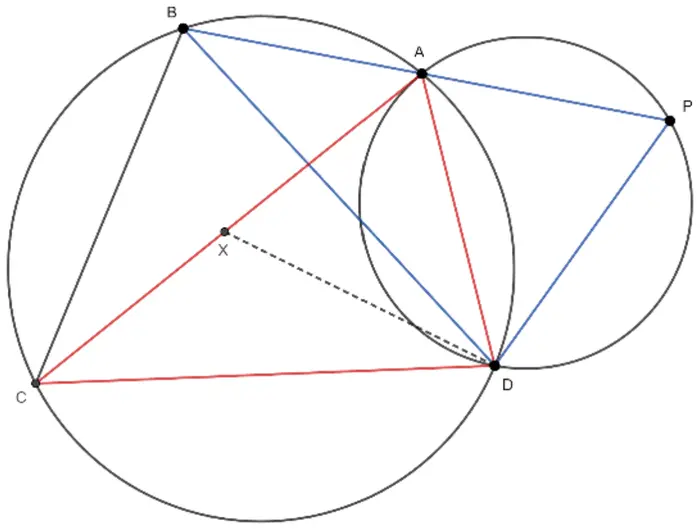
\(AD = PD\) is given.
By the alternate segment theorem in \(\Delta\), we have \(\angle CAD = \angle BPD\).
Then \(\angle DCA = \angle DBA = \angle DBP\) by angles in the same segment in \(\Gamma\).
These two angles show that triangles \(DCA\) and \(DBP\) are similar.
Then we have \(AD = PD\), and so this similarity is a congruence.
So \(CAD\) is congruent to \(BPD\) (by ‘Side-Angle-Side’) and \(BP = AC\).
Alternative
Construct point \(X\) on ray \(AC\) with \(AX = AP\).
Then \(\angle DAX = \angle DPA = \angle PAD\) by the alternate segment theorem and then by \(ADP\) isosceles, so \(AD\) is perpendicular to \(PX\) as the angle bisector of isosceles \(PAX\).
Therefore \(PAXD\) is a kite, and \(DX = PD = AD\).
This gives us \(\angle DXC = 180^\circ - \angle AXD = 180^\circ - \angle DPA = 180^\circ - \angle PAD = \angle DAB\).
Then angles in the same segment gives \(\angle ABD = \angle ACD\).
So we have \(DAB\) similar to \(DXC\), and \(AD = DX\) makes this a congruence.
So \(XC = AB\) as required.
Remark
It is also possible to solve the problem using the Sine Rule, or by quoting the fact that the unique spiral similarity sending segment \(BP\) to \(CA\) is centred at \(D\).
Remark
Arguably the hardest part of this problem is constructing an accurate diagram. Adding points in the order in which they are specified in the question is unhelpful, and a better alternative is to begin by constructiong the circle \(\Delta\) and the isosceles triangle \(ADP\) inside it.
Solution © UK Mathematics Trust, from the BMO1 2020 solutions.