
MOG 2016 Q1
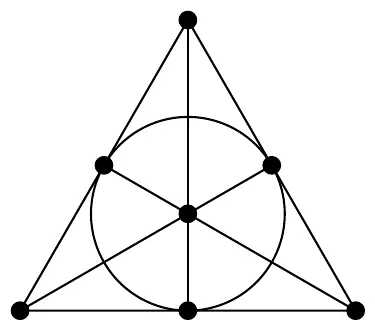
The diagram shows a figure consisting of six line segments and a circle, each containing three points.
Each point is labelled with a real number. The sum of the three numbers on each line segment or circle is \(T\).
Prove that each number is equal to \(\tfrac{1}{3}T\).
Mathematical Olympiad for Girls 2016, Question 1. © UK Mathematics Trust. Original paper on ukmt.org.uk
Commentary
This question is about sums of numbers, so a sensible first step seems to be to give each number a name so we can write some equations.
Label the numbers as shown in the diagram below. There are seven unknowns and we can write seven equations. You may know several different methods for solving such systems of equations, for example elimination and substitution. In this case, substituting from one equation into another is likely to produce long expressions.
A better method is to look for equations which share one or more unknowns and eliminate those unknowns. For example, \(a + b + c = T\) and \(a + d + e = T\). You can subtract the two equations to obtain \(b + c - d - e = 0\) and so \(b + c = d + e\).
You can then look for another two equations that contain those four unknowns, for example \(g + d + b = T\) and \(g + e + c = T\). Subtracting those two gives \(d + b = e + c\). Adding this to the equation we found above gives \(2b + c + d = 2e + c + d\) and so \(b = e\).
You can use the symmetry of the situation to see that we can produce an analogous proof showing that \(b = f\). Having found that several of the unknowns are equal to each other, it may be a good idea to relabel the diagram to show this. We can then complete the proof, as we have done below.
Let the numbers labelling the points be as shown in the diagram.
Since \(T = a + b + c = a + d + e\), we have \(b + c = d + e\). Also, \(T = b + d + g = c + e + g\) and so \(b + d = c + e\). Therefore \(2b + c + d = 2e + c + d\) and so \(b = e\).
Substituting this back into \(b + d = c + e\) we obtain \(d = c\).
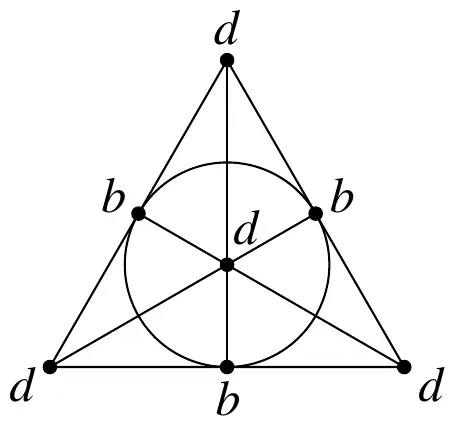
Analogously, we can prove that \(b = f\), and that \(d = a\) and \(d = g\).
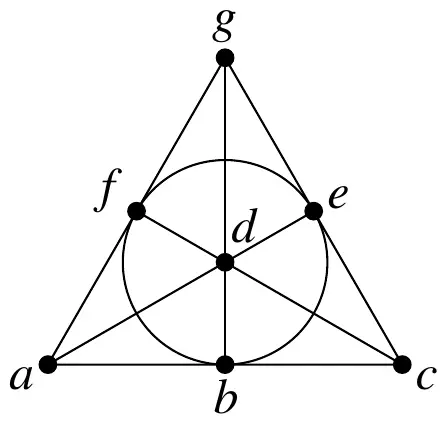
We can therefore relabel the diagram as shown on the right.
Considering the three points on the circle, we have \(3b = T\) and so \(b = \tfrac{1}{3}T\). Considering the base of the triangle, \(2d + b = T\) and so \(d = \tfrac{1}{3}T\) as well.
Thus each number is equal to \(\tfrac{1}{3}T\), as required.
Note
The configuration in the question is known as the Fano plane (after Gino Fano, 1871–1952). The Fano plane is an example of a “finite projective plane”. It has only seven points and seven lines (represented as the six line segments and the circle in our diagram). Notice that every pair of lines have one common point; hence, in this plane, every two lines intersect and there are no parallel lines.
Solution © UK Mathematics Trust, from the MOG 2016 solutions.