
JMO 2018 B6
B6. Sixteen counters, which are black on one side and white on the other,
are arranged in a 4 by 4 square. Initially all the counters are facing
black side up. In one ‘move’, you must choose a 2 by 2 square within
the square and turn all four counters over once. Describe a sequence
of ‘moves’ of minimum length that finishes with the colours of the
counters of the 4 by 4 square alternating (as shown in the diagram).
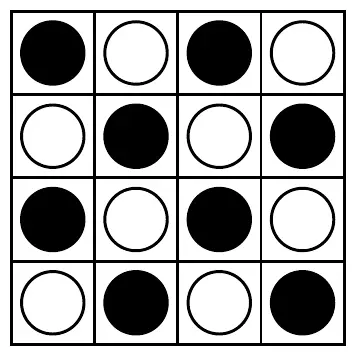
Junior Mathematical Olympiad 2018, Question B6. © UK Mathematics Trust. Original paper on ukmt.org.uk
Define a set of coordinates from the bottom left corner, such that (1, 1)
relates to the counter in the bottom left corner, (1, 4) relates to the counter
in the top left corner, (4, 1) relates to the counter in the bottom right corner,
etc.
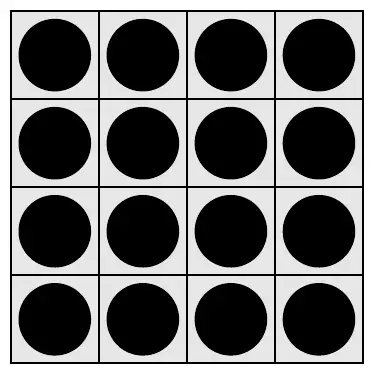
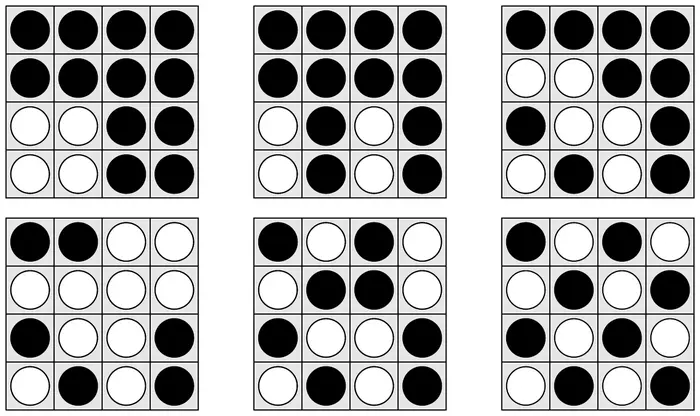
Consider the counter at (1, 1). This must be flipped and can only be flipped by flipping the bottom left 2 by 2 square.
Now both the counter at (1, 2) and (2, 1) need to be flipped and it is not possible to flip both together without also changing (1, 1). Therefore flip the counters in the 2 by 2 square with lower left corner at (2, 1) and in the 2 by 2 square with lower left corner at (1, 2). Since the counter at (2, 2) will have then been flipped three times, it will be of the opposite colour to its original colour as required. Therefore we have completed the square in the bottom left corner with three ‘moves’.
A similar argument can be applied to the counter at (4, 4) and the top right 2 by 2 square which has not been affected by any of the moves so far. Three more ‘moves’ are required to turn all four counters in this 2 by 2 square to the required colour.
In fact, this completes the pattern of the 4 by 4 square as a whole. Therefore a minimum of six ‘moves’ is required.
Solution © UK Mathematics Trust, from the JMO 2018 solutions.