
Maclaurin 2016 Q6
6. The diagram shows two squares \(APQR\) and \(ASTU\), which have vertex \(A\) in common. The point \(M\) is the midpoint of \(PU\).
Prove that \(AM = \tfrac{1}{2}RS\).
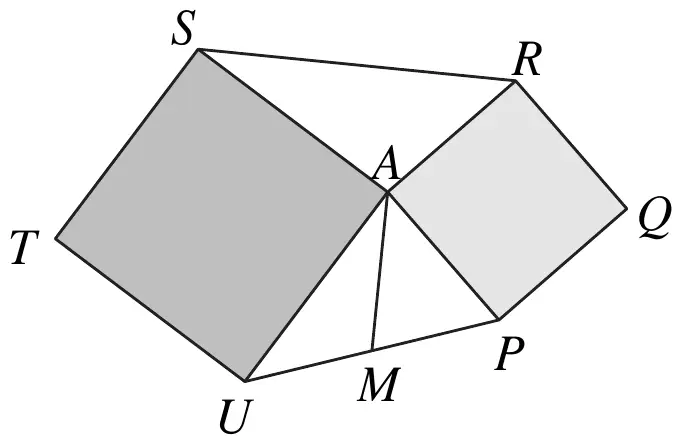
Maclaurin Olympiad 2016, Question 6. © UK Mathematics Trust. Original paper on ukmt.org.uk
There are many methods, some of which use similar triangles or the cosine rule. The method we give below essentially only uses congruent triangles.
Let the point \(B\) be such that \(AUBP\) is a parallelogram, as shown in the following diagram.
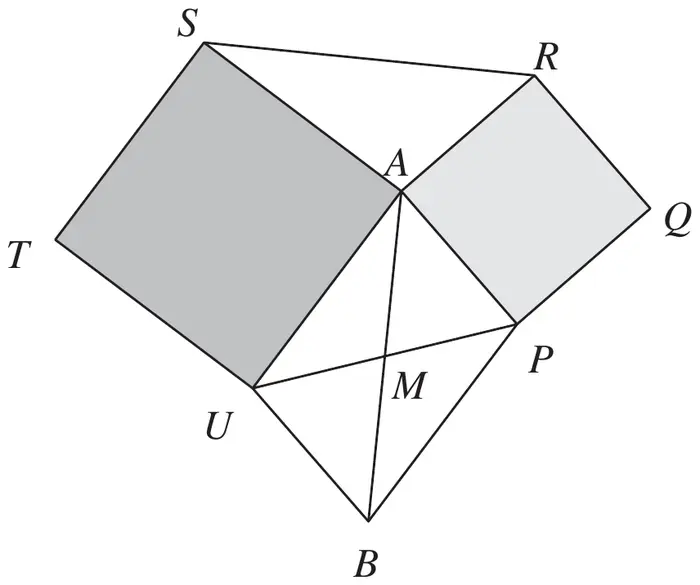
The diagonals of a parallelogram bisect one another. Therefore, because \(M\) is the midpoint of \(PU\), it is also the midpoint of \(AB\), in other words, \(AM = \tfrac{1}{2}AB\).
Now we show that the triangles \(ABP\) and \(RSA\) are congruent.
Firstly, \(PA\) and \(AR\) are equal, because each is a side of the square \(APQR\).
Also, \(BP = UA\) because they are opposite sides of the parallelogram \(AUBP\), and \(UA = SA\) because each is a side of the square \(ASTU\). Hence \(BP = SA\).
Furthermore, because \(BP\) and \(UA\) are parallel, the angles \(BPA\) and \(PAU\) add up to 180° (allied angles, sometimes called interior angles). But \(\angle RAP = 90^\circ\) and \(\angle UAS = 90^\circ\) since each of them is an angle in a square. Then, by considering angles at the point \(A\), we have
so that the angles \(SAR\) and \(PAU\) add up to 180°. Hence \(\angle BPA = \angle SAR\).
In the triangles \(ABP\) and \(RSA\), we therefore have
Thus the triangles \(ABP\) and \(RSA\) are congruent (SAS). It follows that \(AB = RS\).
But \(AM = \tfrac{1}{2}AB\), so that \(AM = \tfrac{1}{2}RS\), as required.
Solution © UK Mathematics Trust, from the Maclaurin Olympiad 2016 solutions.