
Maclaurin 2015 Q6
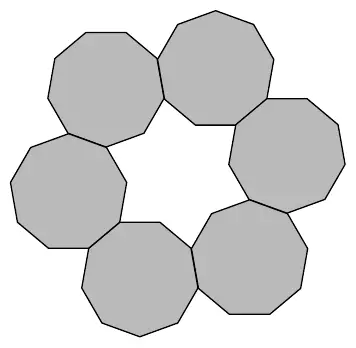
6. A symmetrical ring of \(m\) identical regular \(n\)-sided polygons is formed according to the rules:
The example in the figure shows a ring with \(m = 6\) and \(n = 9\).
For how many different values of \(n\) is such a ring possible?
Maclaurin Olympiad 2015, Question 6. © UK Mathematics Trust. Original paper on ukmt.org.uk
Answer: 6
Let the exterior angle in each polygon be \(\alpha^\circ\), so that \(\alpha = \dfrac{360}{n}\), and let \(P\), \(Q\), \(R\), \(S\) and \(T\) be five consecutive vertices of one of the polygons, as shown, where \(QRS\) is part of the perimeter of the inner region.
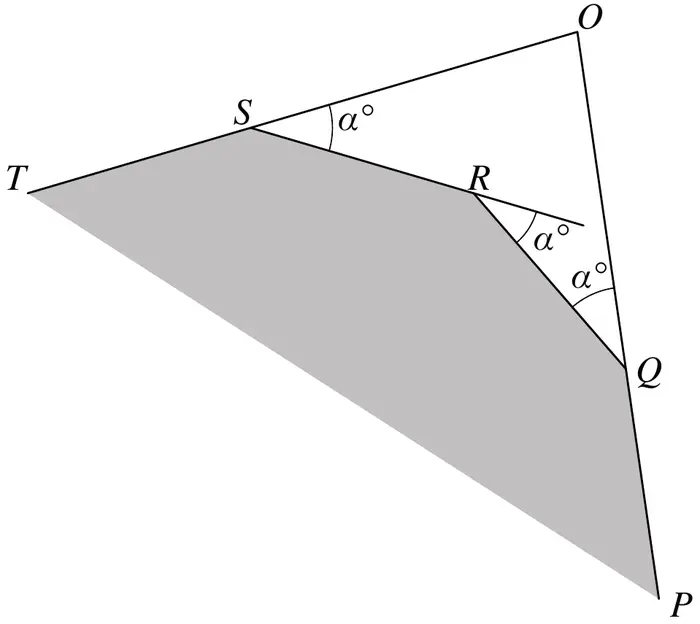
From the symmetry, the point \(O\) where \(PQ\) and \(TS\) meet is the centre of the inner region and hence
Now the sum of the angles in quadrilateral \(OSRQ\) is 360°, so we have
and therefore
Multiplying each term by \(mn\), we obtain
so that
Now \(m > 2\) for the ring to exist. Hence \((m - 2)\,(n - 6)\) is a product of two positive integers, so that \(n - 6\) is a positive factor of 12. The only possibilities for \(n - 6\) are therefore 1, 2, 3, 4, 6 and 12, and thus the only possibilities for \(n\) are 7, 8, 9, 10, 12 and 18. The following figures show the corresponding rings.
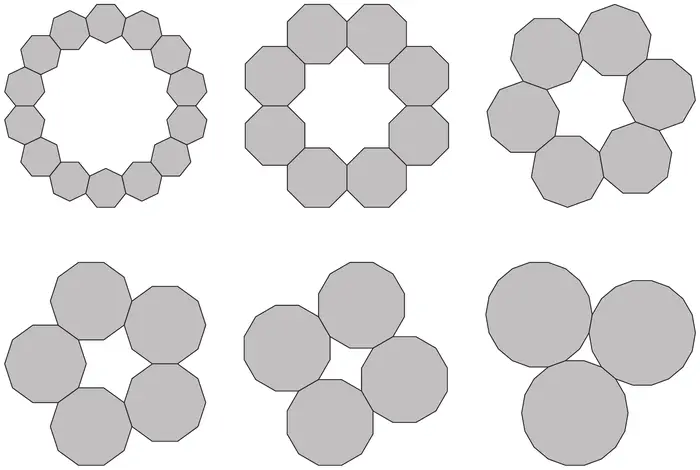
Thus a ring of polygons of the required form is possible for six different values of \(n\).
Solution © UK Mathematics Trust, from the Maclaurin Olympiad 2015 solutions.