
Cayley 2018 Q6
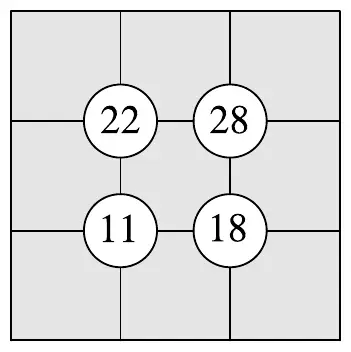
6. In the puzzle Suko, the numbers from 1 to 9 are to be placed in the spaces (one number in each) so that the number in each circle is equal to the sum of the numbers in the four surrounding spaces.
How many solutions are there to the Suko puzzle shown alongside?
Cayley Olympiad 2018, Question 6. © UK Mathematics Trust. Original paper on ukmt.org.uk
Answer: 2
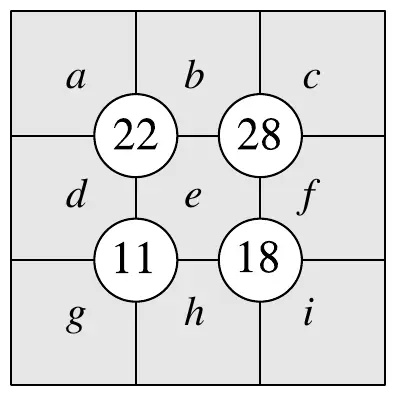
Using the labelling shown in the diagram, \(d + e + g + h = 11\) where \(d\), \(e\), \(g\) and \(h\) are distinct positive integers. The smallest four positive distinct integers (1, 2, 3 and 4) have total 10. To give a total of 11, the only integer that can increase by one and remain distinct is the 4, which means that \(d\), \(e\), \(g\) and \(h\) must be 1, 2, 3 and 5, in some order.
Similarly, \(b + c + e + f = 28\), which means that \(b\), \(c\), \(e\) and \(f\) must be 5, 6, 8 and 9, in some order, or 4, 7, 8 and 9 in some order.
Since \(e\) is the only variable in both lists and 5 is the only number in both lists, \(e\) must be 5, and \(b\), \(c\) and \(f\) must be 6, 8 and 9 in some order.
The only numbers from 1 to 9 not accounted for so far are 4 and 7 so these must be the values of \(a\) and \(i\), in some order.
If \(a = 4\) and \(i = 7\), consider the value of \(f\). Since \(b\), \(c\), \(e\) and \(f\) must be 5, 6, 8 and 9, in some order, and \(e \neq f\), \(f\) must be at least 6.
But \(e + f + h + i = 5 + f + h + 7 = 18\), which would make \(h\) less than or equal to 0, which is impossible.
Hence \(a = 7\) and \(i = 4\).
Consider the value of \(f\). If \(f = 9\), \(e + f + h + i = 5 + 9 + h + 4 = 18\), so \(h = 0\), which is impossible.
If \(f = 8\), it follows that \(h = 1\) and \(d = 2\) or 3, and hence \(g = 3\) or 2 respectively.
This would mean \(b = 8\) or 7 respectively, both of which are impossible.
If \(f = 6\), it follows that \(h = 3\) and \(d = 1\) or 2, and hence \(g = 2\) or 1 respectively.
This would mean \(b = 9\) or 8, respectively. These values are possible and give the complete solutions:
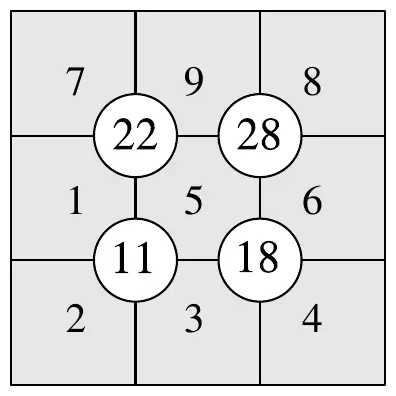
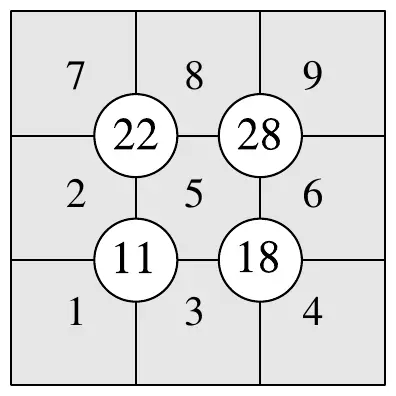
There are two solutions.
Solution © UK Mathematics Trust, from the Cayley Olympiad 2018 solutions.