
GK 2018 Q25
25. In the isosceles triangle \(ABC\), points \(K\) and \(L\) are marked on the equal sides \(AB\) and \(BC\) respectively so that \(AK = KL = LB\) and \(KB = AC\).
What is the size of angle \(ABC\)?
- A 36°
- B 38°
- C 40°
- D 42°
- E 44°
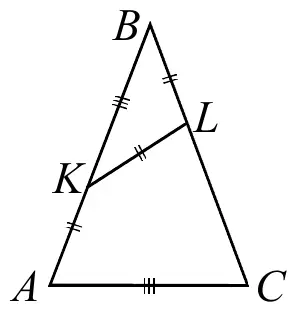
Grey Kangaroo 2018, Question 25. © UK Mathematics Trust. Original paper on ukmt.org.uk
Answer: A 36°
Since triangle \(ABC\) is isosceles with \(AB = BC\) and we are given that \(LB = AK\), the other parts of the equal sides must themselves be equal. Hence \(LC = BK = AC\). Draw in line \(KC\) as shown to form triangles \(ACK\) and \(LCK\). Since \(AK = KL\), \(AC = LC\) and \(KC\) is common to both, triangles \(ACK\) and \(LCK\) are congruent and hence \(\angle KAC = \angle CLK\).
Let the size of \(\angle LBK\) be \(x°\). Since \(KL = LB\), triangle \(KLB\) is isosceles and hence \(\angle BKL = x°\). Since an exterior angle of a triangle is equal to the sum of the interior opposite angles, \(\angle KLC = 2x°\) and hence \(\angle KAC = 2x°\). Since the base angles of an isosceles triangle are equal, \(\angle ACL = 2x°\). Therefore, since angles in a triangle add to 180°, when we consider triangle \(ABC\), we have \(x° + 2x° + 2x° = 180°\) and hence \(x = 36\). Therefore the size of \(\angle ABC\) is 36°.
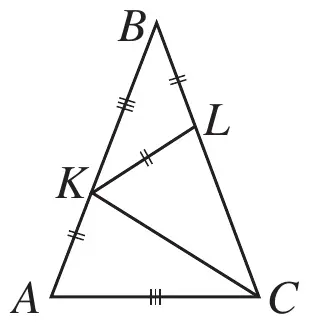
Solution © UK Mathematics Trust, from the GK 2018 solutions.