
SMC 2012 Q24
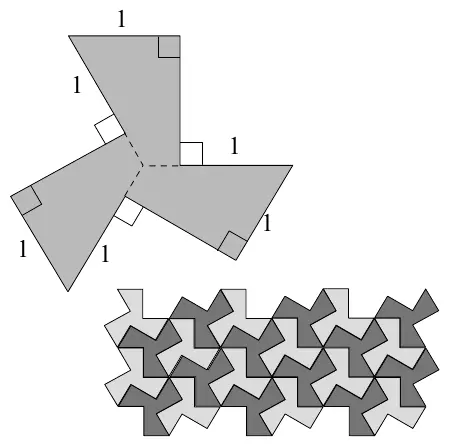
24. The top diagram on the right shows a shape that tiles the plane, as shown in the lower diagram. The tile has nine sides, six of which have length 1. It may be divided into three congruent quadrilaterals as shown. What is the area of the tile?
- A \(\dfrac{1 + 2\sqrt{3}}{2}\)
- B \(\dfrac{4\sqrt{3}}{3}\)
- C \(\sqrt{6}\)
- D \(\dfrac{3 + 4\sqrt{3}}{4}\)
- E \(\dfrac{3\sqrt{3}}{2}\)
Senior Mathematical Challenge 2012, Question 24. © UK Mathematics Trust. Original paper on ukmt.org.uk
Answer: B \(\dfrac{4\sqrt{3}}{3}\)
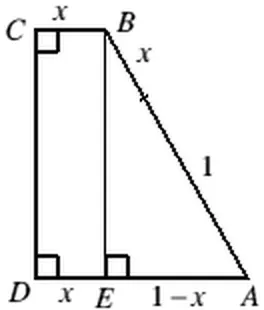
The diagram shows one of the three quadrilaterals making up the tile, labelled and with a line \(BE\) inserted. Note that it is a trapezium. As three quadrilaterals fit together, it may be deduced that \(\angle ABC = 360° \div 3 = 120°\), so \(\angle BAD = 60°\). It may also be deduced that the length of \(AB\) is \(1 + x\), where \(x\) is the length of \(BC\). Now \(\cos\angle BAD = \cos 60° = \tfrac{1}{2} = \tfrac{1 - x}{1 + x}\). So \(1 + x = 2 - 2x\), i.e. \(x = \tfrac{1}{3}\).
The area of \(ABCD\) is \(\tfrac{1}{2}(AD + BC) \times CD = \tfrac{1}{2}\left(1 + \tfrac{1}{3}\right) \times \tfrac{4}{3}\sin 60° = \tfrac{2}{3} \times \tfrac{4}{3} \times \tfrac{\sqrt{3}}{2} = \tfrac{4\sqrt{3}}{9}\). So the area of the tile is \(3 \times \tfrac{4\sqrt{3}}{9} = \tfrac{4\sqrt{3}}{3}\).
Solution © UK Mathematics Trust, from the SMC 2012 solutions. Longer versions with investigations: Solutions and investigations (PDF).